




Silicon Nanowires for Anodes of Rechargeable Li Power Cells
Charge capacities could be increased substantially over those of carbon-based anodes.
Silicon nanowires have been investigated as alternatives to the graphite heretofore widely used as an anode material in rechargeable lithium-ion power cells. The theoretical specific charge capacity of graphite, corresponding to the maximum Li content (at a composition of LiC6) is 372 mA•hr/g. In contrast, the theoretical specific charge capacity of Si corresponding to the maximum Li content (at a composition of Li4.4Si) is much greater — 4.2 A•hr/g. In previous studies in which thin films of silicon on substrates were investigated for use as high-capacity anodes, it was found that charge capacities faded rapidly in charge/discharge cycling because large changes in volume (as much as 310 percent) associated with insertion and extraction of lithium ions caused cracking and crumbling of the films, as well as delamination of the films from the substrates. The basic idea of the present nanowire approach is to disperse the active anode material into regions having small volumes in order to reduce the sizes of the changes in volume in order to reduce the adverse effects of those changes.
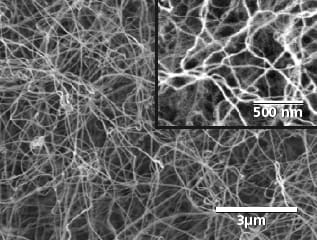
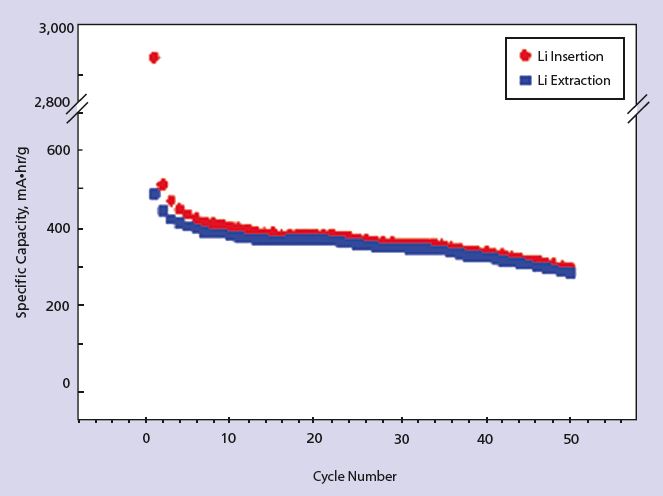
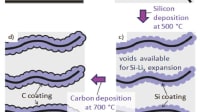
Coating the silicon nanowires with carbon has been proposed as a way of reducing the loss of capacity with cycling. Beneficial effects of coating with carbon include stabilization of the surfaces of the silicon nanowires by blocking oxygen, increasing electrical conductivity, and providing a cushion material to relieve the stress of volume expansion. An investigation of the effects of coating with carbon was in progress at the time of reporting the information for this article.
This work was done by KunHong Lee of Pohang University of Science and Technology for the Air Force Research Laboratory.
AFRL-0078
This Brief includes a Technical Support Package (TSP).
Silicon Nanowires for Anodes of Rechargeable Li Power Cells
(reference AFRL-0078) is currently available for download from the TSP library.
Don't have an account?
More From SAE Media Group

Tech Briefs
Using Silicon for Battery Anodes
Battery Technology
Flexible, Thin-Film Battery
Battery Technology
Design Enables Safe Storage of Lithium Ions
Battery & Electrification Technology
Next-Generation Binder for Lithium-ion Batteries
Battery & Electrification Technology
New Priming Method for Improving Battery Lifecycle
Automotive Engineering
Niobium: Magic Metal for Battery Anodes?
Battery & Electrification Technology
New Polymer Coating Could Boost EV Batteries
Tech Briefs
Products of Tomorrow
Automotive Engineering
NAWA Aims for 5-Minute EV Charge
Battery Technology
Hybrid Membrane Doubles the Lifetime of Rechargeable Batteries
Battery & Electrification Technology
Cobalt-Free Batteries Could Power EVs of the Future
Battery & Electrification Technology
Iron Could Be Key to Less Expensive, Greener Lithium-Ion Batteries


Automotive Engineering
Launching Aerospace Battery Tech for EVs

Battery & Electrification Technology
Developing Safer Batteries with Solid-State Polymer Electrolytes
Aerospace & Defense Tech Briefs
Electrochemical Energy Storage Materials
Battery & Electrification Technology
Manufacturing Advances in Solid-State Batteries
Tech Briefs
Stable, Efficient, Anode-Free Sodium Battery

Battery & Electrification Technology
Material Derived from Trees Could Replace Liquid Electrolytes


Overview
The document presents a research study focused on the synthesis of silicon (Si) nanowires intended for use as an anode material in next-generation lithium-ion (Li-ion) batteries. Conducted by Dr. Kun-Hong Lee at Pohang University of Science and Technology, the project aims to explore new alloy anode materials that can significantly improve battery performance.
The research highlights the potential of Li alloys, particularly Li4.4Si, which boasts a theoretical capacity of 4200 mAhr/g—substantially higher than that of conventional graphite anodes. However, the study also addresses the challenges associated with using silicon in batteries, particularly the significant volume expansion that occurs during charging and discharging cycles, which can lead to a decrease in capacitance. The investigation focuses on understanding the morphological and volumetric changes of Li-Si alloy electrodes to mitigate these issues and enhance the overall performance of Li alloy anodes.
The document details the synthesis methods employed for creating Si nanowires, particularly through microwave heating techniques. Two primary approaches are discussed: synthesizing Si nanowires from Si wafers and from thin Si films. In the first method, a P-type Si (100) wafer is coated with a thin gold film and subjected to microwave irradiation in an inert atmosphere, resulting in the formation of fibrous structures with diameters ranging from 10 to 50 nm. The second method involves a similar process using a thin Si film on a quartz wafer, yielding nanowires with diameters around 25 nm.
The document emphasizes the advantages of microwave synthesis, which allows for rapid, clean production of high-quality nanowires without the limitations associated with traditional chemical vapor deposition (CVD) methods. This technique is noted for its ability to grow nanowires on various substrates, including glasses and organic polymers, which expands the potential applications of Si nanowires in battery technology.
Overall, the research aims to contribute to the development of improved anode materials for Li-ion batteries, addressing the challenges of capacity loss and volume expansion while leveraging the unique properties of silicon nanowires. The findings are expected to pave the way for advancements in battery technology, potentially leading to batteries with significantly enhanced performance.
Top Stories
INSIDERDefense
 New Raytheon and Lockheed Martin Agreements Expand Missile Defense Production
NewsAutomotive
 Ford Announces 48-Volt Architecture for Future Electric Truck
INSIDERManufacturing & Prototyping
 Active Strake System Cuts Cruise Drag, Boosts Flight Efficiency
ArticlesTransportation
 Accelerating Down the Road to Autonomy
INSIDERMaterials
 How Airbus is Using w-DED to 3D Print Larger Titanium Airplane Parts
Road ReadyTransportation

Webcasts
Electronics & Computers
 Cooling a New Generation of Aerospace and Defense Embedded...
Power
 Battery Abuse Testing: Pushing to Failure
Connectivity
 A FREE Two-Day Event Dedicated to Connected Mobility
Automotive
 Quiet, Please: NVH Improvement Opportunities in the Early Design Cycle
Transportation
 Advantages of Smart Power Distribution Unit Design for Automotive &...
Aerospace
 Sesame Solar's Nanogrid Tech Promises Major Gains in Drone Endurance