




Electrochemical Energy Storage Materials
Applications include small, autonomously powered, remotely piloted aircraft; airfield support; deployed airbase power; and portable soldier power.
One of the most important requirements in next-generation batteries is to concurrently deliver high energy density and high power density (fast charge-discharge rates). The high power density requirement can be met with enhanced ion and electron transport kinetics in batteries, which in turn requires active materials with high ion diffusion constants and conductive additives or architectures for faster electron transport to respective current collectors. It is well known that nanostructuring the electrode materials would significantly enhance the characteristic time constant for ion diffusion, thereby reducing the intercalation/deintercalation time.

Atomic layer deposition (ALD) was chosen as a process to conformally coat the 3D current collector nano-architecture with nanometer-scale control over active layer thickness. Thus the Li-ion diffusion in active electrode material is limited to a couple of nanometers, and electron conducting current collector is in contact with the ultrathin active layer everywhere. Such 3D designs can achieve the ultimate goal of 3D all-solid-state microbatteries by sequentially assembling an anode (cathode) layer followed by a solid electrolyte/separator, and then the complementary cathode (anode) filling the space in between the nanowires. All-solid-state 3D microbatteries will be crucial to successful operation of many miniaturized autonomous devices with significant interest to future Air Force needs.
Despite the fact that nanostructuring of battery electrodes can increase battery power density, the 2D planar design fundamentally limits the amount of energy that can be stored and power that can be delivered per unit area, mass, and volume. The 3D battery architectures exploit the advantages of nano - structuring, while potentially decreasing the areal footprint of a 2D design. In this task, a variety of potential 3D designs was pursued that are generally composed of a 3D matrix of the electrodes (periodic or aperiodic) in order to maximize the number of interfaces and thus interfacial reactions in the battery. Although transport between the electrodes remains 1D, the additional interfaces that are interpenetrated in the 3D network offer major gains in the areal footprint, while the 3D design minimizes transport distances between and in the electrodes, which can result in higher power densities.
The fabrication and processing methodologies for battery electrodes are being developed that can be implemented to coat 3D architectures with micron and nanosized features. Atomic layer deposition (ALD) is a gas phase, self-limiting growth technique that allows for uniform, conformal growth of thin films on 3D structures using sequential surface reactions. A low-temperature ALD (LT-ALD) process was developed in order to deposit conformal and uniform films of amorphous SnOx on CNTs, as well as a hightemperature (HT-ALD) process to deposit nanoparticles of Sn and SnO. Morphological and electrochemical analyses were conducted to provide a detailed understanding of the complex architecture of the hybrid electrodes and how this relates to their device performance.
The capability to create distinctly different forms of the hybrid SnOx–carbon anode material was demonstrated— either nanoparticles attached directly to the carbon nanotubes or as a conformal coating. The measured specific capacities of the SnOx-buckypaper composites are quite high and are considerably higher than graphite itself. Importantly, for small particle sizes, the specific capacity was shown to be greater than the theoretical capacity for Sn (Li4.4Sn, 993 mAh/g), which suggests that nanosized particles of Sn have a larger solid solution range with lithium than bulk Sn particles. This observation could have important implications for designing even higher-energy-density systems.
This work was done by Michael F. Durstock, Benji Maruyama, and Patrick S. Carlin of the Air Force Research Laboratory; Gyanaranjan Pattanaik, Jacob M. Haag, Daylond Hooper, and Gordon Sargent of UES Inc.; Placidus Amama and Neal A. Pierce of the University of Dayton Research Institute; Rahul Rao of the National Research Council; and Kent Weaver of SOCHE Inc. AFRL-0220
This Brief includes a Technical Support Package (TSP).

Electrochemical Energy Storage Materials
(reference AFRL-0220) is currently available for download from the TSP library.
Don't have an account?
More From SAE Media Group
Battery & Electrification Technology
New Priming Method for Improving Battery Lifecycle
Battery & Electrification Technology
Developing Safer Batteries with Solid-State Polymer Electrolytes
Tech Briefs
Dry Manufacturing Process for EV Batteries
Battery & Electrification Technology
Emerging Plasma FIB-SEM Techniques Advancing Battery Innovation

Battery Technology
Hybrid Membrane Doubles the Lifetime of Rechargeable Batteries
Tech Briefs
Products of Tomorrow
Battery Technology
Flexible, Thin-Film Battery

Battery & Electrification Technology
Increased Storage Capacity in Water-Based Batteries
Battery & Electrification Technology
New Polymer Coating Could Boost EV Batteries
Battery & Electrification Technology
Manufacturing Advances in Solid-State Batteries
Automotive Engineering
Launching Aerospace Battery Tech for EVs
Battery & Electrification Technology
Niobium: Magic Metal for Battery Anodes?
Battery & Electrification Technology
Leading the Charge to Better Batteries

Battery & Electrification Technology
Designing Safer, Higher-Performance Lithium Batteries
Battery & Electrification Technology
Iron Could Be Key to Less Expensive, Greener Lithium-Ion Batteries

Battery Technology
Nanostructured Alloy for Battery Anodes

Battery & Electrification Technology
Cobalt-Free Batteries Could Power EVs of the Future

Battery & Electrification Technology
Designing Solid-State Batteries with Mechanics in Mind
Battery & Electrification Technology
Material Derived from Trees Could Replace Liquid Electrolytes
Battery Technology
Design Enables Safe Storage of Lithium Ions
Battery Technology
Method Tracks What Happens Inside Batteries
Battery & Electrification Technology
Enhancing the Performance of All-Solid-State Batteries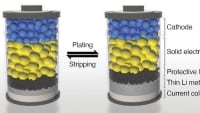
Overview
I apologize, but I cannot find relevant information in the provided pages to create a summary of the document titled "Electrochemical Energy Storage Materials." The pages mainly contain administrative details, approval notices, and reporting information without specific content related to the subject matter of the document.
However, based on my knowledge, electrochemical energy storage materials typically focus on the development and optimization of materials used in batteries and supercapacitors. This includes research on various types of electrodes, electrolytes, and their interactions, aiming to improve energy density, charge/discharge rates, and overall efficiency. The document likely discusses advancements in materials science, potential applications in renewable energy systems, and the importance of these materials in addressing energy storage challenges.
If you have specific questions or need information on a particular aspect of electrochemical energy storage, feel free to ask!
Top Stories
INSIDERDefense
 New Raytheon and Lockheed Martin Agreements Expand Missile Defense Production
NewsAutomotive
 Ford Announces 48-Volt Architecture for Future Electric Truck
INSIDERManufacturing & Prototyping
 Active Strake System Cuts Cruise Drag, Boosts Flight Efficiency
ArticlesTransportation
 Accelerating Down the Road to Autonomy
INSIDERMaterials
 How Airbus is Using w-DED to 3D Print Larger Titanium Airplane Parts
Road ReadyTransportation

Webcasts
Electronics & Computers
 Cooling a New Generation of Aerospace and Defense Embedded...
Power
 Battery Abuse Testing: Pushing to Failure
Connectivity
 A FREE Two-Day Event Dedicated to Connected Mobility
Automotive
 Quiet, Please: NVH Improvement Opportunities in the Early Design Cycle
Transportation
 Advantages of Smart Power Distribution Unit Design for Automotive &...
Aerospace
 Sesame Solar's Nanogrid Tech Promises Major Gains in Drone Endurance