




Real-Time Intelligent Chemical and Biological Nanosensors on a Flexible Platform
Carbon nanotubes are used to fabricate multiple arrays of switching devices.
The objectives of this research are to examine the feasibility of real-time sensing of chemical and biological species by using the unique materials and electronic properties of carbon nanotubes, and to demonstrate the multi-agent sensing and information processing capabilities of such devices.
The current rectification property of chemical-vapor-deposited (CVD), as-grown, single-walled carbon nanotubes (SWNTs) was investigated. The long strands of SWNT bundles were used to fabricate multiple arrays of switching devices with channel lengths of 3, 5, 7, and 10um on a 15×15mm2 silicon dioxide (SiO2) on silicon (Si) substrate. The devices were fabricated by photolithographically depositing a 100-nm layer of gold (Au) on top of 10-nm-thick titanium (Ti) to serve as electrodes with varying source (S) and drain (D) separation. The dimension of each electrode pad was 250 × 250 um. The samples were then annealed at 200°C for 30 minutes in constant flow of nitrogen to eliminate possible oxide defects.
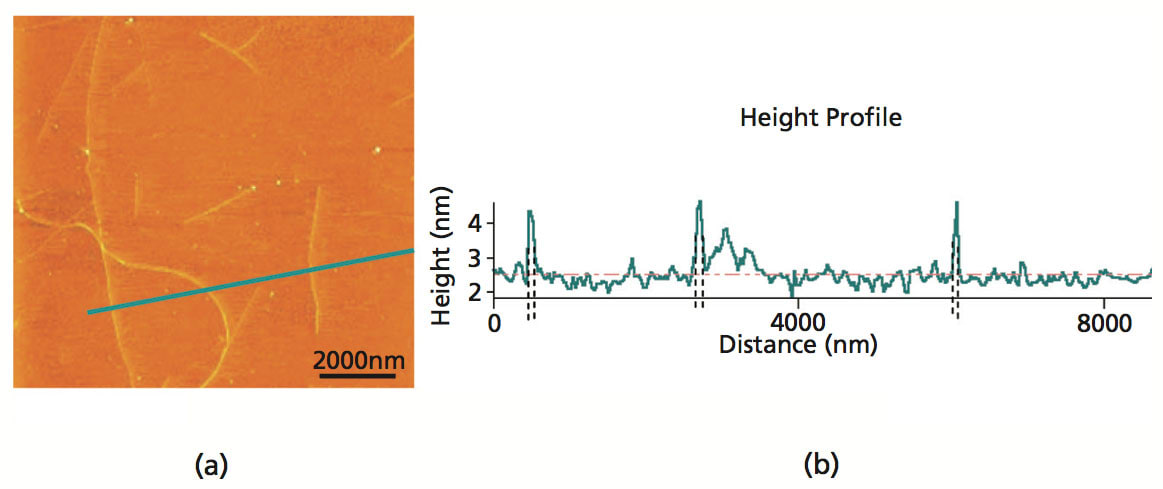
The present process is compatible with current industry-standard silicon electronics and could be easily transitioned for mass fabrication of the SWNT switching devices. The increase in current magnitude in the presence of oxygen and nitrogen shows that the devices composed of SWNTs can be used in sensor applications.
This work was done by Govind Mallick and Shashi P. Karna of the Army Research Laboratory. For more information, download the Technical Support Package (free white paper) at www.defensetechbriefs.com/tsp under the Materials category. ARL-0076
This Brief includes a Technical Support Package (TSP).
Real-Time Intelligent Chemical and Biological Nanosensors on a Flexible Platform
(reference ARL-0076) is currently available for download from the TSP library.
Don't have an account?
More From SAE Media Group
Tech Briefs
Printable Chemical Nanosensor


Tech Briefs
Transparent Graphene Electrodes


Tech Briefs
Foldable Solar Cells
Electronics & Sensors INSIDER
Tiny But Mighty: Next-Gen Transistors Hold Great Promise

Photonics & Imaging Technology INSIDER
Transparent Graphene Electrodes Might Lead to New Generation of Solar Cells
Electronics & Sensors INSIDER
Researchers Wire Up Individual Graphene Nanoribbons
Electronics & Sensors INSIDER
Graphene-Based Electronics

Medical Design Briefs
Atomic Chains in Nanotubes Push the Electronics Frontier


Tech Briefs
Enhanced Material Stable Enough for Solar Cells
Tech Briefs
Better Microelectronics from Coal
Tech Briefs
Sandwiching Materials in Nanoelectronics
Power Electronics INSIDER
Carbon Nanotubes Store Energy
Medical Design Briefs
Electrospinning Advantages for Wearable Technology
Tech Briefs
Metallization for SiC Semiconductors
Medical Design Briefs
Nontoxic, Flexible Energy Converters Could Power Wearable Devices

Tech Briefs
5Ws of the Silk Transistor

Overview
The document titled "Real-time Intelligent Chemical and Biological Nanosensors on Flexible Platform - II," authored by Govind Mallick and Shashi P. Karna, presents research conducted by the U.S. Army Research Laboratory, focusing on the development of advanced nanosensor technologies for the real-time detection of chemical and biological agents. The report, dated March 2009, covers research conducted from October 1, 2007, to September 30, 2008.
The primary objective of the research is to create intelligent nanosensors that can operate on flexible platforms, enhancing their applicability in various environments, including military and civilian settings. The report outlines the background of nanosensor technology, emphasizing the need for rapid and accurate detection methods for hazardous substances. It discusses the advantages of using nanosensors, such as their high sensitivity, low detection limits, and potential for miniaturization.
The approach taken in the research involves the integration of nanomaterials with flexible substrates to develop sensors that can detect specific chemical and biological agents in real-time. The document details the experimental methods employed, including the synthesis of nanomaterials, sensor fabrication, and testing procedures. The results section presents findings on the performance of the developed sensors, highlighting their effectiveness in detecting target analytes under various conditions.
The discussion section analyzes the implications of the results, addressing challenges faced during the research and potential improvements for future work. The authors emphasize the importance of continued research in this field to enhance the reliability and functionality of nanosensors, which could significantly impact safety and security measures.
In conclusion, the report summarizes the key findings and suggests directions for future research, including the exploration of new materials and technologies to further improve sensor performance. The document serves as a valuable resource for researchers and practitioners interested in the field of chemical and biological detection, providing insights into the state of nanosensor technology and its potential applications.
Overall, this report contributes to the understanding of how flexible nanosensors can be developed and utilized for real-time monitoring of hazardous agents, underscoring the importance of innovation in detection technologies for both military and civilian applications.
Top Stories
NewsSensors/Data Acquisition
 Microvision Aquires Luminar, Plans Relationship Restoration, Multi-industry Push
INSIDERRF & Microwave Electronics
 A Next Generation Helmet System for Navy Pilots
INSIDERWeapons Systems
 New Raytheon and Lockheed Martin Agreements Expand Missile Defense Production
NewsAutomotive
 Ford Announces 48-Volt Architecture for Future Electric Truck
INSIDERAerospace
 Active Strake System Cuts Cruise Drag, Boosts Flight Efficiency
ArticlesTransportation

Webcasts
Aerospace
 Cooling a New Generation of Aerospace and Defense Embedded...
Energy
 Battery Abuse Testing: Pushing to Failure
Power
 A FREE Two-Day Event Dedicated to Connected Mobility
Automotive
 Quiet, Please: NVH Improvement Opportunities in the Early Design Cycle
Electronics & Computers
 Advantages of Smart Power Distribution Unit Design for Automotive &...
Unmanned Systems
 Sesame Solar's Nanogrid Tech Promises Major Gains in Drone Endurance