




Study of Submodeling of a Small Component in a Structure
Errors can be minimized through careful consideration of sampling and response frequencies.
A study was performed to evaluate the accuracy achievable in the use of submodeling in finite-element modeling of the mechanical response of a structural system that includes components embedded in a larger structure that is subjected to a large transient load. The specific system studied was a simplified model of a “smart” projectile containing a substructure that supported an electronic-circuit board on which were mounted two capacitors and an eight-lead integrated circuit (see figure). The main body or shell of the projectile was represented as a cylindrical ring supporting the substructure. The dimensions of the various components were chosen to be typical of “smart” munitions. The transient load condition was represented by a velocity-versus-time boundary condition, typical of the velocity versus time of a projectile at launch, imposed at the lower surface of the cylindrical ring.
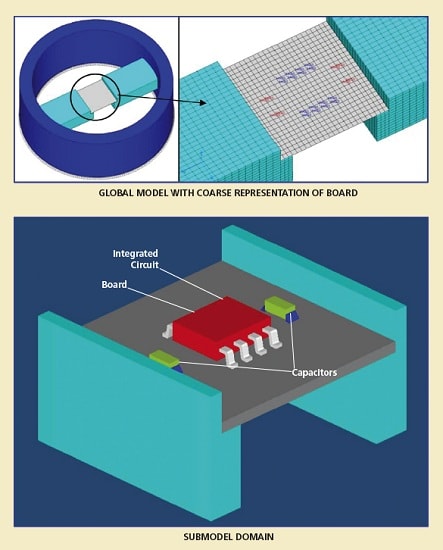
The submodel is a highly refined model of the domain of interest (that is, its computational mesh is much finer than that of the global model). The main motivation for submodeling is that it takes much less computation time than does modeling of the entire structure using a single mesh fine enough for the domain of interest. The primary assumption in submodeling is that the structural details of the submodel do not significantly affect the global model. In most practical applications, there are no known a priori methods for determining the validity of this assumption.
In the study, computational simulations to determine the deformations and stresses in the domain of interest during the first 1.4 ms of launch time were performed by use of (1) a fully refined baseline model of the entire structure, including the domain of interest; (2) a global-model/submodel combination utilizing the displacement boundary condition sampled at 1,000 subintervals of the 1.4-ms launch interval; and (3) a global-model/submodel combination utilizing the displacement boundary condition sampled at 100 subintervals of the 1.4-ms launch interval.
The two different time discretizations of the displacement boundary condition were used because time-dependent fidelity of boundary conditions had previously been found to affect results in submodeling and, hence, it was felt necessary to examine the effect in the system of this study. The results from the two submodel cases were found to be good approximations of those of the global model, but in the 100-point case, the stress peaks and valleys were found to overshoot and undershoot those of the baseline model. In the 1,000-point case, as expected, the stress peaks and valleys overshot and undershot by smaller amounts; that is, they approximated those of the baseline model more closely.
It was known a priori that submodeling might introduce spurious high-frequency content into the solution. The study included an examination of this effect, leading to the conclusion that through proper care in selection of the frequency of the global-model output, one can minimize adverse effects. It was shown that for the case studied, sufficient accuracy in the stress results of the submodel can be realized if one considers the desired frequency response range. If one subsequently samples the global loading finely enough, any high-frequency content introduced lies above the frequency range of interest.
This work was done by Brian M. Powers and David A. Hopkins of the Army Research Laboratory.
ARL-0042
This Brief includes a Technical Support Package (TSP).
Study of Submodeling of a Small Component in a Structure
(reference ARL-0042) is currently available for download from the TSP library.
Don't have an account?
More From SAE Media Group
Motion Control Tech Briefs
Combining Multiple Gyroscope Outputs for Increased Accuracy
Aerospace & Defense Tech Briefs
Revolutionizing Electronic Warfare: Unleashing the Power of High-Performance Software-Defined Radios
Photonics & Imaging Technology
Analysis and Simulation of Low-Light INL in CMOS Image Sensors



Aerospace & Defense Tech Briefs
New Products
Power Electronics INSIDER
Powerful and Precise Multi-color Lasers Now Fit on a Single Chip
Aerospace & Defense Tech Briefs
Benefits and Challenges of Direct-RF Sampling for Avionic Platforms
Aerospace & Defense Tech Briefs
What is Pulse Shaping?
Aerospace & Defense Tech Briefs
Reduced Order Modeling for Rapid Simulation of Blast Events of a Military Ground Vehicle and its Occupants

Tech Briefs
New on the Market
Electronics & Sensors INSIDER
New Transmitter Could Make Wireless Devices More Energy-Efficient
Robotics & Automation INSIDER
New System Enables Robots to Solve Manipulation Problems in Seconds




Aerospace & Defense Tech Briefs
Software for Material/Structural Characterization Across Length Scales

Tech Briefs
Optimization of Turbine Blade Dovetail Geometry
Tech Briefs
Hyper-Distributed RFID Antenna (HYDRA) System
Sensor Technology
Battery-Free Smart Sensing
NASA Spinoff
Tiny Springs Improve Electronic Reliability

Overview
The document titled "Evaluation of the Submodeling Technique for Analyzing Electronic Components" by Brian M. Powers and David A. Hopkins, published in October 2005, presents a comprehensive analysis of the submodeling technique, which is employed to enhance the evaluation of electronic components. The report is part of the Army Research Laboratory's efforts to improve methodologies in the field of electronic component analysis.
The introduction outlines the significance of accurately analyzing electronic components, particularly in the context of military applications where reliability and performance are critical. The authors emphasize the need for advanced techniques that can provide detailed insights into component behavior under various conditions.
The report includes a sample problem that illustrates the application of the submodeling technique. This section details the methodology used to implement the technique, including the selection of parameters and the computational processes involved. The sample problem serves as a practical example, demonstrating how submodeling can be utilized to break down complex systems into more manageable subcomponents, allowing for more precise analysis.
Results from the application of the submodeling technique are presented, showcasing its effectiveness in improving the accuracy of simulations and analyses. The findings indicate that submodeling can significantly enhance the understanding of stress distributions and failure modes in electronic components, leading to better design and reliability assessments.
In the conclusions section, the authors summarize the key benefits of the submodeling technique, highlighting its potential to streamline the analysis process and improve the overall reliability of electronic systems. They also discuss the implications of their findings for future research and development in the field, suggesting that further exploration of submodeling could lead to even more refined analytical tools.
The report concludes with a list of references, providing sources for further reading and validation of the methodologies discussed. The distribution list indicates that the report is intended for a wide audience, reflecting its relevance to both military and civilian applications in electronic component analysis.
Overall, this document serves as a valuable resource for researchers and engineers seeking to enhance their understanding of electronic component behavior through advanced analytical techniques.
Top Stories
INSIDERManufacturing & Prototyping
 How Airbus is Using w-DED to 3D Print Larger Titanium Airplane Parts
INSIDERManned Systems
 FAA to Replace Aging Network of Ground-Based Radars
NewsTransportation
 CES 2026: Bosch is Ready to Bring AI to Your (Likely ICE-powered) Vehicle
NewsSoftware
 Accelerating Down the Road to Autonomy
EditorialDesign
 DarkSky One Wants to Make the World a Darker Place
INSIDERMaterials
 Can This Self-Healing Composite Make Airplane and Spacecraft Components Last...
Webcasts
Defense
 How Sift's Unified Observability Platform Accelerates Drone Innovation
Automotive
 E/E Architecture Redefined: Building Smarter, Safer, and Scalable...
Power
 Hydrogen Engines Are Heating Up for Heavy Duty
Electronics & Computers
 Advantages of Smart Power Distribution Unit Design for Automotive...
Unmanned Systems
 Quiet, Please: NVH Improvement Opportunities in the Early Design...
