




Software for Material/Structural Characterization Across Length Scales
A two-stage approach is used for element-by-element analysis of a micro-structure.
Synthetic and natural micro-architectures occur frequently, and multiphase functionally graded composites are becoming increasingly popular for applications requiring optimized/tailored material properties. When dealing with such materials computationally, one issue that immediately arises is the analysis of the mechanical properties of macroscopically inhomogeneous multi-scale structures. The bulk response of these structures can be determined by performing full finite element analysis (FEA); that is, with the entire geometry discretized at a resolution high enough to accurately model the smallest length scale of interest. However, these full models may easily exceed hundreds of millions, or potentially billions, of degrees of freedom, and solving problems of this magnitude may only be possible with the use of supercomputing facilities.
Additionally, in an iterative optimization process where the performance of the structure may be evaluated thousands of times, the use of full FEA simulations becomes highly impractical. When the performance of a structure is evaluated in an optimization process, typically only some aspect of the bulk response, such as deflection, is considered. For such properties, the use of full FEA simulations to model the problem may be excessive. In the present project, a novel, two-stage approach to solving such a large problem by performing element-by-element homogenization of the micro-structure, followed by solving the global problem with a coarser mesh, was explored.
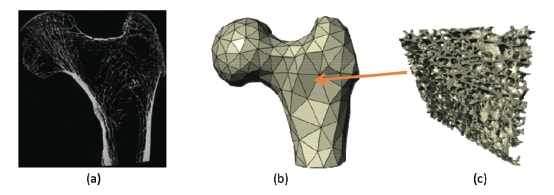
The approach taken is based on creating a coarse tetrahedral/hexahedral discretization of the domain using traditional volume meshing techniques, and assigning appropriate material properties based on a finite element homogenization based on high-resolution mesh at the microstructural level of the macro tetrahedra or hexahedra. In effect, two length scales are decoupled by computing effective properties using the finite element approach for each macro-element. The novelty here lies in effectively discretizing the full 3D mesh into larger tetrahedra and hexahedra, and computing homogenized properties for each macro-element based on exact meshed domains representing the full microstructural complexity within the macro-elements.
For the more general case, this work exploited the use of robust, all-tetrahedral volume meshing as a method for dividing an irregular domain into smaller subvolumes for homogenization. As each sub-volume conformed to its parent macro-element, a method for calculating their effective properties was developed.
At the highest level, the developed homogenization process involves treating the sub-volume as if it were the actual macro-element. Appropriate boundary conditions are applied based on the shape functions of the macro-element such that the sub-volume is constrained to the same modes of deformation. A series of finite element simulations is then performed in order to determine the subvolume’s effective properties.
As part of the validation of the developed homogenization technique for tetrahedral sub-volumes, a homogeneous sub-volume with fully anisotropic material properties was used as a “sanity test.” The input material properties were accurately recovered. More interestingly, the technique was also used to recover the effective properties of a real-world structure and compared to the results obtained using classical methods. The Schoen Gyroid was chosen for this purpose as its periodic geometry allows periodic boundary conditions to be used. These boundary conditions are often considered to be the exact solution.
Following the development of a technique to determine an effective constitutive matrix for an arbitrary tetrahedral subvolume, the issue of multi-scale problems was addressed. Of particular interest is the set of problems having an irregular (i.e. non-cuboidal) domain. While problems of a more regular nature may be addressed with more conventional methods of determining effective constitutive matrices, they are nevertheless addressable using the methods developed in this work.
For many problems, it is highly impractical to attempt to include all length scales in a finite element model; consequently, it is often desirable to only capture the coarser details. Rather than excluding the smaller length scales, a coarse mesh with appropriate homogeneous material properties was produced. The process of generating the macro mesh is outlined in the figure. The homogeneous domain should conform to the bounds of the original domain as closely as possible, representing the result of a “shrink-wrap” operation.
Each of the macro-elements in the generated mesh is subsequently homogenized using the developed technique. As each macro-element is considered as an independent sub-volume, the processing may occur in either series or in parallel, depending on the available computational resources. The final result is a macroscopic homogenous model with varying material properties that can be exported to a traditional finite element package.
This work was done by Philippe G. Young of the University of Exeter; and David Raymont, Joonshik Kim, and Viet Bui Xuan of Simpleware Ltd. for the Air Force European Office of Aerospace Research & Development (EOARD). AFRL-0225
This Brief includes a Technical Support Package (TSP).
Software for Material/Structural Characterization Across Length Scales
(reference AFRL-0225) is currently available for download from the TSP library.
Don't have an account?
More From SAE Media Group
Aerospace & Defense Tech Briefs
Reduced Order Modeling for Rapid Simulation of Blast Events of a Military Ground Vehicle and its Occupants

Tech Briefs
Optimization of Turbine Blade Dovetail Geometry

Aerospace & Defense Tech Briefs
Covariance and Uncertainty Realism in Space Surveillance and Tracking
Software Tech Briefs
3D Direct Modeling: Removing Bottlenecks in Simulation
Aerospace & Defense Tech Briefs
Multi-Scale Analysis of Deformation and Failure in Polycrystalline Titanium Alloys Under High Strain Rates
Aerospace & Defense Tech Briefs
Optimizing Thermal Management to Meet SWaP-C Requirements

Motion Design
ROSE Could Usher in a New Era of Automated Farming

Aerospace & Defense Tech Briefs
NRL Scientists Deliver Quantum Algorithm to Develop New Materials and Chemistry

Aerospace & Defense Tech Briefs
Peridynamic Modeling: An Alternative Approach to Analyzing Material Failure
Aerospace & Defense Tech Briefs
The Influence of Material Processing on the Performance of Composite Parts

Aerospace & Defense Tech Briefs
New Cyber Algorithm Shuts Down Malicious Robotic Attacks
Aerospace & Defense Tech Briefs
Engine Air-Brakes

Tech Briefs
Executive Perspectives: Software

Tech Briefs
Fine-Tuning the Factory Using Simulation
Aerospace & Defense Tech Briefs
Model Development Using Accelerated Simulations of Hypersonic Flow Features
Tech Briefs
Method of Real-Time Principal-Component Analysis
Aerospace & Defense Tech Briefs
Hierarchical Diamond-Based Ceramic Composites
Motion Control Technology
“Pinball Wizards” Bank on Motion/Stress Analysis Software to Redesign Game
Aerospace & Defense Tech Briefs
German Researchers Test Quantum Channels In-Flight
Overview
The document titled "Multi-scale homogenization for 3D multiphase composites" is a final report authored by Professor Philippe G. Young from the University of Exeter, detailing a research project funded by the European Office of Aerospace Research and Development (EOARD) under Grant 12-2087. The project spanned from September 29, 2012, to September 30, 2013, and aimed to develop robust software tools for the characterization of materials and structures across multiple length scales.
The report highlights the increasing importance of multiphase functionally graded composites in various applications that require optimized material properties. These materials often exhibit complex micro-architectures, which pose significant challenges in analyzing their mechanical properties due to their macroscopic inhomogeneity. Traditional methods, such as full finite element analysis (FEA), can be computationally intensive and impractical, especially when iterative optimization processes are involved.
To address these challenges, the research explored a novel two-stage approach to multiscale homogenization. This method involves performing element-by-element homogenization of the micro-structure, followed by solving the global problem using a coarser mesh. This approach allows for a more efficient analysis of the material's bulk response without the need for high-resolution models that require supercomputing resources.
The report presents results from elasto-static cases, demonstrating that the proposed method can effectively bridge high-resolution 3D imagery with multiscale analysis. The findings indicate that this approach is not only viable but also applicable to a broader range of physical scenarios beyond elasto-static loading.
The document also outlines the collaborative efforts with the Air Force Research Laboratory (AFRL) and mentions plans for future visits to present the research findings and explore further collaboration opportunities. The report concludes with references to key literature in the field, including works by G. Milton, M. H. Sadd, and Z. Hashin, among others, which provide foundational knowledge and context for the research conducted.
Overall, this report contributes to the advancement of computational mechanics and material science by providing innovative solutions for the characterization of complex materials, paving the way for enhanced design and optimization in engineering applications.
Top Stories
INSIDERManufacturing & Prototyping
 How Airbus is Using w-DED to 3D Print Larger Titanium Airplane Parts
INSIDERManned Systems
 FAA to Replace Aging Network of Ground-Based Radars
NewsTransportation
 CES 2026: Bosch is Ready to Bring AI to Your (Likely ICE-powered) Vehicle
NewsSoftware
 Accelerating Down the Road to Autonomy
EditorialDesign
 DarkSky One Wants to Make the World a Darker Place
INSIDERMaterials
 Can This Self-Healing Composite Make Airplane and Spacecraft Components Last...
Webcasts
Defense
 How Sift's Unified Observability Platform Accelerates Drone Innovation
Automotive
 E/E Architecture Redefined: Building Smarter, Safer, and Scalable...
Power
 Hydrogen Engines Are Heating Up for Heavy Duty
Electronics & Computers
 Advantages of Smart Power Distribution Unit Design for Automotive...
Unmanned Systems
 Quiet, Please: NVH Improvement Opportunities in the Early Design...
