




German Researchers Test Quantum Channels In-Flight
Researchers at the German Aerospace Center recently tested a quantum sensor in-flight on a Dornier 228 research aircraft.
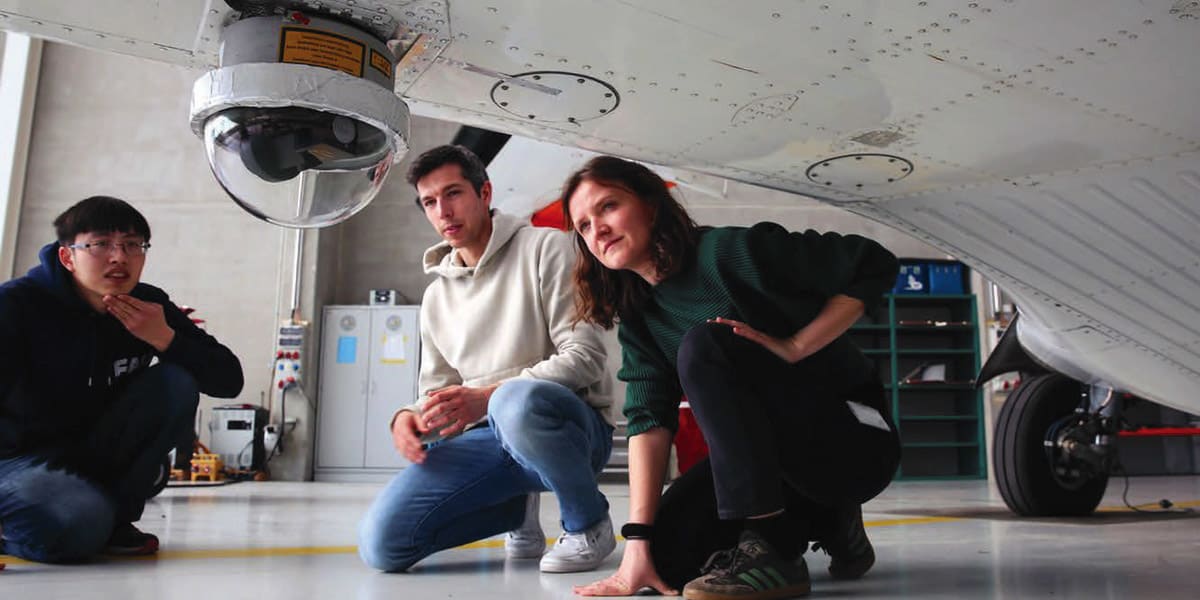
It is not easy to transmit individual photons precisely from an aircraft, capture them in a ground station and detect them successfully. Researchers have, however, now managed to do exactly that. They have even measured, multiple times, various quantum channels between an aircraft and a ground station, sent photons to an ion trap and tested technologies for quantum key distribution (QKD).
The flight experiment in question took place as part of the QuNET initiative, aimed at developing quantum-secure communication. Using photons – particles of light – it is possible to generate quantum encryption keys, which will make future communication eaves-drop-proof. The technologies behind this are also paving the way for a future quantum internet, connecting quantum computers with one another.
Researchers from the German Aerospace Center (Deutsches Zentrum für Luft- und Raumfahrt; DLR), the Max Planck Institute for the Science of Light (MPL), the Friedrich-Alexander-Universität (FAU), the Fraunhofer Institute for Applied Optics and Precision Engineering (IOF) and the Fraunhofer Heinrich-Hertz-Institut (HHI) were involved in the experiment. Their findings have since been presented to Germany’s Federal Ministry of Research, Technology and Space (BMFTR) – the QuNET initiative sponsor. Quantum key distribution is particularly important for secure communication between governments and public authorities, but also for protecting infrastructure and everyday data in the future.
“We are working on practical solutions for satellite-based quantum communication, thanks to which we can transmit quantum states over large distances and generate secure keys. In fiber optics, this is only possible over a few hundred kilometers. Quantum encryption via satellite, on the other hand, enables distances of any length on Earth,” said Florian Moll from the DLR Institute of Communications and Navigation, explaining this pioneering technology. To bridge long distances, satellites, aircraft or other mobile platforms will become part of future quantum networks.
The current experiment used a DLR research aircraft from the Flight Experiments facility. The researchers installed an optical communication terminal into the Dornier 228 aircraft, which during the flights acted as a mobile node in a quantum network and established a connection with a ground station. The receiving station in this case was a mobile container with an integrated receiving terminal – the ‘QuBUS’, provided by the Fraunhofer IOF.
Technically Highly Complex
Individual photons are difficult to handle. For quantum communication, they must be generated with a high quality and clearly detected despite strong external disturbances. To achieve optimum results, the wavelength of the photons also needs to be precisely calibrated. “We have shown in the various tests conducted this is possible. The approach we have tested is not only feasible from within aircraft, but also from satellites,” Moll added.
For the current experiment, multiple research flights took place over the German city of Erlangen, as the ion trap used is located in the laboratories of the MPL institute there. The photons transmitted from the aircraft were directed at the ground station and into a glass fiber-optic cable, which connected to the measuring equipment for the various experiments. The states of the ‘flying’ particles could be detected in measurements at the ion trap – one of the experiment’s objectives. This communication technology can also be used to connect quantum memories or quantum computers within a future quantum network.
Secure Communication for the Future
Systems were installed both in the aircraft and the ground station at Erlangen in order to carry out QKD experiments. These systems are revolutionizing satellite-based quantum communication. For example, a system for clock-channel-free quantum key distribution was tested. What’s more, the researchers also detected photons from an entanglement source on the ground. Channel measurements and component tests for QKD systems with innovative and flexibly configurable protocols also provided valuable insights for further evolving secure communication of the future.
This article was written by Katja Lenz for the German Aerospace Center (DLR). For more information, contact Katja,
More From SAE Media Group




Aerospace & Defense Tech Briefs
SpaceRAN Demonstrator Will Test 5G Connectivity on Software-Defined Satellite
Photonics & Imaging Technology
Meeting the Challenges for Space to Earth Optical Communication
Photonics & Imaging Technology INSIDER
Thin Device Triggers One of Quantum Mechanics’ Strangest Phenomena
Aerospace INSIDER
Airbus Demonstrates Very High-Speed Optical Link Between Space and Earth
Aerospace INSIDER
This Laser Clock Could Transform Satellite Navigation Accuracy
Aerospace INSIDER
Changing the Face of UAV Communications

Aerospace INSIDER
Metamaterials Antenna Makes Generational Leap in Multi-Band Connectivity
Tech Briefs
Engineering the Flow of Light
Aerospace & Defense Tech Briefs
Detection with Quantum Radar

Aerospace Manufacturing and Machining INSIDER
Airbus Developing New Laser Communication Terminal for Military Aircraft
Photonics & Imaging Technology INSIDER
Researchers Teleport Particle of Light Six Kilometers
Photonics & Imaging Technology
Achieving 100 Gb/s Using O-band Technology
Aerospace & Defense Tech Briefs
Could Metasurfaces Be The Next Quantum Information Processors?
Tech Briefs
Building Quantum Computers of the Future
Aerospace INSIDER
LEO Satellites Complete First Ever Link 16 Broadcast From Space
Aerospace & Defense Tech Briefs
Electronically Steered Array Antennas for E2 Jets


Tech Briefs
How Much Do You Know About Quantum Computing?
Top Stories
INSIDERManufacturing & Prototyping
 How Airbus is Using w-DED to 3D Print Larger Titanium Airplane Parts
INSIDERManned Systems
 FAA to Replace Aging Network of Ground-Based Radars
NewsTransportation
 CES 2026: Bosch is Ready to Bring AI to Your (Likely ICE-powered) Vehicle
NewsSoftware
 Accelerating Down the Road to Autonomy
EditorialDesign
 DarkSky One Wants to Make the World a Darker Place
INSIDERMaterials
 Can This Self-Healing Composite Make Airplane and Spacecraft Components Last...
Webcasts
Defense
 How Sift's Unified Observability Platform Accelerates Drone Innovation
Automotive
 E/E Architecture Redefined: Building Smarter, Safer, and Scalable...
Power
 Hydrogen Engines Are Heating Up for Heavy Duty
Electronics & Computers
 Advantages of Smart Power Distribution Unit Design for Automotive...
Unmanned Systems
 Quiet, Please: NVH Improvement Opportunities in the Early Design...
Power

Similar Stories
INSIDERSensors/Data Acquisition
 Blast Tube Tests Simulate Shock Waves Nuclear Weapons Could Face
NewsTest & Measurement

ArticlesAR/AI
 The Evolution of Autonomous Systems in UAV Technology
INSIDERRF & Microwave Electronics
 Advanced Subsystems Improve Performance of Eurofighter Radar Mk1
ProductsElectronics & Computers

INSIDERData Acquisition
 This Laser Clock Could Transform Satellite Navigation Accuracy