




SpaceRAN Demonstrator Will Test 5G Connectivity on Software-Defined Satellite
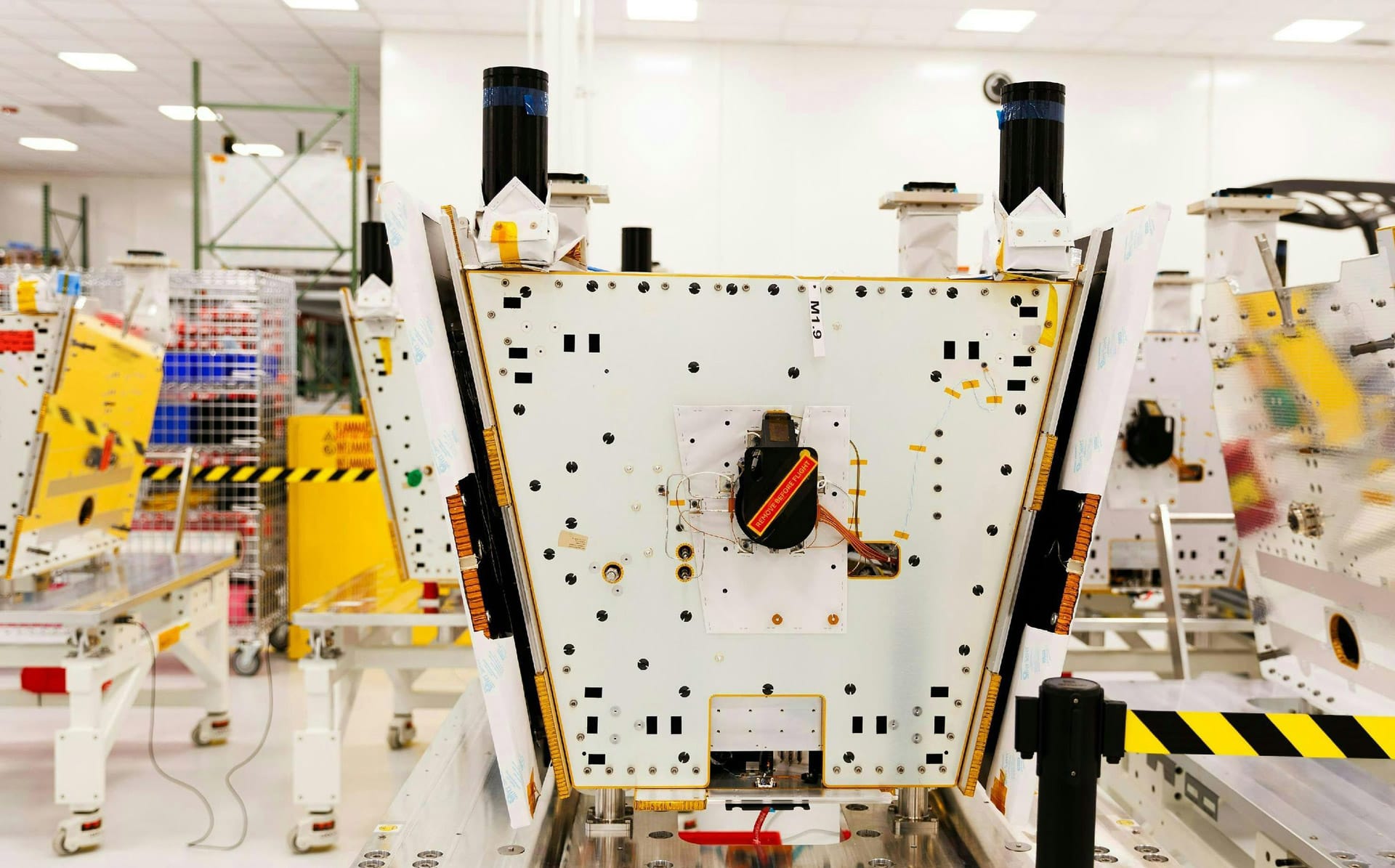
Satellite connectivity is essential for global communications, and Airbus is leveraging its experience in satellites to test the capabilities of a 5G non-terrestrial network.
There are two primary ways to send and receive digital communications. The oldest is through terrestrial networks (TN), which use ground-based infrastructure like cellular towers or fiber-optic cables. For locations that can’t be reached by cables – such as the skies – the only way to communicate is through satellites. Non-terrestrial networks (NTN) thus rely on satellites to provide connectivity unbound by location and available everywhere: on land, at sea and in the sky.
5G, the fifth generation of cellular network technology, represents a significant leap forward from its predecessor, 4G. It was designed to enhance mobile broadband through extremely high data rates, enable massive machine type communications for a high number of connected devices, and provide ultra-reliable and low-latency communications for critical applications. Latency is the time delay between reception and response of a computing system.
As a cellular network, 5G primarily uses TNs to operate in populated areas, which consist of cellular towers connected by high-speed fiber optic cables. However, to provide blanket 5G coverage everywhere on earth, a necessity for continuous connectivity in flight, 5G is being integrated into NTNs that use satellites as ‘floating’ cell towers.
The initial steps towards developing this NTN have already been taken: Airbus, Eutelsat, MediaTek, ITRI and ESA announced the successful trial of 5G NTN technology at the end of February 2025. The test used Eutelsat’s OneWeb LEO satellite constellation, built by Airbus. However, to optimize routing and reduce end-to-end latency, software-defined capabilities are required.
Testing Advanced Software-Defined Satellite Technology
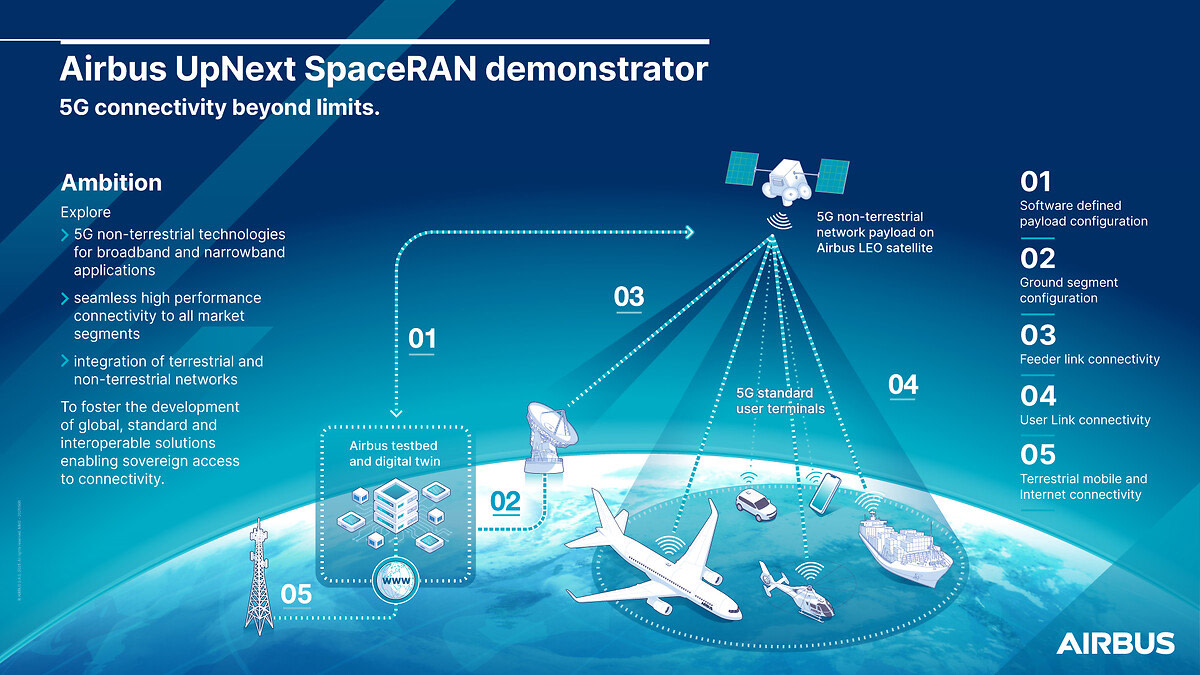
Enter the Airbus UpNext SpaceRAN demonstrator, which will use a software-defined satellite to process signals that can be reprogrammed from the ground after launch. Software-defined means that instead of simply acting as a signal repeater, the satellite actively processes the signal onboard: first it receives the signal and breaks it down, then it processes it, before regenerating the signal to be sent out again.
The ability for satellites to process and regenerate signals on-board is a game-changer. It reduces latency, increases data throughput and enables more efficient network management. By using inter-satellite links to allow satellites to ‘speak’ to each other, the traffic can be routed directly and the number of ground stations needed and thus the overall cost of operations is reduced. A successful demonstration of a 5G NTN software-defined satellite therefore has the potential to expand network coverage and resilience, improve service quality and enable new applications.
The Airbus UpNext SpaceRAN demonstrator will test the 5G connection on two different platforms. The first is a ground demonstration that will simulate a two-satellite constellation in low-Earth orbit (LEO), testing key features like beam and satellite handovers, which are crucial for maintaining smooth and continuous connection. The second is an in-orbit demonstration that will place a 5G non-terrestrial network payload on an Airbus LEO satellite, to act as a 5G base station in space. This phase is scheduled to launch in 2027, with in-orbit testing scheduled for 2028.
A Strategic and Collaborative Approach
In the coming years, aircraft operations will become increasingly connected and digitized as connectivity is firmly established. By actively developing and standardizing 5G NTN capabilities, Airbus, together with some key 5G players, is leading the development of an open and non-proprietary standard for satellite communications. This is key to ensuring connected Airbus products and platforms are linked to a secure, global and resilient connectivity solution that is not dependent on an external provider’s technology, ensuring long-term autonomy and flexibility.
A non-proprietary and sovereign connectivity solution is also essential to give countries autonomy over critical communications infrastructure. Developing this standard is a collaborative effort with many major industry players, including Aalyria, AccelerComm, CesiumAstro, Deutsche Telekom, Eutelsat, the Industrial Technology Research Institute (ITRI), Keysight Technologies, Onati, Radisys, Sener and ST Engineering iDirect. It goes beyond simply exploring new technology, with the ultimate goal of creating and maintaining an entire 5G NTN ecosystem, which would include managing satellites, ground segments, user terminals and launches.
More From SAE Media Group
Aerospace Manufacturing and Machining INSIDER
Airbus Developing New Laser Communication Terminal for Military Aircraft

Defense INSIDER
Satellite Communications for the Army’s NGC2 Pilot
Aerospace INSIDER
Airbus Demonstrates Very High-Speed Optical Link Between Space and Earth

Aerospace INSIDER
LEO Satellites Complete First Ever Link 16 Broadcast From Space
Aerospace & Defense Tech Briefs
A New Network Design for the “Internet from Space”

Aerospace & Defense Tech Briefs
New Satellite Connectivity for Air Force Research Aircraft
Aerospace INSIDER
Aitech’s New Palm-Sized Satellite Enables Space-Based AI Processing
Aerospace INSIDER
Metamaterials Antenna Makes Generational Leap in Multi-Band Connectivity
Aerospace & Defense Tech Briefs
Satellite Antennas
Aerospace & Defense Tech Briefs
Army Completes Satellite as a Managed Service Research Project
Aerospace & Defense Tech Briefs
On-Orbit Satellite Refueling Flow Measurement
Aerospace INSIDER
Leonardo to Design Next Generation Atomic Clock for Galileo Satellites

Aerospace & Defense Tech Briefs
Pushing the Boundaries of Rapid Production of Spacecraft: Flight Results from NearSpace Launch’s TROOP and ThinSat Platforms
Aerospace INSIDER
Space Lasers: Aiming Towards Next Leap in Global Communications
Defense INSIDER
Army Begins Satcom as a Service Evaluation
Aerospace INSIDER
Boeing to Develop New Space Force Nuclear Communications Satellites
Tech Briefs
Near-Real-Time Data Transfer from Space

Aerospace & Defense Tech Briefs
New Zealand and LeoLabs Establish the First Low-Earth Orbit Regulatory Platform

Aerospace Manufacturing and Machining INSIDER
Ball Aerospace Starts Final Assembly of Space Force's Next Generation Operational Weather Satellite

Aerospace & Defense Tech Briefs
Breakthrough in Long-Haul Laser Communication Capabilities
NASA Spinoff
Keeping the Connection
Aerospace & Defense Tech Briefs
NASA Demonstrates a First-of-Its-Kind Space Communications
Aerospace Manufacturing and Machining INSIDER
How AR, Robotics are Increasing Speed of Space Payload Manufacturing at Northrop
Top Stories
INSIDERDefense
 New Raytheon and Lockheed Martin Agreements Expand Missile Defense Production
NewsAutomotive
 Ford Announces 48-Volt Architecture for Future Electric Truck
INSIDERManufacturing & Prototyping
 Active Strake System Cuts Cruise Drag, Boosts Flight Efficiency
ArticlesTransportation
 Accelerating Down the Road to Autonomy
INSIDERMaterials
 How Airbus is Using w-DED to 3D Print Larger Titanium Airplane Parts
Road ReadyTransportation

Webcasts
Electronics & Computers
 Cooling a New Generation of Aerospace and Defense Embedded...
Power
 Battery Abuse Testing: Pushing to Failure
Connectivity
 A FREE Two-Day Event Dedicated to Connected Mobility
Automotive
 Quiet, Please: NVH Improvement Opportunities in the Early Design Cycle
Transportation
 Advantages of Smart Power Distribution Unit Design for Automotive &...
Aerospace
 Sesame Solar's Nanogrid Tech Promises Major Gains in Drone Endurance