




Ball Aerospace Starts Final Assembly of Space Force's Next Generation Operational Weather Satellite
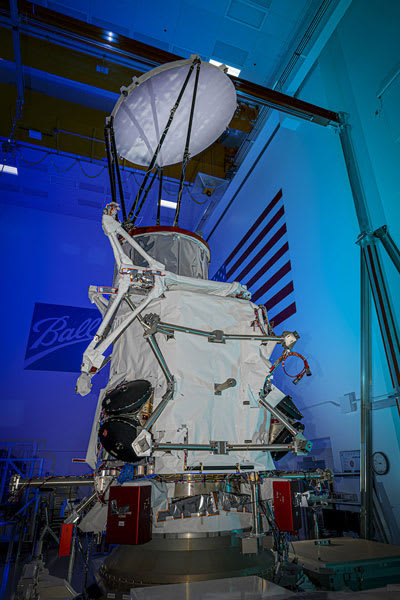
Ball Aerospace completed the spacecraft bus for the Weather System Follow-on-Microwave (WSF-M) satellite, the U.S. Space Force's next-generation operational environmental satellite system. Ball also finalized environmental testing on the Microwave Imager (MWI) instrument and has started final space vehicle assembly, integration and testing.
Upon delivery, WSF-M will provide mission data to Department of Defense's (DoD) environmental prediction systems that support all warfighter domains. In addition, it will broadcast real-time, actionable environmental intelligence to on-going military operations across the globe.
"The nearly simultaneous completion of the spacecraft bus and instrument testing mark a significant milestone for the WSF-M program," said Hope Damphousse, Vice President, Strategic Operations, Ball Aerospace. "We are moving forward with spacecraft integration of the MWI sensor, along with a government-furnished Energetic Charged Particle (ECP) sensor, which will be followed by a suite of space vehicle performance and environmental tests."
At the heart of the WSF-M payload is the Ball-built MWI sensor that takes calibrated passive radiometric measurements at multiple microwave frequencies to measure sea surface winds, tropical cyclone intensity and additional environmental data. The ECP sensor will provide critical space weather measurements. WSF-M was designed to mitigate three high-priority DoD Space-Based Environmental Monitoring (SBEM) gaps: ocean surface vector winds, tropical cyclone intensity and the space weather gap, low Earth orbit (LEO) energetic charged particles.
It will also address three additional SBEM gaps: sea ice characterization, soil moisture and snow depth. Ball Aerospace was recently awarded the contract modification to develop and build the second WSF-M space vehicle, expected to be completed by late 2027.
Ball Aerospace has played key roles on numerous operational weather satellite programs. Its Ozone Mapping and Profiler Suite (OMPS) instruments are operating on the Ball-built Suomi NPP and NOAA-20 satellites, launched in 2011 and 2017, respectively. OMPS is also on board the Joint Polar Satellite System-2 (JPSS-2), which launched on November 10, 2022. Ball is on contract with NASA to build two additional OMPS instruments for JPSS-3 and JPSS-4.
The Ball-built Ion Velocity Meter (IVM) space weather sensors are flying on five of the six Constellation Observing System for Meteorology, Ionosphere and Climate-2 (COSMIC-2) satellites, a joint program with the U.S. Air Force, U.S. Space Force, Taiwan's National Space Organization, NOAA and the University Corporation for Atmospheric Research that launched in 2019.
More From SAE Media Group


Aerospace & Defense Tech Briefs
Navigation Unit

Aerospace & Defense Tech Briefs
Designing, Developing and Deploying CubeSats
Aerospace & Defense Tech Briefs
Pushing the Boundaries of Rapid Production of Spacecraft: Flight Results from NearSpace Launch’s TROOP and ThinSat Platforms
Aerospace & Defense Tech Briefs
Ball Aerospace Awarded Contract for Ion Velocity Meter
Aerospace & Defense Tech Briefs
CubeSat Spacecraft


Aerospace & Defense Tech Briefs
NanoAvionics Satellite Suffers Space Debris Impact, Selfie Image Shows Damage
NASA Spinoff
Make Way for Satellites
NASA Spinoff
Keeping the Connection
Tech Briefs
Answering the Call of Distress
Aerospace INSIDER
Boeing to Develop New Space Force Nuclear Communications Satellites
Aerospace INSIDER
Aitech’s New Palm-Sized Satellite Enables Space-Based AI Processing
Tech Briefs
Getting NASA Data to the Ground with Lasers
Aerospace & Defense Tech Briefs
Solar-Powered Satellite Hardware in Orbit

NASA Spinoff
Unfurling Antennas Let Tiny Satellites Do Big Things
Photonics & Imaging Technology INSIDER
NASA’s First Two-Way End-to-End Laser Communications Relay System


Aerospace & Defense Tech Briefs
NASA Demonstrates a First-of-Its-Kind Space Communications
Aerospace & Defense Tech Briefs
NASA Eyes GPS at the Moon for Artemis Missions
Top Stories
NewsRF & Microwave Electronics
 Microvision Aquires Luminar, Plans Relationship Restoration, Multi-industry Push
INSIDERAerospace
 A Next Generation Helmet System for Navy Pilots
INSIDERDesign
 New Raytheon and Lockheed Martin Agreements Expand Missile Defense Production
INSIDERMaterials
 How Airbus is Using w-DED to 3D Print Larger Titanium Airplane Parts
NewsPower
 Ford Announces 48-Volt Architecture for Future Electric Truck
ArticlesAR/AI

Webcasts
Electronics & Computers
 Cooling a New Generation of Aerospace and Defense Embedded...
Automotive
 Battery Abuse Testing: Pushing to Failure
Power
 A FREE Two-Day Event Dedicated to Connected Mobility
Unmanned Systems
 Quiet, Please: NVH Improvement Opportunities in the Early Design Cycle
Automotive
 Advantages of Smart Power Distribution Unit Design for Automotive &...
Energy
 Sesame Solar's Nanogrid Tech Promises Major Gains in Drone Endurance