




Model Development Using Accelerated Simulations of Hypersonic Flow Features
This code enables more accurate models for computational fluid dynamics applications.
Currently, the two main computational tools used by the aerothermodynamics community to model hypersonic flows are Computational Fluid Dynamics (CFD), and the direct simulation Monte Carlo (DSMC) particle method. Both use essentially the same physical models for rotational-vibrational excitation and dissociation phenomenon, which are based on a limited number of near-equilibrium experiments performed at low temperatures.
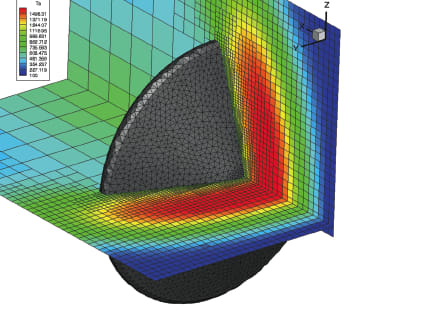
The purpose of this work was to develop a new modeling capability, based on computational chemistry, to provide a more fundamental understanding and develop more accurate thermochemical models for CFD and DSMC. A parallel DSMC code called the Molecular Gas Dynamic Simulator (MGDS) code, was developed that uses an embedded three-level Cartesian flow grid with automated adaptive mesh refinement (AMR). The refinement is arbitrary (non-binary) and enables accurate and efficient simulations with little user input. In addition, MGDS contains a robust “cut-cell” subroutine that cuts complex 3D geometry from the background Cartesian grid and exactly computes the volumes of all cut cells. Combined within a DSMC solver, these two features enable molecular-level physics to be applied to real engineering problems.
In addition to the practicality for complex 3D flows, the DSMC code acts as a bridge between computational chemistry modeling and continuum fluid mechanics. With existing parallel computer clusters, DSMC is able to perform near-continuum simulations using only molecular physics models. Pure computational chemistry of simulation of shock waves and shock layers is computationally feasible with modest parallel computing resources (100 core processors for a few days). Such simulations, which are referred to as “all-atom molecular dynamics” (MD) simulations, require only a potential energy surface (PES) that dictates the interaction forces between individual atoms as the model input. Thus, unlike DSMC or CFD, no models for viscosity, diffusion, thermal conductivity, internal energy relaxation, chemical reactions, cross-sections, or state-resolved probabilities/ rates are required. Rather, every real atom in the system is simulated.
The methodology was validated with experimental data for shock structure in mixtures of noble gases and diatomic nitrogen. All-atom MD simulations of nitrogen discovered clear “direction-dependence” of translational-rotational energy transfer that is not captured by existing models. Compressing flows involve fast rotational excitation, whereas expanding flows involve slower relaxation for the same equilibrium temperature. A new model for both DSMC and CFD reproduces experimental data and is consistent among MD, DSMC, and CFD.
A combined MD-DSMC technique replaces the collision model in DSMC with MD trajectories. The method reproduces exactly pure MD results. This is a significant advancement that enables simulation of axisymmetric and 3D flows where a potential energy surface is the only model input. Thus, the accuracy of pure MD is maintained for full flow fields, directly linking computational chemistry with aerothermodynamics.
This work was done by Thomas E. Schwartzentruber of the University of Minnesota for the Air Force Office of Scientific Research. AFRL-0226
This Brief includes a Technical Support Package (TSP).
Model Development Using Accelerated Simulations of Hypersonic Flow Features
(reference AFRL-0226) is currently available for download from the TSP library.
Don't have an account?
More From SAE Media Group
Aerospace & Defense Tech Briefs
Surviving the Challenge of Thermal Design in Aerospace Electronics
Tech Briefs
Los Alamos National Laboratory
Aerospace & Defense Tech Briefs
Thermal Trends and Improvements for Rugged COTS Cards
Aerospace & Defense Tech Briefs
Rotorcraft Icing Computational Tool Development
Aerospace & Defense Tech Briefs
Aeroacoustic Simulation Delivers Breakthroughs in Aircraft Noise Reduction
Tech Briefs
Rocket Nozzle Side-Load Analysis Software
Aerospace & Defense Tech Briefs
Terrain Model as an Interface for Real-Time Vehicle Dynamics Simulations
Aerospace & Defense Tech Briefs
Bringing Turbine Power to Small Aircraft
Aerospace & Defense Tech Briefs
Reduced Order Modeling for Rapid Simulation of Blast Events of a Military Ground Vehicle and its Occupants
Air Force Research Laboratory Technology Horizons
Unified Flow Solver
Aerospace & Defense Tech Briefs
Comparing Blade-Element Momentum Modeling to 3-D CFD
Aerospace & Defense Tech Briefs
UGVs — On the Cutting Edge of Thermal Management
Aerospace & Defense Tech Briefs
A Supercomputer for Aerospace and Defense Systems Modeling and Simulation
Aerospace & Defense Tech Briefs
R/V Athena Model (5365) Response in Waves
Aerospace & Defense Tech Briefs
Optimizing Thermal Management to Meet SWaP-C Requirements
Tech Briefs
Macroflash Cup Cryostat
Aerospace & Defense Tech Briefs
Multi-Temporal Analysis of Underbody IED Theater Events on Ground Vehicles
Aerospace & Defense Tech Briefs
Characterization of Bore Temperatures and Stresses in Small Caliber Gun Barrels
Software Tech Briefs
Multiphysics Analysis of a Burning Candle
NASA Spinoff
Software Toolkit Steadies Rockets
Aerospace & Defense Tech Briefs
Aerodynamic Modeling of a Flapping Wing Unmanned Aerial Vehicle
Aerospace & Defense Tech Briefs
Blast-Induced Acceleration in a Shock Tube
Aerospace & Defense Tech Briefs
Real-Time, High-Fidelity Simulation of Autonomous Ground Vehicle Dynamics
Aerospace & Defense Tech Briefs
New Cyber Algorithm Shuts Down Malicious Robotic Attacks
Tech Briefs
Extrans Permeation Measurement System

Motion Control Technology
Computational Fluid Dynamics Aids Aerospace Apps
Aerospace & Defense Tech Briefs
Infusing Lightweight Composite Structures
Aerospace & Defense Tech Briefs
Pumped Two-Phase Cooling for Thermal Management of High Heat Flux Electronics
Aerospace & Defense Tech Briefs
Thermal Ground Planes Optimizing Heat Transfer in Aerospace and Defense Applications
Overview
The document titled "Internal Energy Transfer and Dissociation Model Development Using Accelerated First-Principles Simulations of Hypersonic Flow Features" is a final report detailing research conducted under the Young Investigator Program from April 15, 2010, to April 14, 2013. Authored by Thomas E. Schwartzentruber, the report focuses on advancements in computational chemistry techniques aimed at understanding hypersonic flows, particularly in the context of high-temperature dissociated air.
The primary objective of the research was to develop comprehensive gas-phase collision models that can be utilized in Direct Simulation Monte Carlo (DSMC) and Computational Fluid Dynamics (CFD) methods. The study highlights the limitations of previous research, which often involved a restricted number of simulated molecules and high-density conditions. The proposed research aims to overcome these limitations by creating accelerated molecular dynamics (MD) methods specifically designed for dilute gases. These methods allow for the direct incorporation of state-of-the-art interatomic potentials, which govern the interactions between atoms, thereby enhancing the accuracy of simulations.
A significant achievement of the research is the demonstration of accelerated MD simulations capable of modeling 2D and 3D flow fields, focusing solely on atomic interactions without the need for collision or rate models. This advancement enables a more profound understanding of energy exchange and reaction processes in hypersonic flows, particularly under conditions of strong thermochemical nonequilibrium.
The report emphasizes the importance of integrating new developments in computational chemistry with existing simulation techniques to create models that are consistent across various scales, from molecular dynamics to experimental validation. This integration is crucial for advancing the understanding of hypersonic flows at a fundamental level, which has significant implications for aerospace applications.
In summary, the report outlines a comprehensive approach to improving the modeling of hypersonic flows through advanced computational techniques. By developing new methodologies that enhance the simulation of gas-phase interactions, the research contributes to a deeper understanding of the complex phenomena associated with hypersonic flight, paving the way for future advancements in aerospace engineering and related fields.
Top Stories
INSIDERManufacturing & Prototyping
 How Airbus is Using w-DED to 3D Print Larger Titanium Airplane Parts
INSIDERManned Systems
 FAA to Replace Aging Network of Ground-Based Radars
NewsTransportation
 CES 2026: Bosch is Ready to Bring AI to Your (Likely ICE-powered) Vehicle
NewsSoftware
 Accelerating Down the Road to Autonomy
EditorialDesign
 DarkSky One Wants to Make the World a Darker Place
INSIDERMaterials
 Can This Self-Healing Composite Make Airplane and Spacecraft Components Last...
Webcasts
Defense
 How Sift's Unified Observability Platform Accelerates Drone Innovation
Automotive
 E/E Architecture Redefined: Building Smarter, Safer, and Scalable...
Power
 Hydrogen Engines Are Heating Up for Heavy Duty
Electronics & Computers
 Advantages of Smart Power Distribution Unit Design for Automotive...
Unmanned Systems
 Quiet, Please: NVH Improvement Opportunities in the Early Design...
