




Blast-Induced Acceleration in a Shock Tube
High-fidelity simulation of blast flow conditions can aid in developing strategies to mitigate blast-induced brain injury.
The prevalence of blast-induced traumatic brain injury (bTBI) has prompted an urgent need to develop improved mitigation strategies and advance medical care targeting casualties with bTBI. Despite considerable effort, the basic mechanisms of blast-induced brain injury are still undefined. Based largely upon computational modeling, several candidate mechanisms of nonimpact bTBI have been identified and include head acceleration. This work hypothesizes that explosion flow conditions can cause head acceleration sufficient to injure the brain, and that these inertial forces combine with other injury mechanisms to yield bTBI.
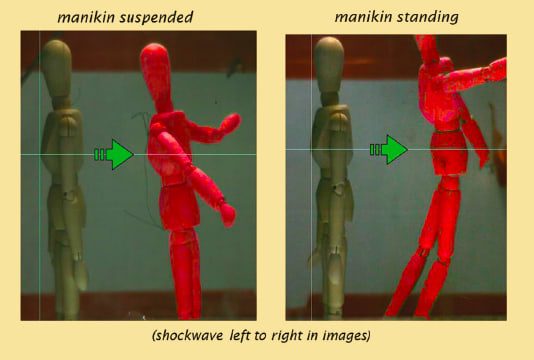
An explosive shockwave is unlike any other conventional mode of loading, and will impart both an abrupt transient crushing action (i.e. static pressure) that envelops the head, as well as some aerodynamic drag (i.e. dynamic pressure creating blast wind). Controversies and confusion concerning the contributions of blast-induced head acceleration to bTBI have in great part resulted from laboratory studies in which blast was inappropriately simulated, and head acceleration was likely, in many cases, an experimental artefact uniquely associated with those particular exposure conditions. In particular, positioning experimental subjects at or near the mouth of the shock tube exposes them to endjet conditions; practically all flow energy is converted to a collimated jet at the shock tube exit, yielding extreme dynamic pressure and negligible static pressure as end wave rarefaction abruptly reduces static pressure and greatly accelerates flow. In addition, cylindrical shock tubes characteristically produce shock waves with flat tops and greater-duration positive phases, which will yield unscaled drag forces greatly exceeding those occurring with an explosion in the free field. Discerning the loading conditions and role of acceleration in blastinduced TBI requires careful monitoring and validation of the fidelity of the experimental model; as noted, creation of an injury does not constitute validation of an injury model.
As a first step toward understanding the head motion of soldiers exposed to a typical IED blast (<10 msec positive phase duration), high-speed video recording was utilized to record the motion imparted by the passage of an air shockwave in an advanced blast simulator (ABS) to various inanimate spherical objects of different areal densities, and to an articulated body represented by a 1-foot-tall wooden artist manikin of a human form. Test objects were carefully suspended in the test section of the ABS by a thread that immediately detached upon arrival of the shock front. Spheres ranged in size from 0.75" diameter steel ball bearings to a 10" Synbone head form ballasted by water to approximate the global shape and mass of a human head. Blast exposures were standardized to a 13 psi by 5 msec waveform.
Velocity of spheres as a function of acceleration coefficient areal density (i.e. total mass/surface area) presented to the oncoming shockwave is considered as the dominant factor affecting blast-drag studies, and its inverse is known as the acceleration coefficient. The blast-induced velocities of spheres with a wide range of mass and size were tracked as a function of these coefficients. In all cases, blast-induced motion was imparted almost immediately (<1 msec), and terminal velocities were reached long before the end of the positive phase of the shock wave, confirming that displacement was dominated by the diffraction phase and had no relation to the quasi-steady drag forces (i.e. dynamic pressure impulse and blast wind) as has been popularly accepted.
This work was done by Dr. Joseph B. Long of The Geneva Foundation for the Army Medical Research and Materiel Command. ARL-0186
More From SAE Media Group
Aerospace & Defense Tech Briefs
WIAMan
Aerospace & Defense Tech Briefs
Terrain Model as an Interface for Real-Time Vehicle Dynamics Simulations
Motion Control Tech Briefs
First-Order Theory of Control of Motion of a Crane and Load
Medical Design Briefs
Safer Helmets Reduce Potential for Traumatic Injury
Aerospace & Defense Tech Briefs
Reduced Order Modeling for Rapid Simulation of Blast Events of a Military Ground Vehicle and its Occupants
Aerospace & Defense Tech Briefs
Modular Biosensor Patch
Aerospace & Defense Tech Briefs
Shaking Outside the Box to Advance Flight Research
Aerospace & Defense Tech Briefs
Software Tool Enables High-Fidelity Simulation of Explosive Device Effects

Tech Briefs
2025 Award Finalists


Aerospace & Defense Tech Briefs
Experimental Confirmation of an Aquatic Swimming Motion Theoretically of Very Low Drag and High Efficiency

Aerospace & Defense Tech Briefs
Notre Dame’s New Boundary Breaking Mach 10 Quiet Wind Tunnel
Aerospace & Defense Tech Briefs
Model Development Using Accelerated Simulations of Hypersonic Flow Features
Tech Briefs
2023 Create the Future Design Contest
Tech Briefs
Magazine Archives
Aerospace & Defense Tech Briefs
Peridynamic Modeling: An Alternative Approach to Analyzing Material Failure
Aerospace & Defense Tech Briefs
Green’s Function Extraction from Atmospheric Acoustic Propagation
Aerospace & Defense Tech Briefs
Computer Simulation’s Role in Advancing Composite Aircraft Structures
Aerospace & Defense Tech Briefs
F-16 Full Mission Trainers
Aerospace & Defense Tech Briefs
Aerodynamic Modeling of a Flapping Wing Unmanned Aerial Vehicle
Tech Briefs
2025 Rising Star Awards Winners
Tech Briefs
Rising Star Awards 2025 Judges
Tech Briefs
Fluid Mechanics Comes to Life in 3D

Aerospace & Defense Tech Briefs
Redesign of composite parts for structural integrity

Top Stories
NewsRF & Microwave Electronics
 Microvision Aquires Luminar, Plans Relationship Restoration, Multi-industry Push
INSIDERAerospace
 A Next Generation Helmet System for Navy Pilots
INSIDERDesign
 New Raytheon and Lockheed Martin Agreements Expand Missile Defense Production
INSIDERMaterials
 How Airbus is Using w-DED to 3D Print Larger Titanium Airplane Parts
NewsPower
 Ford Announces 48-Volt Architecture for Future Electric Truck
ArticlesAR/AI

Webcasts
Electronics & Computers
 Cooling a New Generation of Aerospace and Defense Embedded...
Automotive
 Battery Abuse Testing: Pushing to Failure
Power
 A FREE Two-Day Event Dedicated to Connected Mobility
Unmanned Systems
 Quiet, Please: NVH Improvement Opportunities in the Early Design Cycle
Automotive
 Advantages of Smart Power Distribution Unit Design for Automotive &...
Energy
 Sesame Solar's Nanogrid Tech Promises Major Gains in Drone Endurance