




Polymer Matrix Composite Materials for a Structural Multifunctional Fuel Cell
Structural materials that provide power-generating or energy-storing capacity could provide weight savings over a range of platforms.
A structural multifunctional fuel cell design enables material elements participating in power or energy processes to also carry significant structural loads. Power and energy components require combinations of materials and components such as dielectrics, electrical conductors, and catalytic or reactive surfaces. Polymer matrix composite (PMC) materials were chosen because they are inherently multi-material systems and are well suited to these complex systems. Secondly, composite material processing provides a great degree of fabrication flexibility. PMC processing requires relatively low temperatures, thus preventing damage to embedded components; it can accommodate complex geometries and sub-components and is scalable to manufacturing settings.
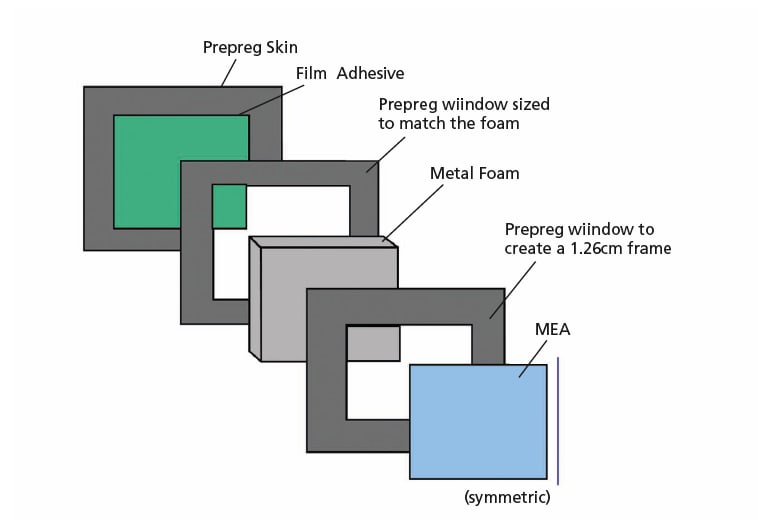
The overall skin-core sandwich structure is a common design approach for creating light structures with high bending stiffness. This stiffness is partly achieved by a core material with a good shear strength. The shear strength of the core allows for load distribution across the sandwich structure. In the case of the multifunction fuel cell, shear strength of the core and the resulting bending stiffness are a challenge because of the presence of the MEA layer along the core shear plane. To investigate this effect, mechanical studies are performed on fuel cell composites with adhesive layers positioned at various planar positions within the core. Other core mechanical properties can be tailored if the characteristic pore size and wall thickness of the foam core are varied. These foam characteristics also influence flow permeability and electrical contact with the MEA, which could have an effect on power performance.
The development of a structural multifunctional fuel cell was separated into mechanical performance and power performance investigations. Testing and designs were evaluated separately to identify key parameters that affect each area of performance. The best parameters from each area of investigation were then combined to fabricate a nearly optimized structural multifunctional fuel cell.
The multifunctional fuel cell is produced via a single-step composite fabrication technique. The skins of the structure are constructed from unidirectional Bryte Tech AS4 carbon fiber-epoxy pre-impregnated fibers (prepreg). The foam is 6.35-mm-thick aluminum foam with densities (relative to bulk aluminum) of 6%, 12%, and 20% and pores per inch (ppi) of 10, 20, and 40. Increasing ppi corresponds to a decrease in the characteristic pore size, while increasing density at fixed ppi corresponds to compressing the foam so that the cells begin to collapse onto one another. The foam is adhesively bonded to the skins with an epoxy film adhesive. The MEA is comprised of Nafion 117 sandwiched between layers of carbon cloth with a platinum-ruthinia (Pt/Ru) catalyst layer. The carbon cloth serves as the gas diffusion layer (GDL). The aluminum foam serves as the anode and cathode current collectors.
The figure shows the layer-by-layer assembly of the basic fuel cell design. All the prepreg plies are overlaid by hand in a continuous 0° or 90° configuration. Four individual ply laminates form the base skin. On top of this skin is a layer comprised of a window of prepreg and an adhesive film. The first prepreg window interior dimensions are sized to match the width and length of the metal foam, and the adhesive film is fabricated to fit into the window. This first prepreg window helps to build up the composite thickness and prevent curvature of the final prepreg skin layers. The metal foam is placed onto the adhesive and a second prepreg window is placed over the foam. This second prepreg window overlaps the metal foam by 1.26 cm. The MEA completes the sandwich structure and lies directly on the second prepreg window. The entire sandwich is symmetrically constructed about the MEA.
Mechanical performance was evaluated by examining eight variables: foam porosity, foam density, location of film adhesive, location of the midplane, incorporation of adhesive strips, integration of an interlocking foam design, and length of the outer skin overlap at the edges of the cell. The mechanical interlock approach was investigated as a means to increase the shear strength of composite. The combination of interlocking and adhesive strips allows for a potential synergistic effect. The length of the overlap investigated the effect of the length of composite exposed along the edge of the fuel cell. The baseline configuration for all of the mechanical testing was 20 ppi, 6% density, top-bottom adhesive, neutral midplane, no adhesive strips or interlocking foam, and an outer edge overlap of 12.7 mm.
Bending stiffness generally increased with foam density and porosity. Increased composite bending stiffness with increased foam density was likely solely attributable to an increase in foam bending stiffness with increasing foam density. Increasing foam porosity from 10 to 20 ppi increased the bending stiffness of the composite. A further increase in porosity to 40 ppi resulted in a decrease in composite bending stiffness, but the 40-ppi sample’s stiffness was still higher than that of the 10-ppi sample and was within standard deviation of the 20-ppi sample. Since the density of all three foams was 6%, the pore size decreased as porosity increased. Decreased pore size results in increased number of cell edges and decreased cell edge length, likely creating a stiffer microstructure and overall stiffer foam.
The mechanical and power performance testing showed that the best overall structural multifunctional fuel cell performance would be obtained with foams that have higher porosity or higher density. However, the use of higher density foam may become a limiting factor because of a lower power-to-weight ratio; thus, foams with a higher porosity may be favorable.
This work was done by Joseph South, Daniel Baechle, Corydon Hilton, Daniel DeSchepper, and Eric Wetzel of the Army Research Laboratory.
ARL-0046
This Brief includes a Technical Support Package (TSP).
Polymer Matrix Composite Materials for a Structural Multifunctional Fuel Cell
(reference ARL-0046) is currently available for download from the TSP library.
Don't have an account?
More From SAE Media Group
Tech Briefs
Conductive Carbon Fiber Polymer Composite
Tech Briefs
Advanced Carbon Aerogels for Energy Applications


Medical Design Briefs
Conductive, Cotton-Based Fiber for Smart Textiles

Tech Briefs
Fiber-Metal Laminate Manufacturing Technique



Tech Briefs
Precision CNT Cutting Mechanism
Tech Briefs
Healable Carbon Fiber Composite

Aerospace & Defense Tech Briefs
Tomographic Electrical Resistance-Based Damage Sensing in Nano-Engineered Composite Structures



Aerospace Manufacturing and Machining
Scaling Low-Cost Carbon Fiber Production with Oxidation Technology
Aerospace & Defense Tech Briefs
Aligned MWCNTs as Thermal Conductors in Adhesive Joints
Aerospace & Defense Tech Briefs
Biobased Carbon Fibers and Thermosetting Resins for Use in DOD Composites Applications


Aerospace & Defense Tech Briefs
Biobased Carbon Fibers and Thermosetting Resins for Use in DOD Composites Applications

Air Force Research Laboratory Technology Horizons
Conductive Polymeric Nanocomposite Materials

Aerospace & Defense Tech Briefs
‘Nanostitches’ Enable Lighter and Tougher Composite Materials
Aerospace & Defense Tech Briefs
Processing and Characterization of Lightweight Syntactic Materials
Overview
The document titled "Design and Response of a Structural Multifunctional Fuel Cell," authored by Joseph South and colleagues, is a technical report published by the U.S. Army Research Laboratory in March 2008. It focuses on the development and analysis of a structural multifunctional fuel cell, which integrates energy generation with structural capabilities, potentially enhancing the performance and efficiency of military systems.
The report outlines the objectives of the research, which include exploring innovative designs that allow fuel cells to serve dual purposes—acting as both an energy source and a structural component. This multifunctionality is particularly relevant in military applications, where weight and space are critical factors. The authors discuss the mechanical and power performance of the fuel cells, providing insights into how these systems can be optimized for better efficiency and durability.
The document is structured into several sections, including a discussion on mechanical performance, which examines the structural integrity and resilience of the fuel cells under various conditions. The power performance section evaluates the energy output and efficiency of the fuel cells, highlighting the importance of these metrics in practical applications.
The report also includes a conclusion that summarizes the key findings and implications of the research, emphasizing the potential benefits of integrating multifunctional fuel cells into military operations. The authors suggest that such advancements could lead to significant improvements in energy management and operational effectiveness.
Additionally, the report contains a references section, which provides citations for the sources and studies that informed the research. This adds credibility to the findings and allows readers to explore the topic further.
Overall, the document presents a comprehensive overview of the design and response characteristics of structural multifunctional fuel cells, showcasing their potential to revolutionize energy solutions in military contexts. The research underscores the importance of innovation in fuel cell technology and its implications for future applications, making it a valuable resource for researchers and practitioners in the field.
Top Stories
INSIDERManufacturing & Prototyping
 How Airbus is Using w-DED to 3D Print Larger Titanium Airplane Parts
INSIDERManned Systems
 FAA to Replace Aging Network of Ground-Based Radars
NewsTransportation
 CES 2026: Bosch is Ready to Bring AI to Your (Likely ICE-powered) Vehicle
NewsSoftware
 Accelerating Down the Road to Autonomy
EditorialDesign
 DarkSky One Wants to Make the World a Darker Place
INSIDERMaterials
 Can This Self-Healing Composite Make Airplane and Spacecraft Components Last...
Webcasts
Defense
 How Sift's Unified Observability Platform Accelerates Drone Innovation
Automotive
 E/E Architecture Redefined: Building Smarter, Safer, and Scalable...
Power
 Hydrogen Engines Are Heating Up for Heavy Duty
Electronics & Computers
 Advantages of Smart Power Distribution Unit Design for Automotive...
Unmanned Systems
 Quiet, Please: NVH Improvement Opportunities in the Early Design...
