




Mechanical Response of an Al-PTFE Composite to Uniaxial Compression Over a Range of Strain Rates and Temperatures
Reactive materials are mechanically robust and can serve as substantial structural components.
Reactive materials can be loosely categorized as composites of inert solid materials which, when subjected to a violent mechanical stimulus such as an impact, react exothermally with a rapid release of energy. This reaction, while aptly described as “explosive,” differs from a true detonation or deflagration in that it requires a mechanical stimulus to not only initiate the reaction but also to sustain it. Such materials can also be fairly robust mechanically and can serve as substantial structural components. Because of these properties, reactive materials have a number of potential ordnance applications. Various compositions have been investigated to tailor properties of reactivity, strength, and density to suit particular needs.

Low-rate tests were performed with an Instron Model 1331 servo-hydraulic load frame. The load applied to the specimen was measured with a load cell, and the specimen deformation was measured using a linear variable differential transformer (LVDT) measurement of the cross-head displacement, and includes a correction for machine compliance. The specimens were cylindrical, nominally 6.35 mm in both diameter and length. Contact surfaces were lubricated with a heat-stable silicone lubricant. All of the low-rate tests were performed at room temperature (22 °C).
A 6.35-mm-diameter 7075-T6 aluminum Split Hopkinson Pressure Bar (SHPB) was used for the high-rate tests. A series of six tests was performed at rates from 600 to 8000/s, all initially at room temperature (22 °C). The specimens were cylindrical, 3.18 mm in diameter and length, and contact surfaces were lubricated with the same silicone lubricant used in the low-rate tests.
A final set of experiments was performed at elevated temperatures to quantify the thermal softening behavior of the material. These were performed at a consistent strain rate of 4000/s using the SHPB. Heating was accomplished by circulating heated air into a chamber that enclosed the specimen and the adjacent ~65 mm sections of the bars. Ideally, specimen temperature would have been monitored directly with a thermocouple glued to each specimen. However, this proved impractical because of the small sample size and also because of the difficulty in adhering gages to the specimen. Instead, specimen temperature was measured with a thermocouple probe placed within 1 cm of the specimen; i.e., the probe measures ambient air temperature and not the specimen temperature directly. The temperature in the chamber was allowed to equilibrate over a 20-minute period prior to each test to ensure that the specimen and relevant sections of the bars were allowed to reach the ambient temperature. The temperature gradient in the bars is believed to have negligible effects on the bar wave propagation and the strain gage measurements. Temp erature measurements made in this way are estimated to be accurate to within ±2 °C.
Figure 1 shows the engineering stress-strain curves obtained from the room-temperature tests. Because of the brief duration of the deformation, the high rate curves (600/s and beyond) are considered adiabatic. In contrast, the lowest rate curves, 0.001 and 0.01/s, are considered isothermal. The intermediate rate, at 0.1/s, is probably somewhere between the two limits.
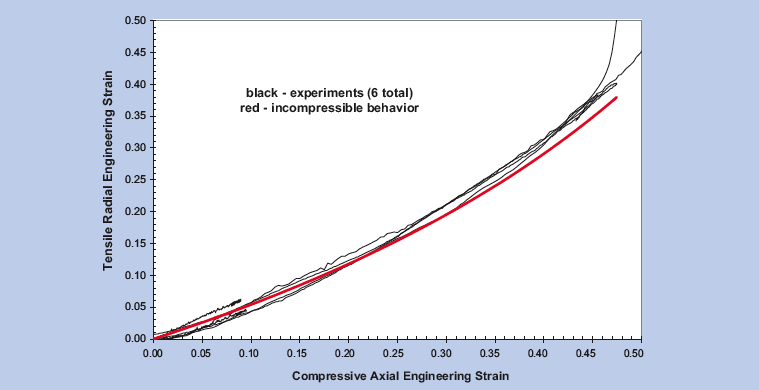
Figure 2 shows the tensile radial engineering strain as measured by the laser extensometer as a function of compressive axial engineering strain for the six SHPB experiments shown in Figure 1. These are plotted as thin black curves. The heavy red curve is the relationship that would result from incompressible deformation. The agreement is good, and what deviation can be measured could easily be explained by barreling.
Data was fitted to the JC and MJC constitutive equations. These models were chosen primarily because of their widespread use, and not necessarily because they are particularly well suited to this material.
Zerilli and Armstrong have developed constitutive models for metals based on thermally activated dislocation motion. Recently, they have adapted the basic framework to apply to viscoplastic deformation of polymers. They have used it to model PTFE, and Cai et al. have used it to model a composite mixture of PTFE-Al-W. Based on the success of these applications, it was decided to use this model to represent the present data. Although the model is physically based, the approach taken here is to treat it as a curve fit; i.e., the values presented below may not necessarily be realistic beyond the observation that they match the existing data.
This work was done by Daniel T. Casem of the Army Research Laboratory. ARL-0051
This Brief includes a Technical Support Package (TSP).
Mechanical Response of an Al-PTFE Composite to Uniaxial Compression
(reference ARL-0051) is currently available for download from the TSP library.
Don't have an account?
More From SAE Media Group
Air Force Research Laboratory Technology Horizons
New Capability to Characterize the Mechanical Properties of Explosive Materials
Aerospace & Defense Tech Briefs
Processing and Characterization of Lightweight Syntactic Materials
Tech Briefs
Self-Healing Aluminum Metal Matrix Composite
Aerospace & Defense Tech Briefs
Hierarchical Diamond-Based Ceramic Composites
Tech Briefs
Virtual Test Laboratory

Aerospace & Defense Tech Briefs
Hydraulic Testing of Polymer Matrix Composite 102mm Tube Section
Medical Design Briefs
Biomedical Balloons: Understanding Their Physical and Mechanical Properties
Automotive Engineering
Tesla’s Cybertruck Is Audaciously Austenitic
Aerospace & Defense Tech Briefs
Solving Signal Interference Challenges in Aerospace and Defense Electronics
Aerospace & Defense Tech Briefs
Spectrum Fatigue of 7075-T651 Aluminum Alloy Under Overloading and Underloading
Tech Briefs
Automated Tow/Tape Placement System
Aerospace & Defense Tech Briefs
Designing Sensory and Adaptive Composite Materials
Medical Design Briefs
Impact-Modified Acrylic Copolymers: Evaluating Chemical Resistance
Automotive Engineering
Constellium Develops New Alloys for EV Battery Enclosures
Aerospace & Defense Tech Briefs
Multi-Scale Analysis of Deformation and Failure in Polycrystalline Titanium Alloys Under High Strain Rates

Aerospace & Defense Tech Briefs
Evaluation of Additively Manufactured Ultrahard Steels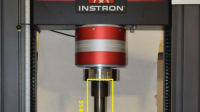
Automotive Engineering
Virtual and Physical Testing of Third-Generation High Strength Steel

Tech Briefs
Method Pinpoints Microscale Damage in Metal
Automotive Engineering
Accelerating Materials Development with Quantum Computing
Tech Briefs
Color-Changing Dyes Visualize Stress in Plastics
Automotive Engineering
Lightweight Steel on a (Cold) Roll
Aerospace & Defense Tech Briefs
Plasma Electrolytic Oxidation: The Future of Lightweight Designs in Aerospace and Defense
Aerospace & Defense Tech Briefs
High-Strain-Rate Tests of Epoxy/Aluminum-Powder Composites
Aerospace & Defense Tech Briefs
Molded RF Materials for Hypersonic Sensors and Seekers
Overview
The document titled "Mechanical Response of an Al-PTFE Composite to Uniaxial Compression Over a Range of Strain Rates and Temperatures" presents a detailed investigation into the mechanical properties of an aluminum-polytetrafluoroethylene (Al-PTFE) composite. Conducted by the U.S. Army Research Laboratory, the study aims to understand how this composite material behaves under different strain rates and temperature conditions, which is crucial for its applications in military and defense sectors.
The report is structured into several key sections, beginning with an introduction that outlines the significance of studying the mechanical response of composite materials. The experimental procedure is divided into low-rate and high-rate tests, as well as temperature tests. Low-rate tests were performed using a servo-hydraulic load frame, measuring the load applied to cylindrical specimens and their deformation at room temperature (22 °C). High-rate tests and temperature tests are also mentioned, indicating a comprehensive approach to understanding the material's behavior under various conditions.
Results from the experiments are presented, showcasing the mechanical properties of the Al-PTFE composite, including its strength and deformation characteristics. The report also delves into constitutive modeling, discussing models such as the Johnson-Cook and Modified Johnson-Cook models, as well as the Zerilli-Armstrong model for polymers. These models are essential for predicting the material's behavior under different loading conditions and are critical for applications where precise material performance is required.
The conclusion summarizes the findings, emphasizing the importance of understanding the mechanical response of the Al-PTFE composite for its potential applications. The report also includes references and an appendix that defines strain measures, providing additional context for the research.
Overall, this document serves as a valuable resource for researchers and engineers interested in the mechanical properties of composite materials, particularly in high-performance applications. The findings contribute to the broader field of materials science, offering insights that can enhance the design and application of composites in various engineering fields.
Top Stories
INSIDERManufacturing & Prototyping
 How Airbus is Using w-DED to 3D Print Larger Titanium Airplane Parts
INSIDERManned Systems
 FAA to Replace Aging Network of Ground-Based Radars
NewsTransportation
 CES 2026: Bosch is Ready to Bring AI to Your (Likely ICE-powered) Vehicle
NewsSoftware
 Accelerating Down the Road to Autonomy
EditorialDesign
 DarkSky One Wants to Make the World a Darker Place
INSIDERMaterials
 Can This Self-Healing Composite Make Airplane and Spacecraft Components Last...
Webcasts
Defense
 How Sift's Unified Observability Platform Accelerates Drone Innovation
Automotive
 E/E Architecture Redefined: Building Smarter, Safer, and Scalable...
Power
 Hydrogen Engines Are Heating Up for Heavy Duty
Electronics & Computers
 Advantages of Smart Power Distribution Unit Design for Automotive...
Unmanned Systems
 Quiet, Please: NVH Improvement Opportunities in the Early Design...
