




Spectrum Fatigue of 7075-T651 Aluminum Alloy Under Overloading and Underloading
Most structural members and machine components are subjected in service to cyclic loadings of varying amplitude. The variation in stress level follows either a regular or random pattern. The resulting crack growth is affected by the applied load sequence in the early stage (crack initiation) and in the later stage (crack propagation) of fatigue. The fatigue crack growth is known to be retarded by tensile overloads and accelerated by compressive overloads (underloads). However, the phenomenon and mechanism of the load sequence effects, especially those of overloading and underloading, on fatigue crack growth in different environments remain to be clarified.

Structural components are mostly subjected to variable amplitude or spectrum fatigue loading in various service environments. Blades in gas turbine engines experience low-amplitude, high- frequency vibration during operation, superimposed on a relatively smaller number of cycles of fatigue loading due to start-up and shut-down. Railway tracks are subjected to random loading depending on the frequency and loading conditions associated with the passage of trains. The rotors and bearings of a turbo-generator are subjected to an overload (OL) during every start-up. On the ground, the lower wing skin of the aircraft is under compression. During flight, variable loads due to gust are superimposed on a mean tensile load corresponding to an undisturbed flight. The transition from a compressive load on the ground to a tensile load during flight is an important load cycle in itself and is usually referred to as a ground-air-ground cycle.
The fatigue crack growth under spectrum loading is affected by load interaction, such as crack growth acceleration, retardation or even arrest. Due to the load interaction effects, reliability, and life assessment of structural components entails considerable difficulties under spectrum loading. For instance, high OL peaks cause retardation effects whereas underload (UL) peaks accelerate the crack growth and weaken the preceding retardation effect.
To account for the load spectrum effects, cycle-by-cycle fatigue crack growth prediction models were developed. They are divided into three main groups, Willenborg, Wheeler, and UniGrow. The first and second ones consider that the current cyclic crack tip plastic zone develops inside a larger zone created by the preceding OL. Furthermore, the second one is based on crack closure, and includes plasticity-induced crack closure model and strip yield model. Third group, the unified two parameter model is based on the elasticplastic crack tip stress-strain history.
This research was initiated to clarify the fatigue crack growth behavior of a 7075-T651 aluminum alloy under spectrum loading with periodic OL or UL cycles in different environments. A middle-tension M(T) specimen was machined in L-T orientation from a 7075-T651 aluminum alloy extrusion of 127x127x394 mm (5x5x15.5 in.). It was 102 mm (4 in.) wide, 235 mm (9.3 in.) long and 2 mm (0.086 in.) thick, and its center notch was 3 mm (1/8 in.) long. Its mechanical properties were UTS 538 MPa (78 ksi), YS 446 MPa (65 ksi) and elongation 11 percent.
The fatigue tests were conducted under constant amplitude loading and spectrum loading with periodic OL or UL cycles at ambient temperature in an MTS machine. The loading frequency was 5 Hz, the growing crack length 2a was measured, employing direct current potential drop technique, and the fatigue crack growth rate da/dN was computed. Subsequently, half crack length vs. number of loading cycle a vs. N and fatigue crack growth rate vs. stress intensity range da/dN vs. ΔK were plotted.
This work was done by E. U. Lee, R. E. Taylor, and B. Pregger for the Naval Air Warfare Center, Patuxent River, Maryland. NAWC-0002
This Brief includes a Technical Support Package (TSP).
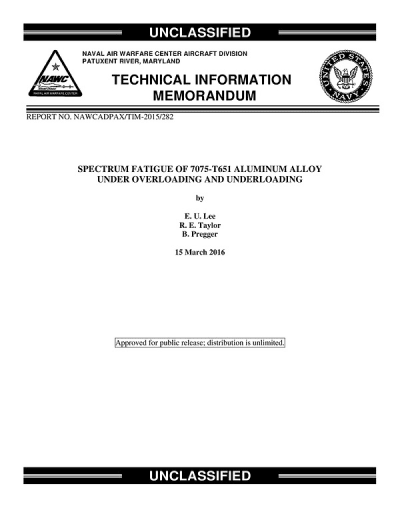
SPECTRUM FATIGUE OF 7075-T651 ALUMINUM ALLOY UNDER OVERLOADING AND UNDERLOADING
(reference NAWC-0002) is currently available for download from the TSP library.
Don't have an account?
More From SAE Media Group
Aerospace & Defense Tech Briefs
Zwick Roell Provides Flexible Materials Testing over a Wide Temperature Range
Tech Briefs
Self-Healing Aluminum Metal Matrix Composite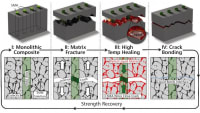
Aerospace & Defense Tech Briefs
SAE International Issues First Technical Standards for Aerospace Additive Manufacturing
Air Force Research Laboratory Technology Horizons
Strain-Induced Porosity Model
Tech Briefs
Method Pinpoints Microscale Damage in Metal
Aerospace & Defense Tech Briefs
Unlocking the Power of Ceramic Matrix Composites
Aerospace & Defense Tech Briefs
Evaluation of Additively Manufactured Ultrahard Steels
Aerospace & Defense Tech Briefs
Plasma Electrolytic Oxidation: The Future of Lightweight Designs in Aerospace and Defense
Aerospace & Defense Tech Briefs
Multi-Scale Analysis of Deformation and Failure in Polycrystalline Titanium Alloys Under High Strain Rates
Aerospace & Defense Tech Briefs
Advancing the Use of Beryllium Bearing Materials for Unmanned Platforms
Aerospace & Defense Tech Briefs
Sensing Applied Load and Damage Effects in Composites with Nondestructive Techniques
Tech Briefs
High-Temperature Ni-Based Superalloy Composition
Aerospace & Defense Tech Briefs
Cold Spray Technology
Aerospace & Defense Tech Briefs
Peridynamic Modeling: An Alternative Approach to Analyzing Material Failure

Aerospace & Defense Tech Briefs
‘Nanostitches’ Enable Lighter and Tougher Composite Materials

Aerospace & Defense Tech Briefs
Thermal Simulation and Testing of Expanded Metal Foils for Lightning Protection
Aerospace & Defense Tech Briefs
Advances in Adhesive Joining of Structural Components Focus of New Book from SAE International
Aerospace & Defense Tech Briefs
Additive Manufacturing Adoption Up, Growing Rapidly in Aerospace

Aerospace & Defense Tech Briefs
Hybrid Ultra-Low VOC and Non-HAP Rain Erosion Coatings
Off-Highway Engineering
NASA Highlights Material and Coating Technology Ready for Commercial Applications
Air Force Research Laboratory Technology Horizons
Characterizing Mechanical Properties at the Microscale
Aerospace & Defense Tech Briefs
Toho Tenax Develops 'Super-Heat-Resistant' Prepreg for Engine Apps
Aerospace INSIDER
New Methods Detect and Predict Fatigue-Related Aircraft Cracks
Aerospace & Defense Tech Briefs
More Bang for the Buck: A New Design and Manufacturing Method for Deep Penetrating Bomb Cases
Automotive Engineering
Lightweight Steel on a (Cold) Roll
Overview
The Technical Information Memorandum (Report No. NAWCADPAX/TIM-2015/282) focuses on the study of spectrum fatigue in the 7075-T651 aluminum alloy, a material widely used in aerospace applications due to its high strength-to-weight ratio. The report, authored by E. U. Lee, R. E. Taylor, and B. Pregger, was published by the Naval Air Warfare Center Aircraft Division and acknowledges support from the Office of Naval Research.
The primary objective of the study is to investigate how the 7075-T651 aluminum alloy behaves under varying loading conditions, specifically overloading and underloading. Spectrum fatigue refers to the material's response to cyclic loading, which is critical for understanding its durability and performance in real-world applications where components are subjected to fluctuating stresses.
The report outlines the methodology used in the experiments, including the specific loading conditions and the parameters measured during testing. The authors emphasize the importance of understanding the fatigue behavior of materials in order to predict their lifespan and ensure safety in aerospace structures.
Key findings from the study indicate that the fatigue life of the 7075-T651 aluminum alloy is significantly affected by the loading spectrum. The results demonstrate that both overloading and underloading conditions can lead to different fatigue mechanisms, which in turn influence the material's overall performance. The report provides detailed data and analysis on how these loading conditions impact crack initiation and propagation, which are critical factors in material failure.
In addition to the experimental results, the report discusses the implications of these findings for engineering practices, particularly in the design and maintenance of aircraft components. The authors suggest that a better understanding of spectrum fatigue can lead to improved predictive models for material behavior, ultimately enhancing the reliability and safety of aerospace structures.
The memorandum concludes with acknowledgments of the support received from the Office of Naval Research and highlights the importance of continued research in this area to advance material science and engineering practices. The document is approved for public release, ensuring that the findings can be shared with the broader scientific and engineering communities.
Top Stories
NewsRF & Microwave Electronics
 Microvision Aquires Luminar, Plans Relationship Restoration, Multi-industry Push
INSIDERAerospace
 A Next Generation Helmet System for Navy Pilots
INSIDERDesign
 New Raytheon and Lockheed Martin Agreements Expand Missile Defense Production
INSIDERMaterials
 How Airbus is Using w-DED to 3D Print Larger Titanium Airplane Parts
NewsPower
 Ford Announces 48-Volt Architecture for Future Electric Truck
ArticlesAR/AI

Webcasts
Electronics & Computers
 Cooling a New Generation of Aerospace and Defense Embedded...
Automotive
 Battery Abuse Testing: Pushing to Failure
Power
 A FREE Two-Day Event Dedicated to Connected Mobility
Unmanned Systems
 Quiet, Please: NVH Improvement Opportunities in the Early Design Cycle
Automotive
 Advantages of Smart Power Distribution Unit Design for Automotive &...
Energy
 Sesame Solar's Nanogrid Tech Promises Major Gains in Drone Endurance