




Strain-Induced Porosity Model
Advanced computer models improve the quality of titanium alloys.
AFRL scientists developed advanced computer models to improve the processing and quality of titanium alloys used in manufacturing gas turbine engine parts and critical structural components for military aircraft. AFRL transferred both the models and the basic materials knowledge to titanium mill suppliers to help them eliminate strain-induced porosity (SIP)—also known as cavitation—in billet products (see Figure 1) and finished parts. The models also increase product yield by reducing the amount of scrap material, which helps lower production costs.
Titanium is a very durable, low-density element (about 60% the density of iron) that gains considerable strength when processed as an alloy or mechanically altered via deformation processing. Because titanium alloys reduce weight and operate very effectively at low to moderately elevated temperatures, engineers have used them as replacements for iron alloys in aerospace applications for many years.
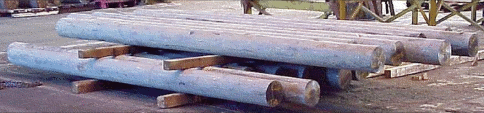
Corrosion-resistant parts and low-weight, high-specific- strength structures represent two typical applications for titanium and its alloys. In aircraft gas turbine engines, rotating components such as turbine disks and blades require titanium alloys in order to maximize strength-to-weight ratio, metallurgical integrity, and reliability at service temperatures. These alloys must exhibit good fatigue resistance and low creep rates. Stringent user requirements ensure controlled homogeneous microstructures and freedom from imperfections. Melting-related imperfections include alloy segregation, high- or low-density inclusions, and ingot porosity, while flaws associated with thermomechanical processing include SIP, shear bands, and undesirable residual stresses.
SIP is the undesirable formation of cavities that form during hot working of metallic materials (see Figure 2). The cavities usually nucleate at grain boundaries (the boundaries between crystals) as a result of local stresses and strains induced by sliding that occurs along the boundaries at hot-working temperatures. Depending on the precise state of stress and strain, the cavities grow to various sizes (from nano- to micrometers) and, in extreme cases, may lead to fracture. Although internal, micrometer-scale cavities are extremely difficult to detect using nondestructive techniques, avoiding cavity formation and growth during hot working is nevertheless important for avoiding the harmful effect of SIP on subsequent processing or service.
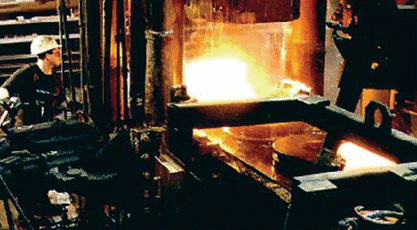
Researchers focused on three different approaches for modeling cavitation during hot working of ductile metals: (1) phenomenological, (2) mesoscale mechanistic, and (3) microscale mechanistic. Phenomenological approaches relate the occurrence of damage and gross fracture in complex stress states to measurements made under a simple stress state, such as uniaxial tension. In contrast, mesoscale mechanistic models examine the plastic growth of individual cavities and their coalescence. Researchers can obtain reasonable estimates of hot ductility from mesoscale modeling, but these techniques do require some assumptions regarding cavity nucleation. Fundamental microscale mechanistic models describe the mechanisms of early-stage cavity growth to provide a basis for quantifying nucleation-type behavior.
AFRL scientists began working on cavitation models in 1997; this initial research resulted in the successful development of the phenomenological and mesoscale mechanistic models. AFRL transferred these models to titanium mill suppliers, who are using them to modify and improve their production practices. Quality improvements in titanium and its alloys will also benefit commercial aircraft and other key industries.
Dr. Lee Semiatin and Dr. Peter S. Meltzer (Anteon Corporation), of the Air Force Research Laboratory's Materials and Manufacturing Directorate, wrote this article. For more information, contact TECH CONNECT at (800) 203-6451 or place a request at http://www.afrl.af.mil/techconn_index.asp . Reference document ML-H-05-06.
More From SAE Media Group
Tech Briefs
Method 3D-Prints Marine-Grade Stainless Steel
Aerospace & Defense Tech Briefs
Evaluation of Additively Manufactured Ultrahard Steels

Aerospace & Defense Tech Briefs
Plasma Electrolytic Oxidation: The Future of Lightweight Designs in Aerospace and Defense
Tech Briefs
Rapid 3D Printing of Biomedical Parts
Aerospace & Defense Tech Briefs
Multi-Scale Analysis of Deformation and Failure in Polycrystalline Titanium Alloys Under High Strain Rates
Tech Briefs
Using 3D Printing to Strengthen Jet Engines
Aerospace & Defense Tech Briefs
Low Distortion Titanium in Laser Powder Bed Fusion Systems
Tech Briefs
Copper Strengthens 3D-Printed Titanium
Tech Briefs
High-Temperature Ni-Based Superalloy Composition
Tech Briefs
Nanoprecipitates Toughen Structural Alloys
Aerospace & Defense Tech Briefs
Limiting Creep in Aerospace Materials
Photonics & Imaging Technology
Deformation Fingerprints Will Help Researchers Identify, Design Better Metallic Materials

Medical Design Briefs
What Medical Device OEMs Should Know About Outsourced MIM
Aerospace & Defense Tech Briefs
Vanadium: A Green Metal Critical to Aerospace and Clean Energy
Automotive Engineering
Lightweight Steel on a (Cold) Roll

Off-Highway Engineering
NASA Highlights Material and Coating Technology Ready for Commercial Applications
Aerospace INSIDER
A New Platform for Developing Advanced Aerospace Metals at Scale
Aerospace & Defense Tech Briefs
SAE International Issues First Technical Standards for Aerospace Additive Manufacturing
Tech Briefs
Manufacturing Process for Aluminum Alloys
Aerospace & Defense Tech Briefs
Molded RF Materials for Hypersonic Sensors and Seekers
Aerospace & Defense Tech Briefs
The Science of Joining Dissimilar Metals in Aerospace Manufacturing
Aerospace & Defense Tech Briefs
Novel Chromium–Molybdenum Metal Alloy Withstands Extreme Conditions
Aerospace & Defense Tech Briefs
Composite Repair Engineering Case Studies for U.S. Army Aerostructures
Tech Briefs
Shear Assisted Processing and Extrusion
Automotive Engineering
Tesla’s Cybertruck Is Audaciously Austenitic
Top Stories
NewsSensors/Data Acquisition
 Microvision Aquires Luminar, Plans Relationship Restoration, Multi-industry Push
INSIDERRF & Microwave Electronics
 A Next Generation Helmet System for Navy Pilots
INSIDERWeapons Systems
 New Raytheon and Lockheed Martin Agreements Expand Missile Defense Production
NewsAutomotive
 Ford Announces 48-Volt Architecture for Future Electric Truck
INSIDERAerospace
 Active Strake System Cuts Cruise Drag, Boosts Flight Efficiency
ArticlesTransportation

Webcasts
Aerospace
 Cooling a New Generation of Aerospace and Defense Embedded...
Energy
 Battery Abuse Testing: Pushing to Failure
Power
 A FREE Two-Day Event Dedicated to Connected Mobility
Automotive
 Quiet, Please: NVH Improvement Opportunities in the Early Design Cycle
Electronics & Computers
 Advantages of Smart Power Distribution Unit Design for Automotive &...
Unmanned Systems
 Sesame Solar's Nanogrid Tech Promises Major Gains in Drone Endurance