




Sensing Applied Load and Damage Effects in Composites with Nondestructive Techniques
Comparing and correlating piezoelectrically induced guided waves, acoustic emission, thermography, and X-ray imaging to determine the effects of applied load on a composite structure.
Composite materials are desirable for aeronautical and aerospace applications for many reasons including their high strength-to-weight ratios, fatigue and corrosion resistance, design adaptability, and performance capabilities in harsh environments. Because of these qualities, composites are useful in many applications such as in armor, helmets, and helicopters, and as structural components.
However, when in-service, composite materials experience very different damage mechanics than metals. Performance and quality of composite materials can suffer from fatigue, environmental conditions, and external damage just as metals can, but due to their inherent complexity and the difficulty of detecting damage in composites with traditional inspection techniques, maintaining and guaranteeing the safety of composite structures is a challenging problem.
Strategies such as structural health monitoring (SHM), a system with which to monitor a structure in real time, are particularly useful for composite materials, because they combat these difficulties by giving warning of any changes to the system. Implementing reliable SHM strategies into composite structures will allow the Army to fully take advantage of the performance capability of composite materials while increasing efficiency by saving time and expense on repair, decreasing the need to take structures out-of- service for inspection, decreasing the occurrence of sudden failures, and extending the lifetime of composite structures by enabling efficient maintenance.
This project studies damage progression in composite materials as monitored by multiple techniques used in nondestructive inspection to further understand the material itself and the capabilities of various nondestructive evaluation (NDE) techniques. Correlating and validating NDE strategies for sensing damage and operational effects on composite materials will add to the knowledge of composites and efficient strategies to monitor these materials and use them to their full capabilities.
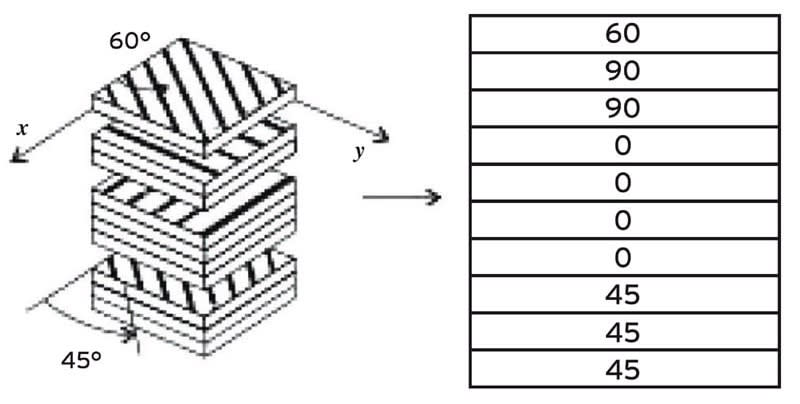
There are many types of composites used in industry based on materials such as glass fiber, Kevlar, and carbon fiber combined with various types of epoxy. Carbon fiber-reinforced polymers are particularly useful in necessarily low-weight but high-strength applications. Unidirectional pre-preg composites, which have fibers oriented in the same direction held together by an epoxy matrix, are one of the most commonly used of these materials. Individual plies can be oriented and stacked together to create a laminated composite structure with specific material properties. The accompanying figure illustrates an example of a laminated composite of unidirectional plies. In this way, a designer can create a composite laminate with tailored material properties necessary for a specific application.
This unique design capability and adaptability coupled with potential high strength-to-weight ratios make composite materials extremely desirable for high-performance applications. However, composites have relatively complicated and situation-dependent damage mechanics. Composite materials experience multiple damage types that can occur together or in sequence to contribute to a weakened structural state or final failure. The main modes of failure are matrix cracking, delamination, fiber breakage, and fiber buckling, which all can contribute individually or together to the progressive degradation, weakening and final failure of a composite structure. In fatigue loading, the types of failure that predominantly occur and are a signal of potential areas for final failure are matrix cracking and delamination.
This work was done by Colleen Rosania, Mulugeta A. Haile, Natasha C. Bradly, Asha Hall, Michael Coatney, and Fu-Kuo Chang for the Army Research Laboratory. ARL-0224
This Brief includes a Technical Support Package (TSP).
Sensing Applied Load and Damage Effects in Composites with Nondestructive Techniques
(reference ARL-0224) is currently available for download from the TSP library.
Don't have an account?
More From SAE Media Group


Aerospace & Defense Tech Briefs
Burner Rig Testing of A500® C/SiC
Aerospace & Defense Tech Briefs
Advanced CT Inspection and Data Analysis
Aerospace Manufacturing and Machining
Scaling Low-Cost Carbon Fiber Production with Oxidation Technology
Aerospace Manufacturing and Machining
Does Your Coating Thickness Meet Spec?

Aerospace & Defense Tech Briefs
‘Nanostitches’ Enable Lighter and Tougher Composite Materials
Aerospace & Defense Tech Briefs
Bioenvironmental Engineering Guide for Composite Materials
Tech Briefs
Compact, Lightweight, CMC-Based Acoustic Liner
Aerospace & Defense Tech Briefs
Hydraulic Testing of Polymer Matrix Composite 102mm Tube Section
Aerospace & Defense Tech Briefs
Thermal Conductivities of Some Polymers and Composites
Aerospace & Defense Tech Briefs
Fiber-Reinforced Thermoplastic Composites
Aerospace Manufacturing and Machining INSIDER
Can This Self-Healing Composite Make Airplane and Spacecraft Components Last for Centuries?
Aerospace & Defense Tech Briefs
Using Thermoplastics in Aerospace Applications
Tech Briefs
Self-Healing Aluminum Metal Matrix Composite
Aerospace & Defense Tech Briefs
Toho Tenax Develops 'Super-Heat-Resistant' Prepreg for Engine Apps
Aerospace & Defense Tech Briefs
Quantitative Diagnostics of Multilayered Composite Structures with Ultrasonic Guided Waves
Aerospace & Defense Tech Briefs
Next-Generation Antenna Design
Tech Briefs
Crack Image Quality Indicator
Aerospace Manufacturing and Machining
Getting the Most Out of Industrial CT Scanning
Tech Briefs
Calibration System for Automated Fiber Placement
Tech Briefs
Thin Heat Shield for Superfast Aircraft
Aerospace & Defense Tech Briefs
Computer Simulation’s Role in Advancing Composite Aircraft Structures

Tech Briefs
Continuous Fiber Composite for Use in Gears
Overview
The document titled "Sensing Applied Load and Damage Effects in Composites with Nondestructive Techniques," published by the US Army Research Laboratory in May 2017, focuses on the development and application of nondestructive testing (NDT) methods to assess the integrity of composite materials used in military and aerospace applications. The report emphasizes the importance of these techniques in monitoring the performance and safety of composite structures, which are increasingly utilized due to their lightweight and high-strength properties.
The authors, comprising researchers from the Army Research Laboratory and Stanford University, explore various NDT methods, including acoustic emission, ultrasonic testing, and fiber optic sensing. These techniques allow for real-time monitoring of applied loads and the detection of damage within composite materials without compromising their structural integrity. The report discusses the principles behind each method, their advantages, and limitations, as well as their potential applications in field settings.
One of the key highlights of the report is the integration of advanced sensing technologies with traditional NDT methods. The authors propose a hybrid approach that combines multiple sensing techniques to enhance the accuracy and reliability of damage detection. This approach aims to provide a comprehensive understanding of the material's condition, enabling timely maintenance and repair decisions, which is crucial for ensuring operational readiness in military applications.
The document also addresses the challenges associated with implementing these NDT techniques in real-world scenarios, such as environmental factors, material variability, and the need for standardized procedures. The authors advocate for further research and development to refine these methods and improve their applicability across different types of composite materials.
In conclusion, the report underscores the significance of nondestructive techniques in the assessment of composite materials, highlighting their role in enhancing safety, performance, and longevity. By advancing these technologies, the research aims to support the Army's mission by ensuring that composite structures can withstand the rigors of operational environments while maintaining their integrity. The findings presented in this document contribute to the broader field of materials science and engineering, offering valuable insights for future research and development in composite material assessment.
Top Stories
NewsRF & Microwave Electronics
 Microvision Aquires Luminar, Plans Relationship Restoration, Multi-industry Push
INSIDERAerospace
 A Next Generation Helmet System for Navy Pilots
INSIDERDesign
 New Raytheon and Lockheed Martin Agreements Expand Missile Defense Production
INSIDERMaterials
 How Airbus is Using w-DED to 3D Print Larger Titanium Airplane Parts
NewsPower
 Ford Announces 48-Volt Architecture for Future Electric Truck
ArticlesAR/AI

Webcasts
Electronics & Computers
 Cooling a New Generation of Aerospace and Defense Embedded...
Automotive
 Battery Abuse Testing: Pushing to Failure
Power
 A FREE Two-Day Event Dedicated to Connected Mobility
Unmanned Systems
 Quiet, Please: NVH Improvement Opportunities in the Early Design Cycle
Automotive
 Advantages of Smart Power Distribution Unit Design for Automotive &...
Energy
 Sesame Solar's Nanogrid Tech Promises Major Gains in Drone Endurance