




Burner Rig Testing of A500® C/SiC
Test method simulates, in a laboratory environment, the service conditions ceramic-matrix composite material would experience in turbine engine exhaust applications.
There is growing interest in developing, testing, and deploying ceramic-matrix composites (CMCs) into commercial and military aerospace gas turbine engines due to their durability under extreme conditions and weight-savings potential. For military applications, the focus is on the afterburning section of the turbine engine, including the flameholder, augmentor liner, and both the convergent and divergent segments of the exhaust nozzle. These are demanding applications because of the high temperatures and rapid thermal cycles.
Each year, a large number of exhaust nozzle divergent flaps and seals are replaced before reaching their scheduled life, causing a large maintenance burden. Engineering evaluation and lab testing have shown that premature distress of divergent seals is due to severe environmental exposure, including: high-temperature-induced creep deformation, rapid thermal cycles, severe thermal gradients, and high acoustic loading.
CMCs are being evaluated to replace traditional nickel-based superalloys because they offer high-temperature capability, limited or no property debit with temperature, they have a density that is a third of that of the nickel-based superalloy, and they do not require cooling air. CMCs being considered for gas turbine applications cover a wide range of fibers and matrices, and are fabricated by chemical-vapor infiltration (CVI), sol-gel techniques, polymer infiltration and pyrolysis (PIP), and melt infiltration (MI). For exhaust nozzle divergent flaps and seals, there is a large body of work that was performed on CVI- and PIP-processed CMC materials. It was in 1997 that the United States Navy (USN) approved full production qualification of SiC/C CMC divergent flaps and seals for the F414 engine that powers the F-18-E/F Super Hornet.
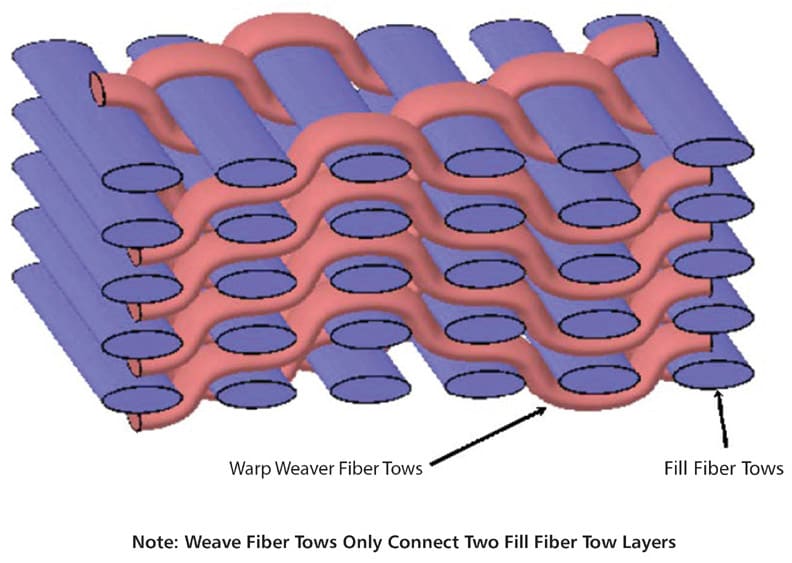
A CMC system developed by SPS was evaluated for a divergent seal application. This material is SEPCARBINOX® A500, a C/SiC composite with a 3-D weave configuration for improved delamination resistance and a sequenced CVI matrix that is self-sealing for protection of the carbon fibers.
Material acceptance testing at the coupon level had already been completed and reported. A database of 65 coupons from nine production runs of A500 showed that the material consistently exceeded the acceptance criteria for ultimate tensile strength (UTS) for the application. The UTS of the material in the database is 252 ± 25 MPa, compared to the acceptance level UTS of 170 MPa. The final stage of testing involved what the industry calls “killer tests” – a series of tests involving aggressive environmental conditions. The aim was to identify and expose any material weaknesses prior to proceeding to ground testing and insertion into actual fielded applications. Such tests were performed on material coupons; this earlier testing involved a combination of two-hour dwell fatigue testing in both air and steam environments. Results showed that the A500 CMC consistently performed better than other C/SiC CMC systems.
As part of the effort to expand the aggressive evaluation of the A500 material, burner rig tests were undertaken at the USN test facility at Naval Air Systems Command (NAVAIR). Burner rig testing simulates the in-flight condition of applying an afterburner, as used on military aircraft engines for takeoff and reaching high-speed supersonic flight. The lighting of an afterburner results in a very rapid thermal spike of the exhaust nozzle hardware. The longer the afterburner is operated, the higher the temperature rises. In addition, aircraft are often operated near a marine saltwater environment. Therefore, in addition to the burner rig exposures, the test specimens were exposed to salt fog before and between intervals of burner rig testing.
Furthermore, some specimens were creep tested and others fatigue tested prior to the salt fog and burner rig exposure with the intention of “pre-conditioning” them by exposing them beyond the predicted in-flight mechanical loads in order to introduce additional matrix cracks.
This work was done by Larry P. Zawada, Universal Technology Corporation; Jennifer Pierce, UDRI; and Craig Przybyla, AFRL/RXCCP for the Air Force Research Laboratory. AFRL-0262
This Brief includes a Technical Support Package (TSP).
Burner Rig Testing of A500® C/SiC
(reference AFRL-0262) is currently available for download from the TSP library.
Don't have an account?
More From SAE Media Group
Tech Briefs
Compact, Lightweight, CMC-Based Acoustic Liner
Aerospace & Defense Tech Briefs
Sensing Applied Load and Damage Effects in Composites with Nondestructive Techniques
Aerospace & Defense Tech Briefs
‘Nanostitches’ Enable Lighter and Tougher Composite Materials
Aerospace & Defense Tech Briefs
Hydraulic Testing of Polymer Matrix Composite 102mm Tube Section
Aerospace & Defense Tech Briefs
Microstructural and Mechanical Characterization of 2-D and 3-D SiC/SiNC Ceramic-Matrix Composites


Aerospace & Defense Tech Briefs
Unlocking the Power of Ceramic Matrix Composites
Aerospace Manufacturing and Machining INSIDER
Can This Self-Healing Composite Make Airplane and Spacecraft Components Last for Centuries?
Aerospace & Defense Tech Briefs
Thermal Conductivities of Some Polymers and Composites
Aerospace Manufacturing and Machining
Scaling Low-Cost Carbon Fiber Production with Oxidation Technology
Aerospace INSIDER
New Methods Detect and Predict Fatigue-Related Aircraft Cracks
Aerospace & Defense Tech Briefs
Bioenvironmental Engineering Guide for Composite Materials
Tech Briefs
Self-Healing Aluminum Metal Matrix Composite

Aerospace & Defense Tech Briefs
Advanced CT Inspection and Data Analysis


Tech Briefs
Fiber-Metal Laminate Manufacturing Technique
Tech Briefs
High-Temperature Ni-Based Superalloy Composition

NASA Spinoff
Analytic Tool Simplifies Metal Fracture Assessments

Overview
The document is a final report titled "Burner Rig Testing of A500® C/SiC," authored by Larry P. Zawada from Universal Technology Corporation, Jennifer Pierce from the University of Dayton Research Institute, and Craig Przybyla from the Air Force Research Laboratory (AFRL). It covers research conducted from January 1, 2005, to December 31, 2007, and was officially reported on March 17, 2018.
The primary focus of the report is on the testing of A500® C/SiC, a composite material that combines silicon carbide (SiC) with a matrix material, aimed at evaluating its performance under high-temperature conditions typical of burner rig applications. The testing is crucial for applications in aerospace and defense, where materials must withstand extreme environments while maintaining structural integrity.
The report details the methodology used in the burner rig tests, including the setup, parameters measured, and the specific conditions under which the tests were conducted. It emphasizes the importance of rigorous testing to ensure that materials can perform reliably in operational settings. The findings from these tests are expected to contribute to advancements in material science, particularly in the development of composites that can endure high thermal and mechanical stresses.
Additionally, the document includes information about the organizations involved in the research, such as the AFRL's Composites Branch and the University of Dayton Research Institute, highlighting their roles in the project. The report is cleared for public release, making it accessible to a wide audience, including foreign nationals, and is available through the Defense Technical Information Center (DTIC).
The report also contains standard documentation elements, such as the OMB control number for public reporting, distribution statements, and a notice regarding the use of government data. It underscores that the publication does not imply government endorsement of the findings or ideas presented.
In summary, this report serves as a comprehensive account of the burner rig testing of A500® C/SiC, providing valuable insights into the performance of advanced composite materials under extreme conditions, which is essential for future applications in aerospace and defense sectors.
Top Stories
NewsRF & Microwave Electronics
 Microvision Aquires Luminar, Plans Relationship Restoration, Multi-industry Push
INSIDERAerospace
 A Next Generation Helmet System for Navy Pilots
INSIDERDesign
 New Raytheon and Lockheed Martin Agreements Expand Missile Defense Production
INSIDERMaterials
 How Airbus is Using w-DED to 3D Print Larger Titanium Airplane Parts
NewsPower
 Ford Announces 48-Volt Architecture for Future Electric Truck
ArticlesAR/AI

Webcasts
Electronics & Computers
 Cooling a New Generation of Aerospace and Defense Embedded...
Automotive
 Battery Abuse Testing: Pushing to Failure
Power
 A FREE Two-Day Event Dedicated to Connected Mobility
Unmanned Systems
 Quiet, Please: NVH Improvement Opportunities in the Early Design Cycle
Automotive
 Advantages of Smart Power Distribution Unit Design for Automotive &...
Energy
 Sesame Solar's Nanogrid Tech Promises Major Gains in Drone Endurance