




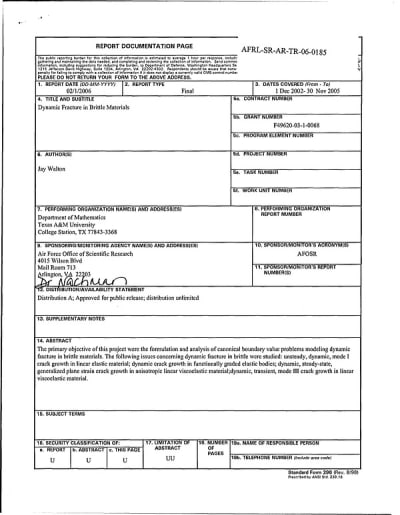
Studies of Dynamic Fracture in Brittle Materials
Several studies have contributed to understanding of fracture mechanisms.
A program of research spanning several years ending in November 2005 was dedicated primarily to formulation and analysis of canonical boundary- value problems in mathematical modeling of dynamic fracture in brittle materials. The sub-topics within the broad topic of dynamic fracture in brittle materials that were studied, and the accomplishments in each sub-topic, are summarized as follows:
Unsteady mode-I (opening-mode) crack growth in elastic material.
A Dirichlet-to-Neumann map needed to relate crack-opening displacement to driving tractions for a semi-infinite, Mode-I crack in an infinite, linearly elastic body was constructed. At the time of reporting the information for this article, the map was in use in a study of a crack-tip cohesive zone and of the use of a critical-crack-opening-displacement fracture criterion for prediction of crack-tip motion.
Dynamic crack growth in functionally graded elastic bodies.
One study addressed the problem of a semi-infinite, tearing-mode crack propagating dynamically along an interface between two half-planes of linear elastic material, the shear modulus of which varies spatially in the direction transverse to the fracture plane. Because this problem is analytically intractable, it was approximated by performing an asymptotic analysis based upon the assumption that the properties of the material throughout its bulk are given by an asymptotic series, the zero-order term of which corresponds to a homogeneous elastic material. The asymptotic analysis effectively converted the problem to a simpler problem involving a quasi-static case for which one can construct analytic solutions for a few special classes of nonhomogeneous material models. The stress-intensity factor (SIF) values calculated in the asymptotic analysis were found to be in reasonable agreement with true SIF values.
Dynamic, steady-state, generalized plane-strain crack growth in anisotropic linear viscoelastic material.
This study produced a general solution method based upon transform and complex-variable techniques that produces a full field solution to a semi-infinite crack problem under general crack-face loadings leading to generalized plane-strain deformations. A key step in the analysis is the construction of the Dirichlet-to-Neumann map on the bounding plane for an anisotropic viscoelastic half-space under dynamic steady-state conditions. Two classes of crack-face tractions were simulated: a point load placed a prescribed distance behind the crack tip and a uniform traction applied over a finite interval placed a prescribed distance behind the crack tip. Each simulation exhibited the surprising feature of vanishing of the SIF at a crack speed strictly less than the glassy Rayleigh wave speed. It was proved that (1) if the loading interval begins at the crack tip, then the SIF cannot vanish until the glassy Rayleigh wave speed is reached, but (2) if the loading interval is moved back from the crack tip, then the SIF can vanish at a lower speed.
Dynamic, transient, mode-III (tearing-mode) crack growth in linear viscoelastic material.
A previously developed method of solving problems of dynamic unsteady crack growth in an isotropic linear elastic body was generalized to a viscoelastic body. The generalized method was applied in simulations of a single semi-infinite tearing-mode shear crack in a viscoelastic body. This was asserted to be the first dynamic, unsteady crack analysis valid for a general linear viscoelastic body, and the results of the simulations were interpreted as demonstrating clearly the critical role played by viscoelasticity in controlling the speed of a propagating crack and the length to which it grows.
In addition to the studies summarized above, studies were initiated in new sub-topics, including various issues concerning finite deformations of nonlinear elastic bodies, a new approach to incorporation of molecular-scale effects into continuum models of brittle fracture without incurring the logical inconsistencies inherent in classical linear elastic fracture mechanics, and a novel approach to modeling residual stress accumulation in a continuously growing oxide layer on a metallic substrate.
This work was done by Jay Walton of Texas A&M University for the Air Force Office of Scientific Research.
AFRL-0087
This Brief includes a Technical Support Package (TSP).
Studies of Dynamic Fracture in Brittle Materials
(reference AFRL-0087) is currently available for download from the TSP library.
Don't have an account?
More From SAE Media Group



Motion Design INSIDER
Autonomous Structures Can Be Programmed to Jump Days in Advance
Aerospace & Defense Tech Briefs
Thermal Mechanical Fatigue Crack Growth Testing
Aerospace & Defense Tech Briefs
Cracking of Aluminum Panels Repaired With Composite Patches

Tech Briefs
Creating 2D All-Organic Perovskites
Aerospace & Defense Tech Briefs
Portable Data Recorder for Measuring Sand Grain Fracture After Blasts

Motion Design INSIDER
NYU Tandon Researchers Explore a More Frictionless Future

NASA Spinoff
Toxin-Eating Plants
Aerospace & Defense Tech Briefs
Microcompression Tests of a BMG and a Tungsten/BMG Composite
Tech Briefs
Time-Dependent Nature of Adhesive EA946
Tech Briefs
First Transformable Nanoscale Electronic Devices


Motion Design INSIDER
Friction That Cools


Power Electronics INSIDER
Breaking the Thermal Conductivity Barrier with Boron Arsenide


Tech Briefs
Octopus-Inspired Tech Can Operate Underwater

Tech Briefs
VaCNT Makes Up a Promising Membrane Material
Tech Briefs
Products of Tomorrow
Tech Briefs
Video on Adhesives for Optical Applications
Overview
The document is a final technical report titled "Dynamic Fracture in Brittle Materials," authored by Jay Walton from the Department of Mathematics at Texas A&M University. It was prepared under the Air Force Office of Scientific Research (AFOSR) grant F49620-03-1-0068 and covers research conducted from December 2002 to November 2005.
The primary objective of the project was to formulate and analyze canonical boundary value problems that model dynamic fracture in brittle materials. The report addresses several key areas of research, including:
-
Unsteady Mode I Crack Growth: The study extends previous analyses of dynamic, transient growth of antiplane shear cracks in infinite linear elastic bodies to more complex scenarios.
-
Dynamic Crack Growth in Functionally Graded Elastic Bodies: This involves examining how material properties vary within the body and how this affects crack propagation.
-
Dynamic, Steady-State, Generalized Plane Strain Crack Growth: The report investigates crack growth in anisotropic linear viscoelastic materials, which exhibit time-dependent behavior under stress.
-
Dynamic, Transient Mode III Crack Growth: This aspect focuses on the growth of cracks under shear loading conditions in linear viscoelastic materials.
The report also highlights the challenges associated with dynamic, unsteady crack problems in nonhomogeneous elastic materials, noting the scarcity of analytical solutions in the literature. To address this, the researchers applied an asymptotic approach to simpler quasi-static problems, achieving reasonable agreement between the asymptotic approximation of the Stress Intensity Factor (SIF) and the true SIF.
Additionally, the document discusses new research directions, including the incorporation of molecular scale effects into continuum models of brittle fracture. This approach aims to resolve logical inconsistencies found in classical linear elastic fracture mechanics. The report emphasizes the importance of understanding finite deformations in nonlinear elastic bodies and the modeling of residual stress accumulation in oxide layers on metallic substrates.
Overall, the report presents a comprehensive overview of the methodologies and findings related to dynamic fracture mechanics, contributing valuable insights into the behavior of brittle materials under various loading conditions. The research aims to enhance the understanding of fracture processes, which is crucial for applications in materials science and engineering.
Top Stories
INSIDERManufacturing & Prototyping
 How Airbus is Using w-DED to 3D Print Larger Titanium Airplane Parts
NewsAutomotive
 Microvision Aquires Luminar, Plans Relationship Restoration, Multi-industry Push
INSIDERAerospace
 A Next Generation Helmet System for Navy Pilots
INSIDERDesign
 New Raytheon and Lockheed Martin Agreements Expand Missile Defense Production
ArticlesAR/AI
 CES 2026: Bosch is Ready to Bring AI to Your (Likely ICE-powered) Vehicle
Road ReadyDesign

Webcasts
Semiconductors & ICs
 Advantages of Smart Power Distribution Unit Design for Automotive...
Unmanned Systems
 Quiet, Please: NVH Improvement Opportunities in the Early Design...
Electronics & Computers
 Cooling a New Generation of Aerospace and Defense Embedded...
Power
 Battery Abuse Testing: Pushing to Failure
AR/AI
 A FREE Two-Day Event Dedicated to Connected Mobility
