




Thermal Mechanical Fatigue Crack Growth Testing
An experimental test method enables detection of crack propagation in jet engine turbine blades.
Turbines in aircraft turbojet engines are being subject to increasingly higher temperatures to improve fuel efficiency. High turbine efficiency requires the ability of turbine blades to withstand gas temperature of the order of 1350 to 1550 °C. In polycrystalline materials, these increased temperatures would cause creep strains along grain boundaries that would be unacceptable. Even single-crystal materials must be pushed to their limits to insure that engine performance is maximized. Airfoils in modern gas turbine aircraft use a systems approach for cooling to achieve required component life. There are three basic components to these systems: a cast nickel single-crystal superalloy in combination with thermal barrier coatings, and a sophisticated cooling scheme consisting of intricately designed channels and holes through the core and surface of the airfoil.
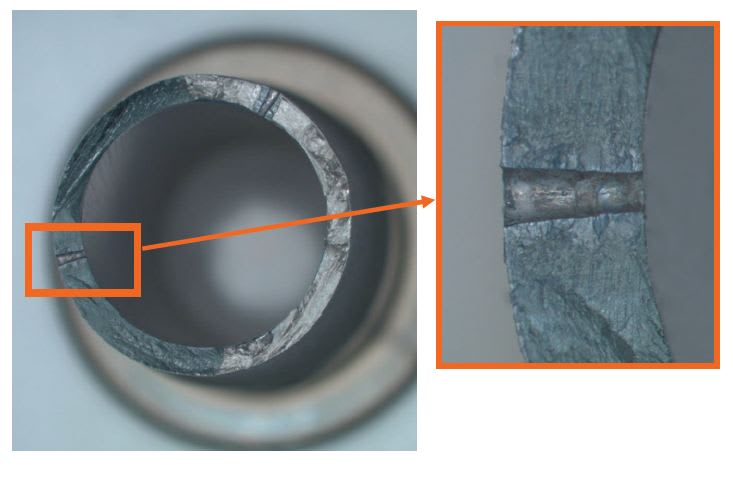
Most thermal mechanical fatigue (TMF) cracks in airfoils start from the cooling holes. Thus, a new thermal fatigue experimental technique is needed to measure the structural life of the specimen containing through holes similar to the ones that are drilled in cooled airfoils.
A newly developed TMF test procedure was used on specimens with laser drilled holes. The cooling holes’ effect on intrinsic serviceable fatigue crack growth and on corresponding TMF life compared to baseline cast nickel single crystal data was investigated. The new method would allow explicit measurements of the effects of crystal secondary orientation, hole geometry, skew angles, and laser drilling effects on TMF crack initiation and propagation.
These TMF test results can be directly used to evaluate structural life of the cooled airfoils as well as provide necessary information on the applicability of smooth specimen TMF data to the assessment of real service components with small features causing local stress concentration.
The new experimental method includes: a) a notched test method and procedure for TMF crack growth; b) successful demonstration of induction thermograpghy for capturing crack growth versus cycle count and subsequent analysis of that data; and c) fast cycle thermomechanical fatigue testing using active cooling, allowing 30-second heat-up and 30-second cooling under sinusoidal command and feedback response.
Using this new technique, it was shown that the life of TMF specimens with notched holes exhibit a 4-times debit compared to smooth gage section specimens under the same loading conditions. In addition, the effect of the hole secondary crystallographic orientation on crack initiation and propagation was investigated. All tests demonstrated that the cracks start crystallographically along the crystallographic plane and later change to mixed-mode fracture. Fractographical analysis using both optical and SEM microscopes revealed that major crack propagation takes place at the low-temperature portion of the cycle; however, there is noticeable damage accumulation during the high-temperature compressive load portion of the cycle. Crack propagation under TMF loading conditions is considerably faster than corresponding isothermal LCF crack growth tested at the temperature and similar loading. Such a significant change in number of cycles to failure must be accounted for in any damage tolerant design system.
This work was done by R. K. Kersey and A. Staroselsky of Pratt & Whitney, and D.C. Dudzinski and M. Genest of the National Research Council Canada, Institute for Aerospace Research, for the Air Force Research Laboratory. AFRL-0216
This Brief includes a Technical Support Package (TSP).
Thermal Mechanical Fatigue Crack Growth Testing
(reference AFRL-0216) is currently available for download from the TSP library.
Don't have an account?
More From SAE Media Group

Aerospace & Defense Tech Briefs
Limiting Creep in Aerospace Materials

Tech Briefs
High-Temperature Ni-Based Superalloy Composition
Tech Briefs
Method Pinpoints Microscale Damage in Metal
Air Force Research Laboratory Technology Horizons
Strain-Induced Porosity Model
Tech Briefs
Single Crystal Nickel-Base Superalloy
Aerospace & Defense Tech Briefs
Burner Rig Testing of A500® C/SiC

Aerospace & Defense Tech Briefs
Spectrum Fatigue of 7075-T651 Aluminum Alloy Under Overloading and Underloading
Motion Design INSIDER
Autonomous Structures Can Be Programmed to Jump Days in Advance
Aerospace & Defense Tech Briefs
Thermal Simulation and Testing of Expanded Metal Foils for Lightning Protection
Motion Design
Multi-Axis Motion Controller Accelerates Gear Testing
Tech Briefs
Self-Healing Aluminum Metal Matrix Composite
Aerospace & Defense Tech Briefs
Multi-Scale Analysis of Deformation and Failure in Polycrystalline Titanium Alloys Under High Strain Rates
Medical Design Briefs
Burnishing Techniques Strengthen Hip Implants
Aerospace & Defense Tech Briefs
Zwick Roell Provides Flexible Materials Testing over a Wide Temperature Range
Aerospace & Defense Tech Briefs
Scientists Fuse Simulations and Machine Learning to Accelerate Novel Additively Manufactured Materials
Photonics & Imaging Technology
Pratt & Whitney, Virginia Tech Pioneer Laser-Optical Approach for Turbofan Engine Thrust Measurement

Tech Briefs
Engineers Develop New Shape-Memory Material
Aerospace & Defense Tech Briefs
Cracking of Aluminum Panels Repaired With Composite Patches
Tech Briefs
Predicting Stresses in Thermal-Barrier Coatings

Overview
The document titled "Thermal Mechanical Fatigue Cracks Growth from Laser Drilled Holes in Single Crystal Material" is a technical paper authored by R.K. Kersey, A. Staroselsky, D.C. Dudzinski, and M. Genest, published in March 2012. It addresses the critical issue of crack growth in single crystal materials, particularly in the context of aerospace applications where such materials are commonly used.
The study investigates the mechanisms of thermal mechanical fatigue (TMF) and how they are influenced by various factors, including mechanical strain ranges, temperature variations, and the presence of hot dwell periods. The authors aim to understand the damage mechanisms that lead to crack propagation in materials subjected to cyclic loading and thermal stresses, which are prevalent in high-performance aerospace components.
A significant focus of the research is on the effects of laser-drilled holes, which are often used in manufacturing processes for cooling and weight reduction. The presence of these holes can significantly alter the stress distribution within the material, potentially leading to accelerated crack growth. The paper discusses the experimental setup and methodologies used to analyze crack growth rates and mechanisms, providing insights into how these factors interact under different loading conditions.
The findings of the study are crucial for improving the reliability and lifespan of aerospace components, as they highlight the importance of considering both mechanical and thermal stresses in the design and analysis of materials. By understanding the interplay between these factors, engineers can develop better predictive models for crack growth, ultimately leading to safer and more efficient aerospace systems.
The document is part of a broader effort by the Air Force Research Laboratory and other organizations to enhance material performance in demanding environments. It is approved for public release, ensuring that the knowledge gained from this research can be shared with the wider scientific and engineering communities.
In summary, this technical paper provides valuable insights into the mechanisms of thermal mechanical fatigue in single crystal materials, particularly in relation to laser-drilled holes. The research contributes to the ongoing efforts to improve material performance in aerospace applications, emphasizing the need for comprehensive understanding of crack growth mechanisms under varying operational conditions.
Top Stories
INSIDERDefense
 New Raytheon and Lockheed Martin Agreements Expand Missile Defense Production
NewsAutomotive
 Ford Announces 48-Volt Architecture for Future Electric Truck
INSIDERManufacturing & Prototyping
 Active Strake System Cuts Cruise Drag, Boosts Flight Efficiency
ArticlesTransportation
 Accelerating Down the Road to Autonomy
INSIDERMaterials
 How Airbus is Using w-DED to 3D Print Larger Titanium Airplane Parts
Road ReadyTransportation

Webcasts
Electronics & Computers
 Cooling a New Generation of Aerospace and Defense Embedded...
Power
 Battery Abuse Testing: Pushing to Failure
Connectivity
 A FREE Two-Day Event Dedicated to Connected Mobility
Automotive
 Quiet, Please: NVH Improvement Opportunities in the Early Design Cycle
Transportation
 Advantages of Smart Power Distribution Unit Design for Automotive &...
Aerospace
 Sesame Solar's Nanogrid Tech Promises Major Gains in Drone Endurance