




Cracking of Aluminum Panels Repaired With Composite Patches
Strains have been found to be substantially proportional to crack lengths.
An experimental study of the mechanical behavior of cracked aluminum specimens repaired with composite-material patches has yielded findings that may eventually contribute to the development of more- effective composite patches and of techniques for predicting and detecting failures in composite-patched aluminum aircraft panels. Some prior studies have addressed various aspects of composite-patch repair of aluminum specimens, but until now, little attention has been given to such important aspects of mechanical behavior and properties as the relationships among stress, strain, and growth of cracks through-out the lifetimes of specimens. In this study, effects of initiation and growth of cracks on the residual strengths of the patched specimens were characterized. This study established a correlation among damage modes, residual strengths, and evolution of strain inside and outside the patched areas.
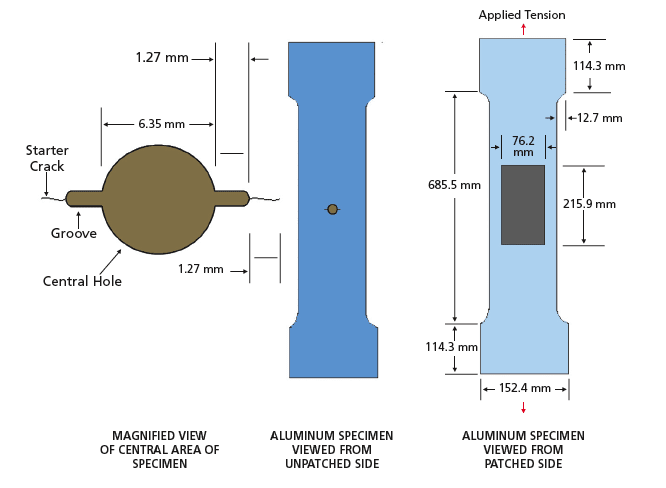
A monotonic tensile test was performed on one specimen to determine baseline strength. Fatigue tests were performed on two other specimens to establish baseline fatigue life. The three other specimens were fatigue-tested to different fractions of the expected fatigue life, introducing damage that was then analyzed by non-destructive evaluation techniques. Then each of these three specimens was subjected to a monotonic tensile test to failure in order to characterize (1) its residual strength, (2) the evolution of strain inside and outside its patch area, and (3) the correlation between debonding of the patch and strain measurements at various locations. Debonding was detected by use of thermal imaging following transient heating. Crack lengths were measured by use of a travelling microscope with a digital readout.
Some of the results of the tests were as anticipated; others were not as anticipated. Two main conclusions were drawn from the results:
- Strain values were found to be approximately proportional to crack lengths, with no noticeable dependence on the crack-growth rates. For strain gauges close to cracks, crack lengths could be determined to within close approximations from the strain readings alone.
- It was found that when a cyclically loaded specimen is overloaded in the sense that the load applied during one or a few cycles significantly exceeds the standard cyclic load, then there occurs a retardation effect in the sense that crack growth slows significantly for a while. Once the standard cyclic loading is resumed, the crack-growth rate rises, gradually approaching the rate for standard cyclic loading as though the overload had not occurred.
This work was done by Michael A. Hansen of the Air Force Institute of Technology.
AFRL-0098
This Brief includes a Technical Support Package (TSP).
Cracking of Aluminum Panels Repaired With Composite Patches
(reference AFRL-0098) is currently available for download from the TSP library.
Don't have an account?
More From SAE Media Group
Tech Briefs
Self-Healing Aluminum Metal Matrix Composite
Aerospace & Defense Tech Briefs
Testing Mechanical Properties of Polymer-Based Multi- Phase Particulate Composites
Tech Briefs
A Method of Strengthening Composite/Metal Joints

Aerospace & Defense Tech Briefs
Fatigue Crack Detection Via Load-Differential Guided Wave Methods
Photonics Tech Briefs
Curved Piezoelectric Actuators for Stretching Optical Fibers
Aerospace & Defense Tech Briefs
Fuzzy Fiber Sensors for Structural Composite Health Monitoring
Photonics & Imaging Technology
Deformation Fingerprints Will Help Researchers Identify, Design Better Metallic Materials
Tech Briefs
Flexible Lightweight Radiation Shielding


Aerospace & Defense Tech Briefs
Microcompression Tests of a BMG and a Tungsten/BMG Composite
Aerospace & Defense Tech Briefs
‘Nanostitches’ Enable Lighter and Tougher Composite Materials
Tech Briefs
Method Pinpoints Microscale Damage in Metal
Aerospace & Defense Tech Briefs
Thermo-Elastic Nondestructive Evaluation of Fatigue Damage in PMR-15 Resin
Aerospace & Defense Tech Briefs
High-Strain-Rate Tests of Epoxy/Aluminum-Powder Composites
Aerospace & Defense Tech Briefs
Continuous Carbon Nanofibers for Structural Composites


Overview
The document is a Master’s Thesis authored by Captain Michael A. Hansen, focusing on the mechanical behavior of cracked aluminum panels repaired with bonded boron/epoxy composite patches. The research was conducted at the Air Force Institute of Technology from August 2003 to June 2005 and is approved for public release.
The thesis is structured into five distinct chapters. The first chapter outlines the motivation behind the research, emphasizing the importance of effective repair methods for cracked structures, particularly in aerospace applications. The second chapter provides a background on bonded repair technology, discussing previous efforts and theoretical frameworks that inform the study.
Chapter three details the experimental setup and testing procedures employed to evaluate the performance of the repaired panels. This includes descriptions of the materials used, the methods of applying the composite patches, and the specific tests conducted to assess mechanical behavior under various conditions.
In chapter four, the results of the experiments are presented. This section highlights key findings regarding the effectiveness of the bonded composite patches in restoring the strength and integrity of cracked aluminum panels. The study investigates how different factors, such as the size and location of the cracks, influence the residual strength of the repaired panels. It also examines the modes of damage that occur during testing, providing insights into the failure mechanisms associated with bonded repairs.
The final chapter summarizes the findings and discusses future directions for research in this area. It emphasizes the potential for bonded composite patches to enhance the longevity and safety of aerospace structures, suggesting that further studies could explore different materials and repair techniques.
Overall, the thesis contributes valuable knowledge to the field of structural repair technology, particularly in the context of military and aerospace applications. It underscores the significance of understanding the mechanical behavior of repaired structures to ensure their reliability and performance in critical environments. The research findings may inform future practices in the maintenance and repair of aircraft and other aerospace vehicles, ultimately supporting operational readiness and safety.
Top Stories
NewsRF & Microwave Electronics
 Microvision Aquires Luminar, Plans Relationship Restoration, Multi-industry Push
INSIDERAerospace
 A Next Generation Helmet System for Navy Pilots
INSIDERDesign
 New Raytheon and Lockheed Martin Agreements Expand Missile Defense Production
INSIDERMaterials
 How Airbus is Using w-DED to 3D Print Larger Titanium Airplane Parts
NewsPower
 Ford Announces 48-Volt Architecture for Future Electric Truck
ArticlesAR/AI

Webcasts
Electronics & Computers
 Cooling a New Generation of Aerospace and Defense Embedded...
Automotive
 Battery Abuse Testing: Pushing to Failure
Power
 A FREE Two-Day Event Dedicated to Connected Mobility
Unmanned Systems
 Quiet, Please: NVH Improvement Opportunities in the Early Design Cycle
Automotive
 Advantages of Smart Power Distribution Unit Design for Automotive &...
Energy
 Sesame Solar's Nanogrid Tech Promises Major Gains in Drone Endurance