




Fuzzy Fiber Sensors for Structural Composite Health Monitoring
Carbon nanotube-based fiber sensors can sense local composite damage.
The onset of local damage in structures, such as delamination, cracking, and fastener loosening, can often be difficult to detect and has long-term implications on the performance of the composite structure. These structures are often exposed to a variety of conditions, including impact, shock loading, and extreme changes in temperature. Because of both manufacturing requirements and design specifications, large and complex sections often need to be joined together to form the final structures. It is important to understand the failure behavior of these joints under a variety of static and dynamic loading conditions.
Methods have been devised to use the sensors in a network to “triangulate” readings/ locations of interest. This is especially true for piezoelectric sensors, which provide an actuation, as well as a sensing, function. One approach to wide-area damage detection is to harness the ability of certain classes of materials to provide a self-diagnosing function.
The unique structure of carbon nanotubes (CNTs) brings the material some outstanding properties that make it possible to apply CNTs to applications in various areas of materials, including the development of a new generation of sensors. CNTs are a promising material for detecting chemicals and biochemicals due to several intriguing properties, including their ability to mediate fast electron-transfer kinetics for a wide range of electroactive species, and large length-to-diameter aspect ratios that provide high surface area.
In this study, the unique capability of CNT-based sensors for sensing local composite damage was used. Through careful design of the specimen, it will be possible to detect the onset and progression of damage in the fiber. This work demonstrates a novel, multi-modal, nanomaterial- based sensor technology that can provide wide-area detection of damage.
CNT growth on glass fibers (fuzzy glass fiber) was carried out using a traditional chemical vapor deposition process. Two sets of fuzzy glass fiber were prepared by changing only the growth time. CNT fuzzy glass with short resident time exhibits less-dense CNT growth than long resident time.
Fuzzy fiber strain sensors were characterized as fibers, tows, monocomposites (embedded in epoxy matrix material), and composite specimens. Coupon geometries were designed to evaluate specific characteristics of the sensors of interest. Following successful evaluation of individual fibers, single tows were embedded in an epoxy matrix monocomposite and subsequently incorporated into carbon composite specimens designed to produce specific geometryinduced responses. These included straight-sided, stress-concentration, and Poisson’s-effect specimens. All composite specimens were fabricated as both unidirectional and orthotropic fiber orientations.
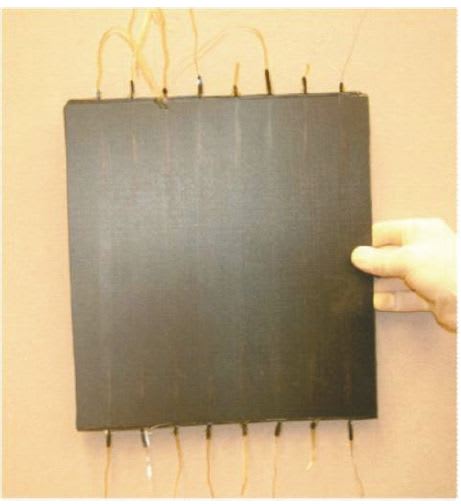
Experiments indicated that fuzzy fiber with high-density CNTs produced the best strain response, so sensors were developed accordingly for use in the composite specimens. The process of embedding sensors in a carbon composite panel required electrical isolation for the sensor. Instrumentation leads were bonded to the fiber tow with conductive epoxy and extended beyond the isolation layer. All composite specimens were fabricated through a similar process. Six composite panels, 12 × 12" , were fabricated with IM7/977-2 prepreg unidirectional carbon fiber tape. Three panels each were prepared with unidirectional or orthotropic layups. Sensors were embedded at specified levels in the layup depending on the type of specimen response to be tested. The figure shows a typical cured panel with embedded sensor elements prior to cutting into individual specimens.
A series of tests progressed from an initial sensor feasibility study to incorporation in segments of actual composite panels. The sensors were shown to produce consistent response, low noise, high strain capability, and were repeatable for elastic strain in the same specimen (no hysteresis or offset).
At the beginning of tensile testing, substantial thermal response was ob - served, causing unacceptable drift in the strain signal. Faster loading rates or insulating the specimen from the air and allowing it to thermally stabilize before testing overcame the thermal issues. However, a separate investigation was performed to determine the magnitude of error in strain measurement that could be expected due to thermal errors.
This work highlights the feasibility of incorporating carbon nanomaterials into structural composites as sensors. The fuzzy fiber sensors exhibit similar sensitivity to conventional strain gages, and are more easily integrated into composite structures as the sensor itself is a composite. The fuzzy fiber strain gages can be used to sense strain within composite structures, and can be readily integrated into the structural laminate to provide sensing over large sections and in locations not accessible to conventional strain gaging techniques.
This work was done by K. Lafdi, J. Sebastian, N. Schehl, M. Bouchard, M. Boehle, and L. Linge of the University of Dayton for the Air Force Research Laboratory. AFRL-0209
This Brief includes a Technical Support Package (TSP).
Fuzzy Fiber Sensors for Structural Composite Health Monitoring
(reference AFRL-0209) is currently available for download from the TSP library.
Don't have an account?
More From SAE Media Group


Aerospace & Defense Tech Briefs
Measuring Impact Damage to Toughened CFRP Laminates with Time Domain Reflectometry
Aerospace & Defense Tech Briefs
Cracking of Aluminum Panels Repaired With Composite Patches
Photonics Tech Briefs
Curved Piezoelectric Actuators for Stretching Optical Fibers
Aerospace & Defense Tech Briefs
Mechanical Aspects of Structural Composite Batteries
Automotive Engineering
Linking Embroidery and Carbon Fiber to save Weight and Cost
Aerospace & Defense Tech Briefs
Nanostructured Ferromagnetic-Wire/Insulator Composites
Tech Briefs
Flexible Lightweight Radiation Shielding
Aerospace & Defense Tech Briefs
Testing Mechanical Properties of Polymer-Based Multi- Phase Particulate Composites
Tech Briefs
VaCNT Makes Up a Promising Membrane Material
Motion Design INSIDER
Superlubricity Coating for Nearly Friction-Free Surfaces
Power Electronics INSIDER
Carbon Nanotubes Store Energy

Aerospace & Defense Tech Briefs
Structural Composite Batteries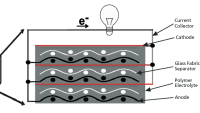
Tech Briefs
Video on Adhesives for Optical Applications
Tech Briefs
Capturing Water from Thin Air

NASA Spinoff
Toxin-Eating Plants

Tech Briefs
First Transformable Nanoscale Electronic Devices
Motion Design
Miniature 3D-Printed Actuators to Control Soft Robots
Photonics & Imaging Technology
Leveraging CAD for Precision in Wide Field Star Imaging and Spectroscopy
Electronics & Sensors INSIDER
Graphene-Based Electronics
Power Electronics INSIDER
An Electrifying Improvement in Copper Conductivity
Tech Briefs
Self-Cleaning Coatings for Space or Earth

Tech Briefs
Thin Film Sensor for Ultra High-Temp Measurement
Overview
The document titled "Fuzzy Fiber Sensors for Structural Composite Health Monitoring" is a preprint authored by K. Lafdi, J. Sebastian, N. Schehl, M. Bouchard, M. Boehle, and L. Linge from the University of Dayton. It discusses the development and application of fuzzy fiber sensors designed to monitor the health of structural composites, which are critical in various engineering applications, particularly in aerospace and defense.
The research focuses on enhancing the reliability and performance of composite materials by integrating fuzzy fiber sensors that can detect structural changes and potential failures. These sensors utilize carbon nanotube (CNT) growth on glass fibers, referred to as "fuzzy glass fibers," which are produced through a chemical vapor deposition process. The study highlights the impact of growth time on the density of CNTs on the glass fibers, indicating that longer growth times result in higher density CNT growth, which is crucial for sensor performance.
The document includes SEM (scanning electron microscopy) micrographs illustrating the differences in CNT density on the glass fibers, showcasing the potential for improved sensor sensitivity and functionality. The authors emphasize the importance of these sensors in real-time health monitoring, which can lead to proactive maintenance and enhanced safety in composite structures.
Additionally, the research is supported by the Department of Defense under contract FA8650-09-C-5324, indicating its relevance to military applications. The authors express gratitude to collaborators, particularly Ron Trejo from the University of Dayton Research Institute, for their assistance in processing composite samples.
Overall, the document presents a significant advancement in the field of structural health monitoring, proposing a novel approach that leverages the unique properties of fuzzy fiber sensors. By integrating these sensors into composite materials, the research aims to improve the detection of structural integrity issues, thereby contributing to the longevity and reliability of critical engineering systems. The findings are positioned to have a broad impact on the development of smart materials and the future of composite technology in various industries.
Top Stories
NewsRF & Microwave Electronics
 Microvision Aquires Luminar, Plans Relationship Restoration, Multi-industry Push
INSIDERAerospace
 A Next Generation Helmet System for Navy Pilots
INSIDERDesign
 New Raytheon and Lockheed Martin Agreements Expand Missile Defense Production
INSIDERMaterials
 How Airbus is Using w-DED to 3D Print Larger Titanium Airplane Parts
NewsPower
 Ford Announces 48-Volt Architecture for Future Electric Truck
ArticlesAR/AI

Webcasts
Electronics & Computers
 Cooling a New Generation of Aerospace and Defense Embedded...
Automotive
 Battery Abuse Testing: Pushing to Failure
Power
 A FREE Two-Day Event Dedicated to Connected Mobility
Unmanned Systems
 Quiet, Please: NVH Improvement Opportunities in the Early Design Cycle
Automotive
 Advantages of Smart Power Distribution Unit Design for Automotive &...
Energy
 Sesame Solar's Nanogrid Tech Promises Major Gains in Drone Endurance