




Structural Composite Batteries
With further development, dual functionality is expected to translate to weight efficiency.
A continuing program of research and development is devoted to the design, fabrication, and testing of polymeric composite- material devices that are multifunctional in the sense that they both store electrochemical energy and bear mechanical loads. It is anticipated that if designed to exhibit sufficient structural and energy efficiencies, these devices could enable significant reductions in the weights of systems in which they could be used, by supplanting electrically inert structural components and conventional batteries while providing supplementary power for lightload applications.
Not only can a device of this type be regarded in its entirety as both a structural component and an electrochemical cell or battery, in addition, each component (the electrodes and electrolyte) of the device is designed to have a desired combination of electrochemical properties and mechanical strength. In the fabrication of the device, these components are integrated by use of costeffective molding processes and other processes that are commonly used in the manufacture of composite-material objects and that can be scaled up to mass production.
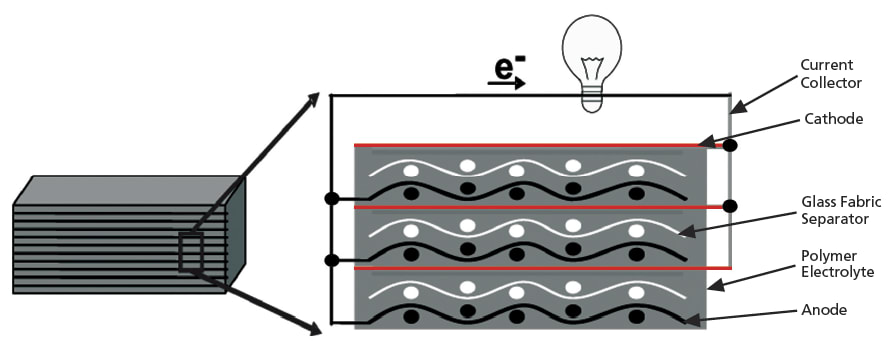
The designs of these structural polymeric composite batteries incorporate lithiumbased electrochemistry, which is chosen because it offers high energy density and compatibility with polymer-based electrolytes. The carbon-fiber fabric anode material (typically, a carbon paper, a mat of nonwoven carbon fibers, or a bidirectional woven carbon fabric) is chosen partly because carbon fibers exhibit sufficient stiffness and strength to afford the desired mechanical reinforcement and sufficient electrical conductivity for transport of electrons into and out of each cell. In addition, for lithium ion battery chemistry, carbon fibers can serve as media for intercalation of lithium ions.
In a cathode, the metal mesh serves as a current collector. The mesh is coated with a thin film comprising a mixture of an active cathode material and a carbon powder. The composition of the mixture and the processing thereof are optimized to obtain high electrochemical capacity, electrical conductivity, rechargeability, and mechanical integrity. LiCoO2 and LiFePO4 are active cathode materials that have been evaluated thus far. The chosen carbon powder is acetylene black, which is highly electrically conductive and is used to optimize the electronic conductivity of the cathode coating film.
For a given battery, electric power and mechanical strength can be increased by using a more processable electrolyte resin that performs well as a thin film. Reducing the thickness of the electrolyte increases the current by increasing the rate of conduction of ions between electrodes. In addition, the ability to fabricate a structural polymeric composite battery using only a small quantity of polymer electrolyte as a binder would enable the incorporation of a relatively large volume fraction of structural electrode materials; as a result, such a battery could have both greater strength and higher charge/discharge capacity than would otherwise be achievable.
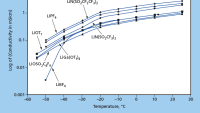
The polymer electrolytes being developed for use in structural polymeric composite batteries can be characterized as load-bearing ion-conductive resins and nanocomposites of those resins. The specific resins receiving the most attention have been polymerized vinyl ester derivatives of poly(ethylene glycol) (PEG). A broad selection of monomers has been complexed with lithium triflate and thermally cured as solvent-free polymers. The etheric oxygen groups of PEG are capable of dissociating and transporting donor salt ions in the absence of solvents, while mechanical strength is provided by crosslinked vinyl ester networks. By varying the proportions, molecular structures, and functionalities of the vinyl ester and PEG constituents, it has been possible to tailor structural and electrolytic properties over wide ranges.
An additional benefit of the specific choice of resins is that their viscosities are low enough that vacuum-assisted resintransfer molding (VARTM) can be used as a processing technique for distribution of monomers through stacked layers and sublayers. In comparison with manuallayup processing techniques, VARTM results in less void content, makes it possible to use higher volume fractions of fibers, and is more readily scalable to mass production.
At the beginning of a typical fabrication process, the various layers and sublayers are stacked and enclosed in a vacuum bag equipped with ports for inflow and outflow of resin. During VARTM, the suction applied to the outflow port causes the resin to be pulled from a reservoir, through the inflow port, through the layers and sublayers, and then through the outflow port. The anode, cathode, and separator sublayers become wetted by the resin. The vacuum bagging causes compaction of the layers, while the glass fabric separators maintain electrical isolation between anodes and cathodes in the face of the compaction. After VARTM, the composite is cured at a temperature of 80 °C in an oven overnight.
This work was done by J. F. Snyder, R. H. Carter, K. Xu, E. I. Wong, P. A. Nguyen, E. H. Hgo, and E. D. Wetzel of the Army Research Laboratory.
This Brief includes a Technical Support Package (TSP).
Structural Composite Batteries
(reference ARL-0022) is currently available for download from the TSP library.
Don't have an account?
More From SAE Media Group
Aerospace & Defense Tech Briefs
Mechanical Aspects of Structural Composite Batteries
Battery & Electrification Technology
Developing Safer Batteries with Solid-State Polymer Electrolytes
Battery & Electrification Technology
Enhancing the Performance of All-Solid-State Batteries
Battery & Electrification Technology
Designing Safer, Higher-Performance Lithium Batteries
Battery & Electrification Technology
Next-Generation Binder for Lithium-ion Batteries


Battery & Electrification Technology
Sodium Battery Is Capable of Rapid Charging in Just a Few Seconds
Battery & Electrification Technology
Cheaper and Safer Battery Storage
Battery Technology
Flexible, Thin-Film Battery
Battery & Electrification Technology
Examining EV Battery Thermal Management
Tech Briefs
Electrochemical Disposal of Hydrazines in Water
Power Management INSIDER
New Technique Extends Next-Generation Lithium Metal Batteries
Power Management INSIDER
A Fluid Solution to Dendrite Growth in Batteries
Battery & Electrification Technology
Recyclable ‘Water Batteries’ That Won’t Catch Fire
Power Electronics INSIDER
Carbon Nanotubes Store Energy
Power Management INSIDER
A New Electrolyte for Lithium-Metal Batteries

Tech Briefs
Low-Current Cathodic Protection of Metal

Tech Briefs
Products of Tomorrow
Electronics & Sensors INSIDER
Powerful Family of Two-Dimensional Materials
Battery & Electrification Technology
Folded or Cut, This Lithium-Sulfur Battery Keeps Going
Tech Briefs
Dry Manufacturing Process for EV Batteries
Automotive Engineering
Launching Aerospace Battery Tech for EVs
Tech Briefs
Flexible Lightweight Radiation Shielding
Battery & Electrification Technology
Iron Could Be Key to Less Expensive, Greener Lithium-Ion Batteries
Battery & Electrification Technology
Material Derived from Trees Could Replace Liquid Electrolytes
Overview
The document titled "Multifunctional Structural Composite Batteries for U.S. Army Applications" is a reprint from the Proceedings of the 2006 Army Science Conference, authored by J. F. Snyder and colleagues from the U.S. Army Research Laboratory. It discusses the development of innovative structural polymeric composites that serve dual purposes: carrying structural loads and storing electrochemical energy. This multifunctionality aims to significantly reduce system-level weight by replacing traditional inert structural components with materials that also provide supplementary power for light load applications.
The report emphasizes the design of battery components that possess both mechanical strength and electrochemical performance. Key components being developed include carbon fiber fabric anodes, cathode-coated metal meshes, and solvent-free structural polymer electrolytes. Each of these components is engineered to exhibit desirable properties that enhance the overall functionality of the battery system.
The integration of these components is facilitated through moldable, scalable, and cost-effective composite processing techniques. This approach not only aims to improve the performance of the batteries but also to make them more practical for military applications, where weight and efficiency are critical factors.
The document outlines the potential benefits of these multifunctional batteries, including the ability to provide power for various applications while simultaneously serving as structural elements. This could lead to significant advancements in the design and functionality of military equipment, enhancing operational capabilities.
The report is approved for public release, indicating its relevance and importance to broader research and development efforts within the military and related fields. It serves as a foundational piece for ongoing research into composite materials that can meet the demanding requirements of modern military applications.
In summary, the document presents a forward-looking perspective on the integration of structural and energy storage capabilities in composite materials, highlighting the potential for significant advancements in military technology through innovative battery design.
Top Stories
INSIDERDefense
 New Raytheon and Lockheed Martin Agreements Expand Missile Defense Production
NewsAutomotive
 Ford Announces 48-Volt Architecture for Future Electric Truck
INSIDERManufacturing & Prototyping
 Active Strake System Cuts Cruise Drag, Boosts Flight Efficiency
ArticlesTransportation
 Accelerating Down the Road to Autonomy
INSIDERMaterials
 How Airbus is Using w-DED to 3D Print Larger Titanium Airplane Parts
Road ReadyTransportation

Webcasts
Electronics & Computers
 Cooling a New Generation of Aerospace and Defense Embedded...
Power
 Battery Abuse Testing: Pushing to Failure
Connectivity
 A FREE Two-Day Event Dedicated to Connected Mobility
Automotive
 Quiet, Please: NVH Improvement Opportunities in the Early Design Cycle
Transportation
 Advantages of Smart Power Distribution Unit Design for Automotive &...
Aerospace
 Sesame Solar's Nanogrid Tech Promises Major Gains in Drone Endurance