




Measuring Impact Damage to Toughened CFRP Laminates with Time Domain Reflectometry
This technique can be used to measure damage to composite aeronautical structures.
Laminated Carbon Fiber Reinforced Polymer (CFRP) composites are very effective in weight saving in aeronautical structural components. For these laminated CFRP structures, it is difficult to detect damage such as delamination, matrix cracks, and local fiber breakages caused by low-velocity impact loading because these damages are difficult to detect from the outside of the structure. This difficulty of inspection of the laminated CFRP structures demands the development of automatic monitoring or damage detection systems.
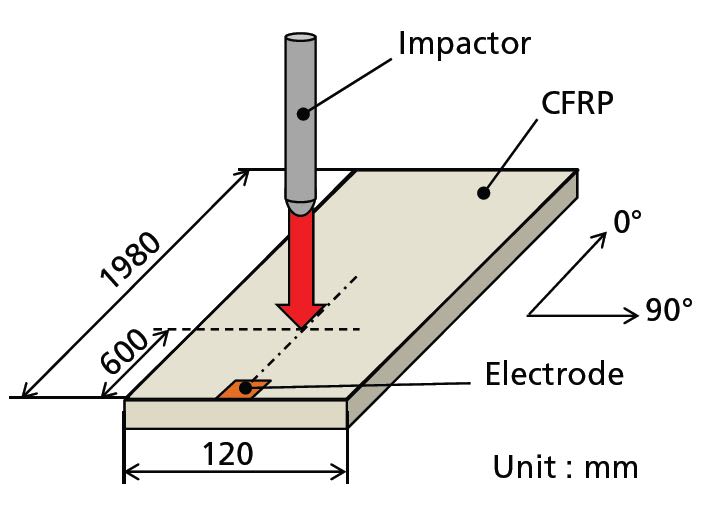
An actual impact loading test was performed, and the Time Domain Reflectometry (TDR) method was applied to detect the impact damage. The TDR method uses a pulse signal in a transmission line. The reflected pulse signal from the transmission line is measured and the result is observed in a figure in which the abscissa is time and the ordinate is the voltage. The TDR method requires a wave generator, an oscilloscope, and a target cable. The wave generator produces a pulse wave signal, which is sent in the directional coupler. The signal propagates only into the target cable because of the directional coupler. Part of the signal is reflected at the input end of the cable because of the slight difference of the characteristic impedance. The other signal propagates in the target cable. The signal input in the target cable is divided into the reflection and transmission at the damaged point. The reflected signal returns back and is measured at the oscilloscope. The time difference between the input signal and reflected signal indicates the distance to the damaged point after multiplication by the speed. Using the TDR method, the damage and its location can be measured.
A narrow-copper-mesh strip is adopted as a transmission line. Usually, copper mesh is adopted as an anti-lightning method for aircraft composite structures. On the surface of a target CFRP plate, a thin GFRP plate is stacked as dielectric material, and a narrow copper strip is placed at the middle of the plate on the thin GFRP plate. The narrow copper mesh strip and the CFRP plate with the GFRP dielectric material make a transmission line with the CFRP plate.
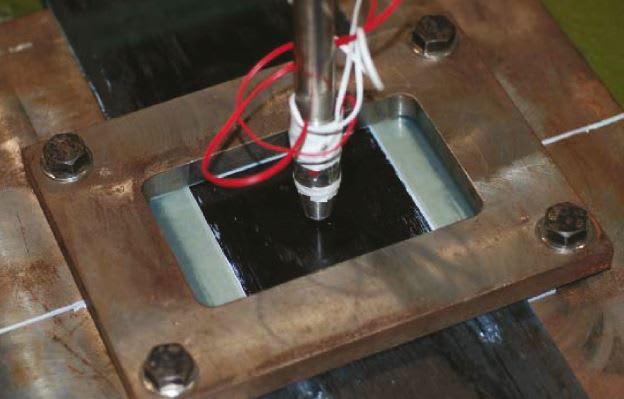
A small dent was observed on the impact surface. The reflected signal from the impact damage is observed at approximately 10 ns. The wave speed can be calculated from the time difference between the input time and the reflected signal from the end. Using the wave speed, the location of the damaged point can be calculated. The calculated damaged point is 0.58 m from the input end terminal. The actual damaged point is 0.6 m. This indicates the method gives good estimation of the impact damage of a composite plate.
Fiber breakages are observed at the dent area because of the fiber microbuckling. Although the fiber breakages have fiber contact, the sudden change of the electric conductance caused the reflection of the impulse signal. This result implies that the TDR method is useful for the detection of actual impact damage of CFRP structures.
This work was done by Akira Todoroki of the Tokyo Institute of Technology for the Air Force’s Asian Office of Aerospace Research and Development. AFRL-0222
More From SAE Media Group

Aerospace & Defense Tech Briefs
‘Nanostitches’ Enable Lighter and Tougher Composite Materials
Aerospace & Defense Tech Briefs
Mechanical Aspects of Structural Composite Batteries
Tech Briefs
Conductive Carbon Fiber Polymer Composite
Electronics & Sensors INSIDER
Researchers Demonstrate a High-Speed Electrical Readout Method for Graphene Nanodevices
Photonics Tech Briefs
Curved Piezoelectric Actuators for Stretching Optical Fibers
Aerospace & Defense Tech Briefs
Fuzzy Fiber Sensors for Structural Composite Health Monitoring
Aerospace & Defense Tech Briefs
Biobased Carbon Fibers and Thermosetting Resins for Use in DOD Composites Applications
Aerospace & Defense Tech Briefs
Biobased Carbon Fibers and Thermosetting Resins for Use in DOD Composites Applications
Medical Design Briefs
Conductive, Cotton-Based Fiber for Smart Textiles

Power Electronics INSIDER
An Electrifying Improvement in Copper Conductivity
Battery & Electrification Technology
Enhancing the Performance of All-Solid-State Batteries

Tech Briefs
Electronics Withstand Extreme Heat
NASA Spinoff
Toxin-Eating Plants
Battery & Electrification Technology
New Products


Aerospace Manufacturing and Machining INSIDER
Can This Self-Healing Composite Make Airplane and Spacecraft Components Last for Centuries?

Tech Briefs
Healable Carbon Fiber Composite
Aerospace INSIDER
Non-Contact Method Measures Aircraft Internal Stresses
Tech Briefs
Automated Tow/Tape Placement System
Tech Briefs
Stretchable Thermoelectric Generators
Electronics & Sensors INSIDER
Piezo Composites with Carbon Fibers for Motion Sensors
Aerospace & Defense Tech Briefs
Advanced CT Inspection and Data Analysis
Top Stories
INSIDERDefense
 New Raytheon and Lockheed Martin Agreements Expand Missile Defense Production
NewsAutomotive
 Ford Announces 48-Volt Architecture for Future Electric Truck
INSIDERManufacturing & Prototyping
 Active Strake System Cuts Cruise Drag, Boosts Flight Efficiency
ArticlesTransportation
 Accelerating Down the Road to Autonomy
INSIDERMaterials
 How Airbus is Using w-DED to 3D Print Larger Titanium Airplane Parts
Road ReadyTransportation

Webcasts
Electronics & Computers
 Cooling a New Generation of Aerospace and Defense Embedded...
Power
 Battery Abuse Testing: Pushing to Failure
Connectivity
 A FREE Two-Day Event Dedicated to Connected Mobility
Automotive
 Quiet, Please: NVH Improvement Opportunities in the Early Design Cycle
Transportation
 Advantages of Smart Power Distribution Unit Design for Automotive &...
Aerospace
 Sesame Solar's Nanogrid Tech Promises Major Gains in Drone Endurance