




Nanostructured Ferromagnetic-Wire/Insulator Composites
High effective permeabilities would translate to high sensitivities for flux-gate magnetometers.
A research and development effort now in progress is focused on nano-structured ferromagnetic- wire/insulator composite materials to be used as the magnetic-core materials of sensors for measuring weak magnetic fields. Figure 1 schematically depicts an example of such a sensor — a flux-gate magnetometer that resembles a traditional orthogonal flux-gate magnetometer except that, instead of a single cylindrical ferromagnetic core, there are multiple parallel ferromagnetic wire cores packed together with insulating material between them. An overriding consideration in the design, fabrication, and operation of such a magnetometer is that high effective magnetic permeability of the core is necessary as one of the prerequisites for obtaining high sensitivity.

- To maximize the effective volume of a given amount of ferromagnetic wire material, the number of wires should be as large as possible — in other words, the wires should be as narrow as possible — leading to the requirement of nanoscale wires.
- For maximum dynamic domain unification, the ferromagnetic wires should be intimately close to each other with insulation between them — leading to the requirement of a nanostructured array.
- In operation, all of the wires should be excited by a current of sufficient amplitude at the dynamic-domain-unification frequency in order to maximize the effective magnetic permeability.
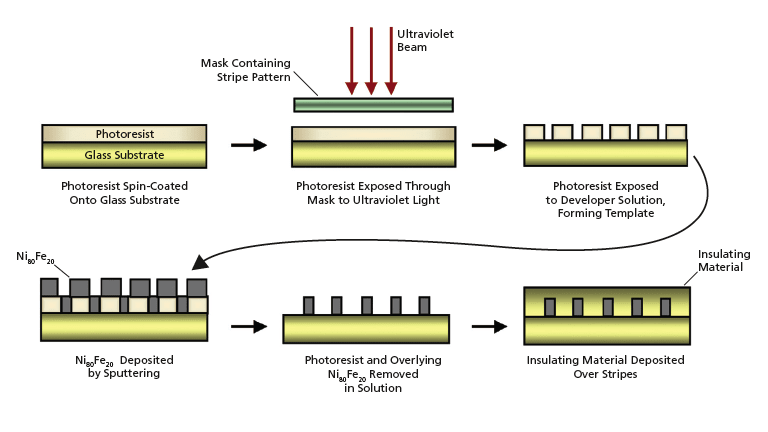
The development effort has also included design, fabrication, and characterization of specimens, containing small numbers of nanoscale ferromagnetic stripe, pillar, and wire structures, as prototypes for assessing feasibility of fabricating ferromagnetic/insulator cores containing large numbers of wires in nanostructured arrays. The ferromagnetic material that has been used in this effort is permalloy (Ni80Fe20). Arrays of nanoscale Ni80Fe20 stripes have been synthesized by use of a combination of lithography and sputtering (see Figure 2). Template-assisted electrodeposition has been demonstrated to be feasible as a means of fabricating arrays of microscale Ni80Fe20 wires (the nanoscale has not yet been reached because of limitations on the means available for drilling narrow holes in templates). It was shown to be possible to fabricate ferromagnetic wires by electrodeposition of Ni80Fe20 onto Cu wires held at the desired lateral distances in a custom fixture. (It is envisioned that the wires would later be potted in epoxy, and the resulting workpiece would be machined to the final desired core size and shape).
In view of the limitations and difficulties of the fabrication approaches tested thus far, an alternative approach has been conceived for future testing: A large number of insulator/Ni80Fe20/Cu rods would be packed together and subjected to repeated cold drawing or cold rolling steps until each rod was reduced to the desired microscale or nanoscale width.
This work was done by Xiaoping Li of the National University of Singapore.
NUS-0001
More From SAE Media Group

Tech Briefs
Improved Sensing Coils for SQUIDs


Power Electronics INSIDER
Breakthrough Iron-Based Magnetic Material for Next-Generation Power Electronics
Power Electronics INSIDER
Diamond Quantum Imaging Can Enable Next-Gen Power Electronics
Aerospace & Defense Tech Briefs
Fuzzy Fiber Sensors for Structural Composite Health Monitoring
Electronics & Sensors INSIDER
Researchers Develop Ultra-Sensitive Device for Detecting Magnetic Fields
Aerospace & Defense Tech Briefs
Development of High-Resolution Eddy Current Imaging Using an Electromechanical Sensor


Tech Briefs
Electron-Spin Filters Based on the Rashba Effect
Aerospace & Defense Tech Briefs
Expanding Possibilities for Superconducting Qubits With Niobium
Electronics & Sensors INSIDER
Novel Nanowire Fabrication Technique Paves Way for Next Generation Spintronics

Aerospace & Defense Tech Briefs
Physicists Measure a Key Aspect of Superconductivity in ‘Magic-Angle’ Graphene
Tech Briefs
First Transformable Nanoscale Electronic Devices
Tech Briefs
VaCNT Makes Up a Promising Membrane Material
Battery & Electrification Technology
Designing Safer, Higher-Performance Lithium Batteries
Electronics & Sensors INSIDER
Novel Approach to Advanced Electronics and Data Storage with Ferroelectricity
Electronics & Sensors INSIDER
Blocking Electromagnetic Radiation with the Flip of a Switch
Tech Briefs
Integrated Arrays of Ion-Sensitive Electrodes


Tech Briefs
Iodine-Compatible Hall Effect Thruster
Software Tech Briefs
Surface Plasmon Resonance
Tech Briefs
University of Pennsylvania School of Engineering
Top Stories
NewsRF & Microwave Electronics
 Microvision Aquires Luminar, Plans Relationship Restoration, Multi-industry Push
INSIDERAerospace
 A Next Generation Helmet System for Navy Pilots
INSIDERDesign
 New Raytheon and Lockheed Martin Agreements Expand Missile Defense Production
INSIDERMaterials
 How Airbus is Using w-DED to 3D Print Larger Titanium Airplane Parts
NewsPower
 Ford Announces 48-Volt Architecture for Future Electric Truck
ArticlesAR/AI

Webcasts
Electronics & Computers
 Cooling a New Generation of Aerospace and Defense Embedded...
Automotive
 Battery Abuse Testing: Pushing to Failure
Power
 A FREE Two-Day Event Dedicated to Connected Mobility
Unmanned Systems
 Quiet, Please: NVH Improvement Opportunities in the Early Design Cycle
Automotive
 Advantages of Smart Power Distribution Unit Design for Automotive &...
Energy
 Sesame Solar's Nanogrid Tech Promises Major Gains in Drone Endurance