




Latest Stories
Briefs Materials
New Cryogenic Shape Memory Alloy Designed for Outer Space
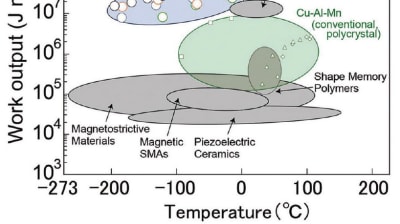
A study led by Tohoku University, Iwate University, The Japan Aerospace Exploration Agency (JAXA), National Astronomical Observation of Japan, Tokyo City University, and Kyoto University developed a novel copper-based alloy that exhibits a special shape memory effect at temperatures as low as -200 °C. Read on to learn more.
Products Sensors/Data Acquisition
New Products
See the new products, including Microchip Technology's PolarFire® Core Field-Programmable Gate Arrays and System on Chips; an electromechanical subsea actuator from WITTENSTEIN motion control Gmbh; PI's expansion of its PICMA® piezo stack actuator series; Samtec, Inc.'s microwave cable assemblies using Nitrowave™ cable technology; and more.

Articles Defense
Reclaiming Readiness: Advancing US Defense Through Scalable Additive Manufacturing
It is critical to demonstrate that the United States can readily maintain its defense capabilities even if current conventional supply chains break down or critical manufacturing hubs come under threat. This is where advanced manufacturing in general and additive manufacturing (AM) specifically stands out not as a futuristic technology promise, but as a practical and proven production solution that directly supports our defense industrial base and mission assurance. Read on to learn more.

Articles Research Lab
When Innovation Outpaces Infrastructure: R&D’s New Reality in Aerospace
Aerospace research and development is at a turning point. Emerging technologies promise faster and more efficient systems, but also expose deep limitations in aging infrastructure, siloed processes, and manual workflows. The growing disconnect between technological advances and the physical and organizational infrastructures that support them creates a bottleneck to industry progress. Read on to learn what this means.

Articles Aerospace
Confidence Through Testing: How to Design a Practical Structural Test Program
Here, we share a practical approach to building a structural testing strategy grounded in real-world challenges.

Articles Aerospace
The Tug-of-War Between Speed and Strength
Here, Jeff Wood, from mil-spec cable specialist WireMasters, explains the importance of both performance and resilience in wiring solutions for aviation and military, and how to find a middle ground that best fits the application.

Articles Communications
101st Combat Aviation Brigade Makes History with First MUOS Connectivity in a Helicopter
In a groundbreaking achievement, the 101st Combat Aviation Brigade, 101st Airborne Division earlier this year became the first unit to successfully use the Mobile User Objective System function of the Army/Navy Portable Radio Communications (AN/PRC) 158 and 162 radios for conventional rotary wing operations. Read on to learn more.

Articles Aerospace
Are Military Avionics Systems Ready for Artificial Intelligence?
This article highlights trends across several industry partnerships, demonstration flights and the enabling elements that are providing opportunities to integrate AI and ML into military avionics systems. Read on to learn more.

Application Briefs Weapons Systems
A400M DIRCM Upgrades
Airbus has been awarded a contract from the German procurement agency Bundesamt für Ausrüstung, Informationstechnik und Nutzung der Bundeswehr (BAAINBw) to equip 23 Luftwaffe A400Ms with DIRCM protection systems. Read on to learn more.

Application Briefs Aerospace
G5000 Prime Flight Deck
Garmin introduced its new G5000 PRIME flight deck for Part 25 transport aircraft at the 2025 Paris Air Show. Read on to learn more.

Application Briefs Manned Systems
Spyder Rocket’s First Hypersonic Flight
UP Aerospace has achieved a significant milestone with the successful launch of its high-performance Spyder rocket. The maiden flight took place at Launch Complex 36, in White Sands, New Mexico, marking a new era in hypersonic mission capabilities. Read on to learn more.

Application Briefs Aerospace
Hybrid Electric EWIS System
GKN Aerospace has completed and delivered the first high voltage Electrical Wiring Interconnection System for the Clean Aviation SWITCH project. Read on to learn more.

Briefs Manufacturing & Prototyping
New Laser Technique Revolutionizes Ultra-High Ceramic Manufacturing for Spacecraft
A new technique that leverages the concept of sintering, can be used to create ceramic coatings, tiles or complex three-dimensional structures, which allows for increased versatility when engineering new devices and technologies. Read on to learn more about it.

Briefs Mechanical & Fluid Systems
A Twist in Topology Optimization Leads to High-Performing Heat Exchanger
By combining topology optimization and additive manufacturing, a team of University of Wisconsin-Madison engineers created a twisty high-temperature heat exchanger that outperformed a traditional straight channel design in heat transfer, power density and effectiveness. Read on to learn more.

Briefs Materials
New Copper Alloy Could Provide Breakthrough in Durability for Military Systems
U.S. Army researchers, in collaboration with academic partners, invented a stronger copper that could help advance defense, energy and aerospace industries thanks to its ability to endure unprecedented temperature and pressure extremes. Read on to learn more.

Products Electronics & Computers
New Products
See the new products, including Microchip's BR235 and BR235D series of 25A QPL hermetically sealed electromechanical power relays; PIC Wire & Cable’s new Single Pair Ethernet; Galleon Embedded Computing's high performance recorder (HPR); Pixus Technologies' new SOSA aligned ATR enclosures utilizing the 3U OpenVPX form factor; and more.

Articles RF & Microwave Electronics
Pushing the Boundaries of Rapid Production of Spacecraft: Flight Results from NearSpace Launch’s TROOP and ThinSat Platforms
NearSpace Launch is actively redefining the boundaries of responsive spaceflight through its development and deployment of the Train Rapid on Orbit Payload (TROOP) and ThinSat platforms. Read on to learn more.
Articles RF & Microwave Electronics
Transforming Satellite Antenna Technology for the Next Era of Aerospace and Defense
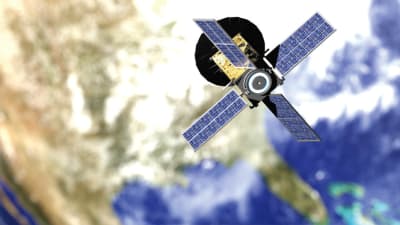
The global satellite communications sector is undergoing profound transformation. Read on to learn more about it.

Articles Aerospace
Legacy in Action: The Enduring Role of MIL-STD-1553B
In an industry where failure is not an option, the enduring strength of MIL-STD-1553B — and the innovations keeping it relevant — serve as a powerful reminder that sometimes, the best way forward is to build on the foundations that have already proven their worth. Read on to learn more.

Articles RF & Microwave Electronics
Are Defense Satellites Ready for Space-Based Laser Communications?
The Department of Defense is developing technology for satellites to communicate via lasers. Laser communications could transmit data faster and more securely than traditional radio frequency communications. Read on to learn more.

Articles Photonics/Optics
Microcomb Chips Could Improve Accuracy of GPS Systems
The optical atomic clocks that exist today are bulky and require complex laboratories with specific laser settings and optical components, making it difficult to use them outside lab environments, such as in satellites, remote research stations, or drones. Now, a research team has developed a technology that makes optical atomic clocks significantly smaller and accessible for more widespread use in society. Read on to learn more.

Articles Design
IQSat: Aitech’s AI-Enabled Picosatellite for Earth Observation and Imaging Applications
Aitech introduced its new AI-enabled picosatellite constellation platform, IQSat, at the 40th annual Space Symposium in April. The platform is designed to bring ready to use COTS embedded computing to data heavy earth imaging and pattern recognition applications. Read on to learn more.

Application Briefs RF & Microwave Electronics
Synthetic Aperture Radar Satellites for UK Defense
Airbus has been awarded the U.K. Ministry of Defense’s Oberon contract to design and build two Synthetic Aperture Radar satellites with day-and-night, all-weather, space-based ‘Intelligence, Surveillance and Reconnaissance’ (ISR) capability. Read on to learn more.
Application Briefs Photonics/Optics
Breakthrough in Long-Haul Laser Communication Capabilities
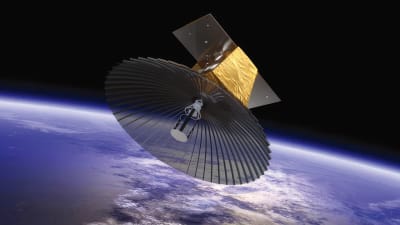
BlueHalo announced the successful milestone demonstration of its two-terminal long-haul, multi-orbit laser communication system. The achievement marks a significant breakthrough in the development of space-based laser communication technology with far-reaching implications for national security and commercial sectors. Read on to learn more.

Application Briefs Manned Systems
Electronically Steered Array Antennas for E2 Jets
Embraer has finalized an agreement with Intelsat to install its high-speed in-flight connectivity system on their E-Jet E2s during aircraft production. The system, with transmission speeds up to 275 Mbps, gives passengers a similar in-flight streaming and surfing experience to their home networks. Read on to learn more.

Application Briefs RF & Microwave Electronics
In-Orbit Commercial Spacecraft Undocking
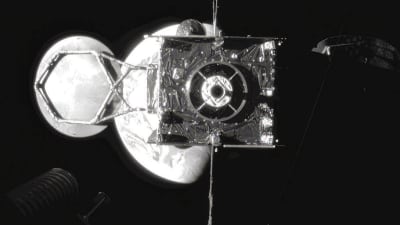
A Mission Extension Vehicle developed by Northrop Grumman’s Space Logistics LLC has successfully undocked with Intelsat’s IS-901 satellite, completing its life extension service. This marks the first undocking between two commercial spacecraft in the geosynchronous earth orbit graveyard. Read on to learn more.
Briefs Energy
Thermoelectric Generators Could Convert Waste Heat to Clean Energy in Jet Engines and Spacecraft
Thermoelectric generators that can convert waste heat to clean energy could soon be as efficient as other renewable energy sources, like solar, according to a team led by Penn State scientists. Using high-entropy materials, the researchers created more efficient thermoelectric materials than previously possible, an advancement that they said could even help make long-distance space exploration possible. Read on to learn more.

Briefs Aerospace
Improving Electric Propulsion Thrusters for Future Spacecraft Missions
Go faster, farther, more efficiently. That’s the goal driving spacecraft propulsion engineers like Chen Cui, a new assistant professor at the University of Virginia School of Engineering and Applied Science. Cui is exploring ways to improve electric propulsion thrusters — a key technology for future space missions. Read on to learn more.

Briefs Manned Systems
A Satellite to Detect Short Gamma-Ray Burst Emissions
The U.S. Naval Research Laboratory (NRL), in partnership with NASA’s Marshall Space Flight Center (MSFC), has developed StarBurst, a small satellite (SmallSat) instrument for NASA’s StarBurst Multimessenger Pioneer mission, which will detect the emission of short gamma-ray bursts (GRBs), a key electromagnetic (EM) signature that will contribute to the understanding of neutron star (NS) mergers. Read on to learn more.

Top Stories
INSIDERManufacturing & Prototyping
 How Airbus is Using w-DED to 3D Print Larger Titanium Airplane Parts
NewsAutomotive
 Microvision Aquires Luminar, Plans Relationship Restoration, Multi-industry Push
INSIDERManufacturing & Prototyping
 A Next Generation Helmet System for Navy Pilots
INSIDERManufacturing & Prototyping
 New Raytheon and Lockheed Martin Agreements Expand Missile Defense Production
ArticlesTransportation
 Accelerating Down the Road to Autonomy
Road ReadyDesign

Webcasts
Electronics & Computers
 Advantages of Smart Power Distribution Unit Design for Automotive...
Transportation
 Quiet, Please: NVH Improvement Opportunities in the Early Design...
Defense
 Cooling a New Generation of Aerospace and Defense Embedded...
Power
 Battery Abuse Testing: Pushing to Failure
Internet of Things
 A FREE Two-Day Event Dedicated to Connected Mobility
