




A Satellite to Detect Short Gamma-Ray Burst Emissions
Physicists at the Naval Research Laboratory are collaborating with several universities throughout the U.S. to develop a small satellite that will detect the emission of short gamma-ray bursts.

The U.S. Naval Research Laboratory (NRL), in partnership with NASA’s Marshall Space Flight Center (MSFC), has developed StarBurst, a small satellite (SmallSat) instrument for NASA’s StarBurst Multimessenger Pioneer mission, which will detect the emission of short gamma-ray bursts (GRBs), a key electromagnetic (EM) signature that will contribute to the understanding of neutron star (NS) mergers.
NRL transferred the instrument to NASA on March 4 for the next phase, environmental testing. From there, the instrument will be integrated onto the spacecraft bus, followed by launch into Low Earth Orbit in 2027. StarBurst will be installed as a secondary payload via the Evolved Expendable Launch Vehicle Secondary Payload Adapter Grande interface with a mission duration of one year, with the option of extension.
“StarBurst represents a significant leap forward in gamma-ray astronomy,” said Richard S. Woolf, Ph.D., Research Physicist with NRL’s Space Science Division. “Our team at NRL has drawn upon years of expertise in detector development to create an instrument that is both highly sensitive and cost-effective. StarBurst will play a critical role in the exciting new era of multimessenger astronomy, allowing us to study neutron star mergers in unprecedented detail.”
NS collisions are significant cosmic events and are recently understood as major producers of heavy elements such as gold and uranium. This process, known as nucleosynthesis, involves the formation of new atomic nuclei and occurs in various astrophysical settings, including neutron star mergers, supernovae, stellar burning, and the Big Bang.
The StarBurst Multimessenger Pioneer is a wide-field gamma-ray observatory focused on detecting short-duration bursts of gamma-rays that are produced following NS mergers that are observed via the gravitational waves that they produce. The combination of the gamma-ray and gravitational-wave signals provides fundamental insight into the parent stars and the physics of these extreme explosions. With an effective area four times greater than the Fermi Gamma-ray Burst Monitor – the most sensitive monitor currently on orbit – it will provide full coverage of the unobscured sky.
The enhanced sensitivity due to the large collecting area of the telescope will make StarBurst a vital partner to the gravitational wave network. This will significantly increase the detection rate of EM counterparts to NS mergers at a fraction of the cost of current gamma-ray missions.
The fundamental properties of the gamma-ray bursts measured by StarBurst will give scientists a representative picture of the ensemble properties of remnant explosions following NS mergers, for the first time.
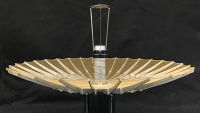
The StarBurst Sensor Head comprised of 12 thallium-doped cesium iodide (CsI:Tl) scintillation detectors, each utilizing a custom array of low-mass, low-voltage silicon photomultipliers (SiPMs), is designed to allow StarBurst to detect GRBs in an energy range from 50 keV to 2000 keV, optimizing its sensitivity.
The instrument’s design is inspired by NRL’s successful technology demonstrator, Glowbug, led by J. Eric Grove, Ph.D., NRL Space Science Division Acting Superintendent, which recently concluded a highly productive mission on the International Space Station, detecting numerous GRBs and contributing to important astrophysical research.
StarBurst is a collaborative effort. MSFC leads the mission and partners with NRL, the University of Alabama Huntsville, the Universities Space Research Association, and the University of Toronto Institute for Aerospace Studies Space Flight Laboratory.
This article was written by Emily Winget for the Naval Research Laboratory. For more information, contact
More From SAE Media Group
NASA Spinoff
A Huge Development for Tiny Satellites
Aerospace & Defense Tech Briefs
NASA Demonstrates a First-of-Its-Kind Space Communications

Aerospace & Defense Tech Briefs
NanoAvionics Satellite Suffers Space Debris Impact, Selfie Image Shows Damage
Tech Briefs
7 Space Sustainability Startups
NASA Spinoff
Make Way for Satellites
NASA Spinoff
Keeping the Connection

NASA Spinoff
Cloud Software for Above the Clouds
Photonics & Imaging Technology INSIDER
NASA Targets 2026 for Launch of Israel's First Space Telescope
Tech Briefs
Building Technology to Clean Up Space
Aerospace INSIDER
Boeing's New Approach to 3D Printing Solar Arrays for Satellites
Aerospace INSIDER
NASA Seeks Space Technologies for Suborbital and Orbital Flight Tests

NASA Spinoff
Ion Thrusters Keep Satellites Going and Going

Aerospace INSIDER
Three Companies to Build New Multi-Orbit Logistics Prototype Spacecraft
Aerospace & Defense Tech Briefs
Breakthrough in Long-Haul Laser Communication Capabilities
Aerospace & Defense Tech Briefs
In-Orbit Commercial Spacecraft Undocking
Aerospace INSIDER
Assembly and Testing Milestone for Artemis II Spacecraft
Aerospace INSIDER
Blue Ghost Arrives in Lunar Orbit, Prepares for Landing

Aerospace & Defense Tech Briefs
Firefly Aerospace Is the Latest Addition to Florida’s “Space Coast”
Aerospace & Defense Tech Briefs
In-Space Upgrade Satellite System
Tech Briefs
Lunar Surface Navigation System

Top Stories
INSIDERDefense
 New Raytheon and Lockheed Martin Agreements Expand Missile Defense Production
NewsAutomotive
 Ford Announces 48-Volt Architecture for Future Electric Truck
INSIDERManufacturing & Prototyping
 Active Strake System Cuts Cruise Drag, Boosts Flight Efficiency
ArticlesTransportation
 Accelerating Down the Road to Autonomy
INSIDERMaterials
 How Airbus is Using w-DED to 3D Print Larger Titanium Airplane Parts
Road ReadyTransportation

Webcasts
Electronics & Computers
 Cooling a New Generation of Aerospace and Defense Embedded...
Power
 Battery Abuse Testing: Pushing to Failure
Connectivity
 A FREE Two-Day Event Dedicated to Connected Mobility
Automotive
 Quiet, Please: NVH Improvement Opportunities in the Early Design Cycle
Transportation
 Advantages of Smart Power Distribution Unit Design for Automotive &...
Aerospace
 Sesame Solar's Nanogrid Tech Promises Major Gains in Drone Endurance