




New Laser Technique Revolutionizes Ultra-High Ceramic Manufacturing for Spacecraft
Researchers have demonstrated a new technique that uses lasers to create ceramics that can withstand ultra-high temperatures, with applications ranging from nuclear power technologies to spacecraft and jet exhaust systems.
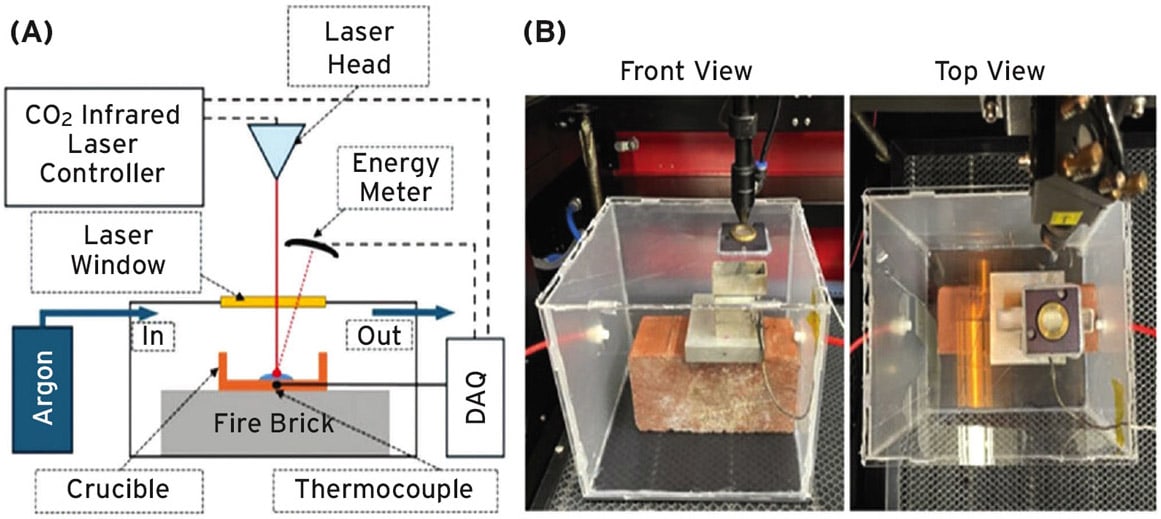
A new technique that leverages the concept of sintering, can be used to create ceramic coatings, tiles or complex three-dimensional structures, which allows for increased versatility when engineering new devices and technologies.
“Sintering is the process by which raw materials – either powders or liquids – are converted into a ceramic material,” says Cheryl Xu, co-corresponding author of a paper on this research and a Professor of Mechanical and Aerospace Engineering at North Carolina State University (NCSU). “For this work, we focused on an ultrahigh temperature ceramic called hafnium carbide (HfC). Traditionally, sintering HfC requires placing the raw materials in a furnace that can reach temperatures of at least 2,200 degrees Celsius – a process that is time-consuming and energy intensive.
“Our technique is faster, easier and requires less energy.”
The new technique works by applying a 120-watt laser to the surface of a liquid polymer precursor in an inert environment, such as a vacuum chamber or a chamber filled with argon. The laser sinters the liquid, turning it into a solid ceramic. This can be used in two different ways.
First, the liquid precursor can be applied as a coating to an underlying structure, such as carbon composites used in hypersonic technologies like missiles and space exploration vehicles. The precursor can be applied to the surface of the structure and then sintered with the laser.
“Because the sintering process does not require exposing the entire structure to the heat of the furnace, the new technique holds promise for allowing us to apply ultra-high temperature ceramic coatings to materials that may be damaged by sintering in a furnace,” Xu says.
The second way that engineers can make use of the new sintering technique involves additive manufacturing, also known as 3D printing. Specifically, the laser sintering method can be used in conjunction with a technique that is similar to stereolithography.
In this technique, a laser is mounted on a table that sits in a bath of the liquid precursor. To create a three-dimensional structure, researchers create a digital design of the structure and then “slice” that structure into layers. To begin, the laser draws the profile of the first layer of the structure in the polymer, filling the profile in as if coloring in a picture. As the laser “fills in” this area, thermal energy converts the liquid polymer into ceramic. The table then lowers a little bit further into the polymer bath, and a blade sweeps across the top to even out the surface. The laser then sinters the second layer of the structure, and this process repeats itself until you have a finished product made of the sintered ceramic.
“It’s actually a bit of an oversimplification to say that the laser is only sintering the liquid precursor,” Xu says. “It is more accurate to say that the laser first converts the liquid polymer into a solid polymer and then converts the solid polymer into a ceramic. However, all of this happens very quickly – it’s essentially a one-step process.”
In proof-of-concept testing, the researchers demonstrated that the laser sintering technique produced crystalline, phasepure HfC from a liquid polymer precursor.
“This is the first time we know of where someone was able to create HfC of this quality from a liquid polymer precursor,” Xu says. “And ultra-high temperature ceramics, as the name suggests, are useful for a wide range of applications where technologies must withstand extreme temperatures, such as nuclear energy production.”
The researchers also demonstrated that laser sintering could be used to create high quality HfC coatings of carbon-fiber reinforced carbon composites (C/C). Basically, the ceramic coating bonded to the underlying structure and didn’t peel away.
“The HfC coatings on C/C substrates demonstrated strong adhesion, uniform coverage, and potential for use as thermal protection and an oxidation resistant layer,” Xu says. “This is particularly useful because, in addition to hypersonic applications, carbon/carbon structures are used in rocket nozzles, brake discs and aerospace thermal protection systems such as nose cones and wing leading edges.”
The new laser sintering technique is also significantly more efficient than conventional sintering in several ways.
“Our technique allows us to create ultra-high temperature ceramic structures and coatings in seconds or minutes, whereas conventional techniques take hours or days,” Xu says. “And because laser sintering is faster and highly localized, it uses significantly less energy. What’s more, our approach produces a higher yield. Specifically, laser sintering converts at least 50 percent of the precursor mass into ceramic. Conventional approaches typically convert only 20-40 percent of the precursor.
“Lastly, our technique is relatively portable,” Xu says. “Yes, it has to be done in an inert environment, but transporting a vacuum chamber and additive manufacturing equipment is much easier than transporting a powerful, large-scale furnace.
“We are excited about this advance in ceramics and are open to working with public and private partners to transition this technology for use in practical applications,” says Xu.
This article was written by Matt Shipman, Assistant Director of Research Communications, North Carolina State University. It has been edited. For more information, contact
More From SAE Media Group
Aerospace Manufacturing and Machining INSIDER
Researchers Push Limits in High-Temp, Polymer Additive Manufacturing
Aerospace & Defense Tech Briefs
Streamlining Post-Processing in Additive Manufacturing
Aerospace INSIDER
Can Neutrons Improve 3D-Printing of Aluminum Aerospace Components?

Aerospace & Defense Tech Briefs
Additive Manufacturing Utilizing a Novel In-Line Mixing System for Design of Functionally Graded Ceramic Composites
Tech Briefs
3D-Printed Composites for High-Temperature Uses
Aerospace & Defense Tech Briefs
Physics-Guided Neural Network for Regularization and Learning Unbalanced Data Sets

Automotive Engineering
Lyten Says 3D Graphene Could Disrupt Racing, Automotive and Space

Aerospace Manufacturing and Machining INSIDER
Can This Self-Healing Composite Make Airplane and Spacecraft Components Last for Centuries?
Aerospace Manufacturing and Machining INSIDER
How Airbus is Using w-DED to 3D Print Larger Titanium Airplane Parts
Tech Briefs
Strong, Stretchy, 3D-Printed Metamaterials
Aerospace Manufacturing and Machining INSIDER
Supernova to 3D Print Military Grade Energetic Materials
Aerospace & Defense Tech Briefs
Next Generation Carbon Fiber Composites 3D Printer for Hypersonic Research
Aerospace & Defense Tech Briefs
Plasma Surface Activation for Stronger, More Durable CFRP Bonds in Aerospace
NASA Spinoff
3D Printable Alloy Can Take the Heat
Medical Manufacturing and Fabrication
Electrochemical Etching Improves 3D printing of metals
Automotive Engineering
3D-Printed High-Temperature Ceramics


Tech Briefs
Using 3D Printing to Strengthen Jet Engines
Medical Design Briefs
New Products and Services
Medical Design Briefs
Reimagining Innovation: Additive Manufacturing
Medical Design Briefs INSIDER
New Process Could Enable 3D Printing of Nanoscale Implants
Tech Briefs
High-Color-Purity 3D Printing
Aerospace INSIDER
Air Force Wind Tunnel Team Takes 3D Printing Program to Next Dimension
Top Stories
NewsAutomotive
 Microvision Aquires Luminar, Plans Relationship Restoration, Multi-industry Push
INSIDERDesign
 A Next Generation Helmet System for Navy Pilots
INSIDERWeapons Systems
 New Raytheon and Lockheed Martin Agreements Expand Missile Defense Production
NewsPower
 Ford Announces 48-Volt Architecture for Future Electric Truck
INSIDERAerospace
 Active Strake System Cuts Cruise Drag, Boosts Flight Efficiency
ArticlesTransportation

Webcasts
Aerospace
 Cooling a New Generation of Aerospace and Defense Embedded...
Test & Measurement
 Battery Abuse Testing: Pushing to Failure
Internet of Things
 A FREE Two-Day Event Dedicated to Connected Mobility
Transportation
 Quiet, Please: NVH Improvement Opportunities in the Early Design Cycle
Electronics & Computers
 Advantages of Smart Power Distribution Unit Design for Automotive &...
Aerospace
 Sesame Solar's Nanogrid Tech Promises Major Gains in Drone Endurance