




Plasma Surface Activation for Stronger, More Durable CFRP Bonds in Aerospace
Carbon fiber–reinforced polymers (CFRPs) have become essential in modern aerospace structures, from fuselage skins and wing components to nacelles, interior structures, and a growing range of primary load-bearing parts. Their high strength-to-weight ratio delivers major benefits in fuel efficiency, payload capacity, and fatigue performance. Yet achieving reliable adhesive bonds on CFRP surfaces remains a persistent engineering challenge. The low intrinsic surface energy of composites — particularly under thermal cycling, vibration, and moisture exposure — limits bond durability unless surfaces are properly prepared.
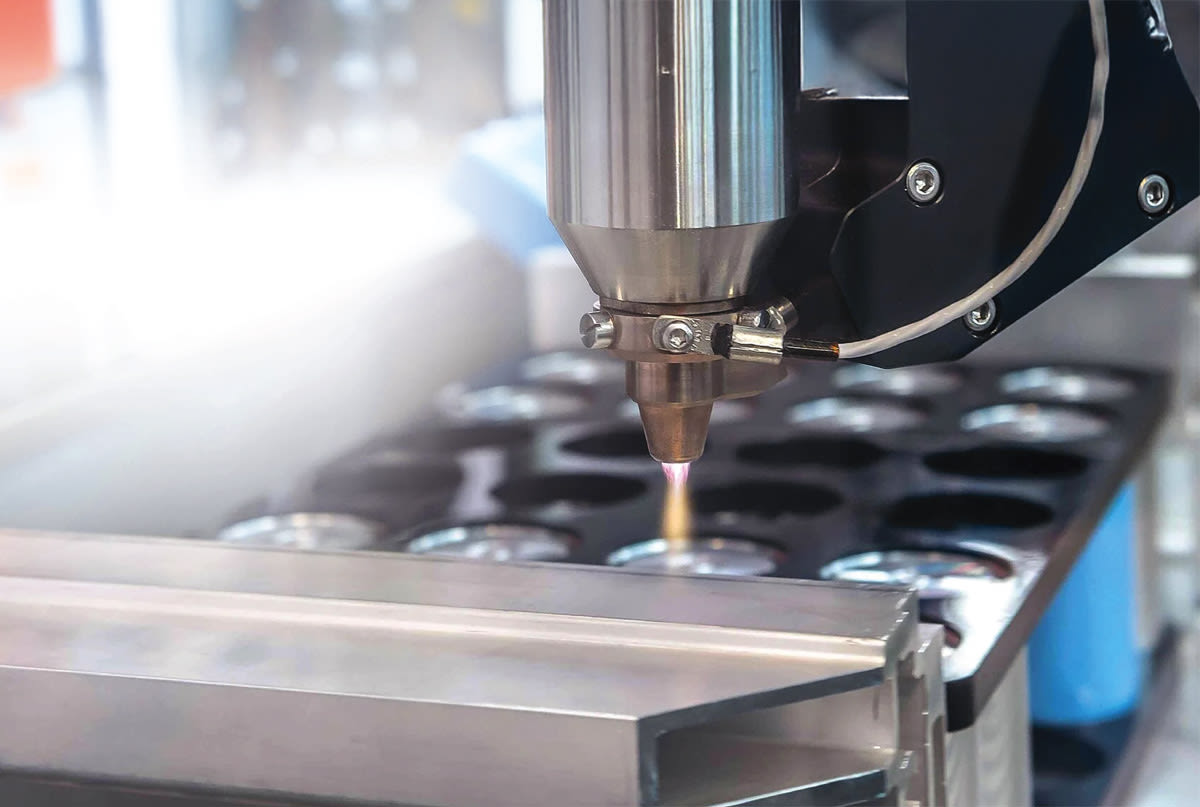
Plasma surface treatment has emerged as a pivotal solution, offering a fast, controllable, and non-destructive way to increase surface energy, improve wettability, and enhance adhesion across complex geometries. This is especially important as the aerospace industry transitions from thermoset to thermoplastic composites (TPCs), which enable faster processing, lower production costs, and better recyclability.
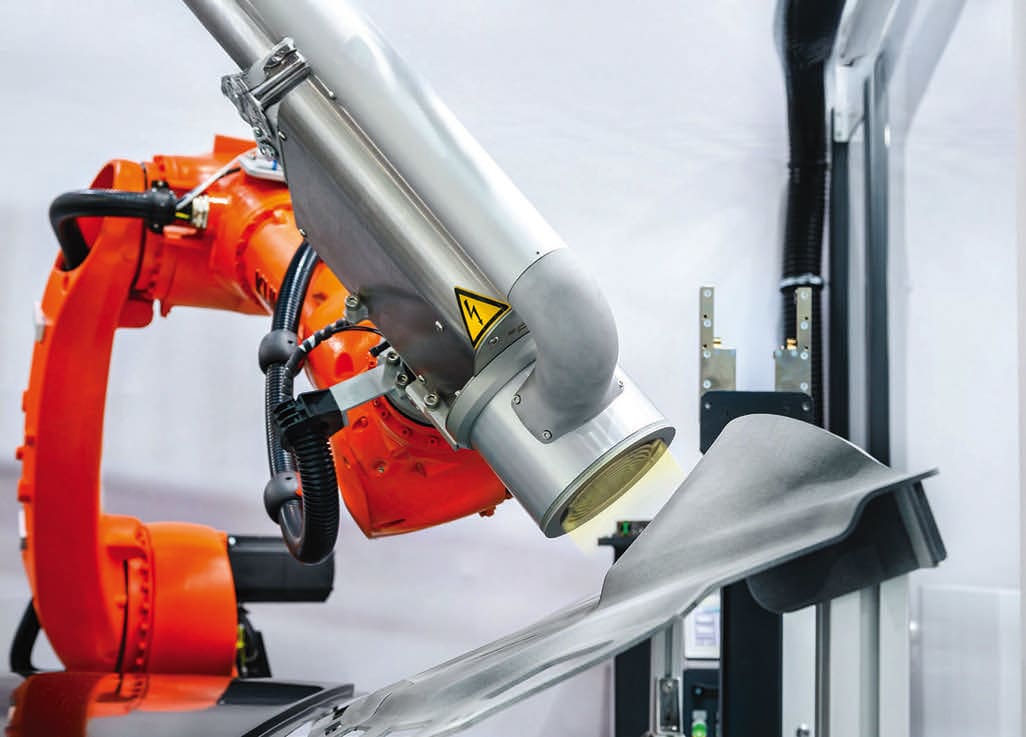
Thermoplastics are even more difficult to bond: their extremely low surface energy makes mechanical roughening largely ineffective. Plasma activation overcomes this barrier by introducing polar functional groups directly onto the polymer surface — without abrasion, solvents, or primers — enabling strong, durable bonding to metals, coatings, and other polymers. As adoption of thermoplastic composites accelerates, plasma treatment is becoming not just an enhancement but an essential enabler for next-generation aerospace manufacturing.
What is Plasma?
Plasma is an ionized gas composed of electrons, ions, radicals, and excited neutral species. Often called the “fourth state of matter,” plasma is generated when sufficient energy is applied to a gas to cause partial ionization. The resulting medium is electrically quasi-neutral and chemically active, capable of initiating a wide range of surface reactions. In aerospace manufacturing, these energetic species clean, activate, and functionalize composite or metallic surfaces — removing contaminants, creating polar functional groups, and improving adhesion to adhesives and coatings.
When applied to CFRPs, plasma provides a highly controllable surface activation method that overcomes the low surface energy characteristic of composites. Unlike sanding or grit blasting, which can damage fibers and introduce variability, plasma treatment is non-destructive and repeatable. Polar functional groups such as hydroxyl, carbonyl, and carboxyl groups form stronger secondary bonds with adhesives, increasing the energy required to separate bonded surfaces. This molecular-level activation is critical for consistent bond performance across complex composite geometries, supporting stronger, more reliable joints in both commercial and military aircraft.
Low-Pressure Plasma: Uniform, Immersive Treatment at Production Scale
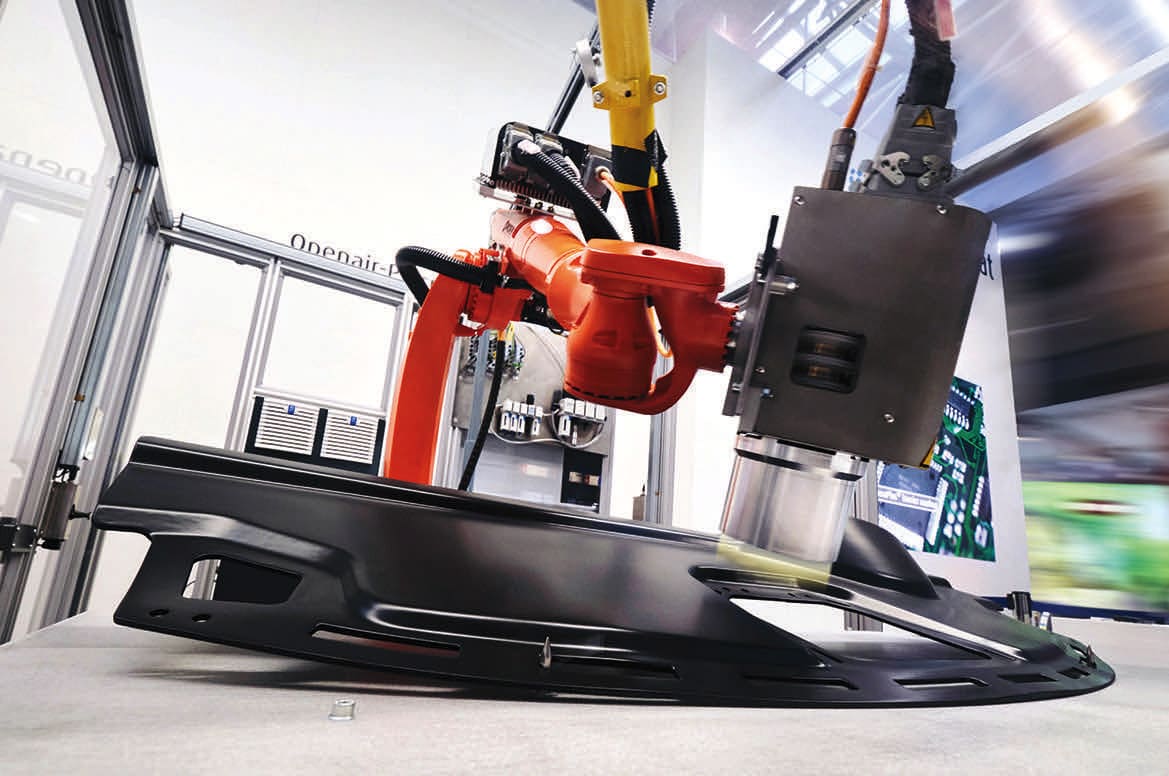
Low-pressure plasma, generated inside a vacuum chamber at pressures from 10-3 to 10-9 bar, remains the gold standard for highly uniform, 360° surface activation. Under vacuum, reactive species travel farther without collision, enabling full penetration into complex geometries. Historically limited to small laboratory chambers, low-pressure plasma now benefits from large-capacity systems capable of treating sizable aerospace components, including honeycomb structures, contoured CFRP parts, and wing-tip assemblies.
These expanded chambers offer:
Complete plasma immersion for uniform activation of internal cavities and multi-layer structures
Flexible fixturing to accommodate various part sizes and orientations (interior footprint ~77 in × 56 in × 30 in)
Full-width front doors for ergonomic loading
Robust process control with PLC operation, touchscreen interfaces, recipe storage, and manual/automatic modes
Precise gas mixing via multiple mass flow controllers
Stable, high-power RF excitation for consistent plasma density
These advancements have moved low-pressure plasma from niche laboratory tooling to production-scale technology for high-value aerospace parts requiring deep, uniform surface activation.
Atmospheric-Pressure Plasma: Inline, Robotic, High Throughput
Atmospheric-pressure plasma (APP) systems, such as Openair-Plasma®, operate at ambient pressure and are optimized for inline, continuous processing. Plasma is delivered through focused jets mounted on:
3- or 6-axis robots
CNC/gantry systems
Automated tape-laying or fiber-placement units
APP excels in high-throughput, selective treatment, and seamless integration into layup or assembly lines with minimal tooling changes. While low-pressure plasma provides unmatched uniformity, APP offers speed, flexibility, and scalability, ideal for localized surface activation on complex edges or large structures.
Enhancing CFRP Adhesion with Atmospheric-Pressure Plasma
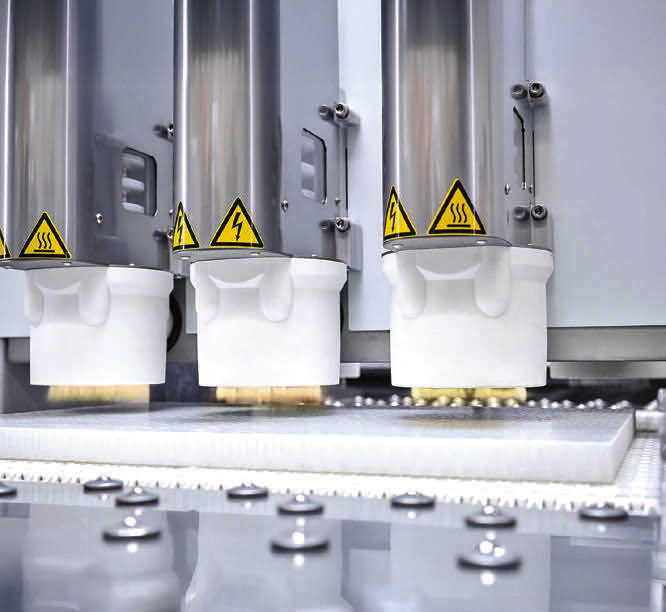
The aerospace industry increasingly adopts plasma surface treatment to strengthen adhesive bonds in CFRP components, driven by lightweighting, fewer mechanical fasteners, and improved joint durability under fatigue, vibration, and environmental exposure. Traditional approaches, such as increasing laminate thickness or resin toughness, strengthen the bulk material but do not enhance the fiber-matrix interface — the critical region for adhesive bonding.
Non-thermal APPs provide a fast, scalable, cost-effective, and environmentally friendly alternative. They modify both the polymeric matrix and exposed fibers through mild etching, cross-linking, and the addition of polar functional groups, improving adhesion without altering the composite’s bulk mechanical properties. Inline monitoring of surface energy and contamination ensures repeatable activation, reducing variability and improving first-pass yield in production.
Case Study 1: Plasma Surface Preparation for CF-PEKK Adhesion
Thermoplastic composites like CF-PEKK present particular adhesion challenges for paint and environmental coatings. A collaborative study by the University of Washington and The Boeing Company evaluated three surface-preparation methods: chemical treatment using sulfuric dichromic acid, flame treatment with a butane torch, and atmospheric plasma treatment. The plasma jet was placed at 0.5 in from the part and moved at a speed of 0.4 in/s. All three processes increased the polar component of surface energy and improved wettability. X-ray photoelectron spectroscopy (XPS) confirmed oxidation of ketone and ether groups, producing higher concentrations of C–O and C=O functional groups essential for paint adhesion.
ASTM D3359 adhesion tests demonstrated that plasma treatment outperformed the other methods, providing the strongest bond without mechanical abrasion or chemical primers.
Conclusion: Plasma treatment is a scalable, non-destructive solution for paint and coating adhesion on CF-PEKK, highlighting its potential as the most effective surface-preparation method for aerospace thermoplastics. The collaboration between the University of Washington and Boeing underscores the industrial relevance and credibility of the findings.
Case Study 2: NASA Collaboration – APPJ Activation of AFP-Fabricated CFRP Laminates
In collaboration with NASA Langley Research Center, this study evaluated atmospheric-pressure plasma jet (APPJ) treatment as a fast, solvent-free method to activate CFRP surfaces produced by automated fiber placement (AFP). The goal was to enhance surface chemistry and bond performance without compromising structural integrity.
Unidirectional laminates made from Hexcel® IM7/8552 prepreg were treated at two speeds (0.1 in/s and 1.0 in/s) with a 0.25-in standoff distance. Surface characterization — including water contact angle, X-ray photoelectron spectroscopy, scanning electron microscopy, and atomic force microscopy showed increased oxygen-containing functional groups and dramatically improved wettability. SEM and AFM revealed mild nanoscale texturing without damage. DCB tests demonstrated higher mode I interlaminar fracture toughness and increased resistance to delamination, particularly at slower treatment speeds where oxidation and roughness were maximized.
Conclusion: APPJ treatment effectively activates AFP-manufactured CFRP laminates, enhancing adhesion and fracture toughness. The collaboration with NASA Langley Research Center underscores the aerospace relevance of this work and demonstrates the scalability and industrial applicability of plasma treatment for next-generation aircraft structures.
From Lab to Line: Plasma Surface Activation for Composite Manufacturing
Plasma treatment provides several benefits aligned with aerospace production requirements:
Non-mechanical, low-damage alternative to grit blasting or sanding
Inline, high-throughput atmospheric plasma jets for integration into automated assembly lines
Improved bond durability under thermal cycling, moisture, and fatigue—plasma-enhanced treatments block moisture ingress in composite-metal joints
Engineers can optimize treatment by adjusting nozzle speed, standoff distance, and overlap, and by monitoring surface energy and contamination inline. Early integration of plasma into bonding process design improves joint strength, repeatability, and longterm performance. As aerospace structures grow in size and complexity, plasma surface treatment is moving from laboratory demonstration into production-scale manufacturing, delivering stronger, more reliable bonded assemblies for next-generation aircraft.
Source Material for Case Studies
Case Study 1: Nandi, A., Biswal, A. K., Nguyen, A., Nordyke, L., Behling, E., Foulds, T., Schultz, K., & Vashisth, A. (2024). Comparative study of surface preparation for paint adhesion on CF-PEKK composites: Plasma, chemical, and flame treatment . Applied Surface Science, Volume 669, 2024, 160533, ISSN 0169-4332.
Case Study 2: Sarikaya, I.; Tahiyat, M.; Harik, R.; Farouk, T.; Connell, J.; Gilday, P. Plasma Surface Functionalization of AFP Manufactured Composites for Improved Adhesive Bond Performance. SAMPE Conference Proceedings, Charlotte, NC, May 20–23, 2019; Society for the Advancement of Material and Process Engineering (SAMPE).
This article was written by Mary Battiste, Director of Marketing, Plasmatreat U.S.A. (Elgin, IL). For more information, visit here .
More From SAE Media Group

Aerospace & Defense Tech Briefs
Aerospace Production: Overcoming Challenges in Composite Machining
Aerospace & Defense Tech Briefs
‘Nanostitches’ Enable Lighter and Tougher Composite Materials
Aerospace & Defense Tech Briefs
Next Generation Carbon Fiber Composites 3D Printer for Hypersonic Research
Aerospace & Defense Tech Briefs
Modeling and Experimenting with 2D Materials for CMOS Type Devices and Digital Integrated Circuits
Aerospace Manufacturing and Machining INSIDER
Can This Self-Healing Composite Make Airplane and Spacecraft Components Last for Centuries?
Tech Briefs
Conductive Carbon Fiber Polymer Composite

Aerospace & Defense Tech Briefs
Quantitative Diagnostics of Multilayered Composite Structures with Ultrasonic Guided Waves


Aerospace Manufacturing and Machining INSIDER
Clean Sky Demonstrator Fuselage Shows Potential of Thermoplastics in Aircraft Production
Tech Briefs
A Self-Healing Structural Composite
Aerospace Manufacturing and Machining INSIDER
How Airbus is Using w-DED to 3D Print Larger Titanium Airplane Parts
Aerospace Manufacturing and Machining INSIDER
Developing Multifunctional Composite Materials for Aerospace Applications

Aerospace Manufacturing and Machining INSIDER
NASA to Increase Sustainable Aircraft Manufacturing with HiCAM
Aerospace Manufacturing and Machining INSIDER
Unlocking the Digital Potential in Composite Manufacturing
Aerospace & Defense Tech Briefs
Unlocking the Potential of 3D-Printed Polymers in Aerospace and Defense
Aerospace Manufacturing and Machining INSIDER
Supernova to 3D Print Military Grade Energetic Materials

Aerospace Manufacturing and Machining INSIDER
Hybrid Nanomaterials Hold Promise for Improved Ceramic Composites


Tech Briefs
Fiber-Metal Laminate Manufacturing Technique
Tech Briefs
Strong, Stretchy, 3D-Printed Metamaterials
Automotive Engineering
Plasma Process Could Cut Carbon Fiber Costs
Aerospace & Defense Tech Briefs
Outsourcing Plasma Treatments for Surface Modification
Top Stories
INSIDERManned Systems
 How Airbus is Using w-DED to 3D Print Larger Titanium Airplane Parts
INSIDERAerospace
 FAA to Replace Aging Network of Ground-Based Radars
NewsUnmanned Systems
 Microvision Aquires Luminar, Plans Relationship Restoration, Multi-industry Push
NewsDesign
 CES 2026: Bosch is Ready to Bring AI to Your (Likely ICE-powered) Vehicle
NewsSoftware
 Accelerating Down the Road to Autonomy
INSIDERManned Systems
 Can This Self-Healing Composite Make Airplane and Spacecraft Components Last...
Webcasts
Power
 Hydrogen Engines Are Heating Up for Heavy Duty
Transportation
 Advantages of Smart Power Distribution Unit Design for Automotive...
Automotive
 Quiet, Please: NVH Improvement Opportunities in the Early Design...
Power
 A FREE Two-Day Event Dedicated to Connected Mobility
Connectivity
 E/E Architecture Redefined: Building Smarter, Safer, and Scalable Vehicles
Manufacturing & Prototyping
 How Sift's Unified Observability Platform Accelerates Drone Innovation