




Hybrid Nanomaterials Hold Promise for Improved Ceramic Composites
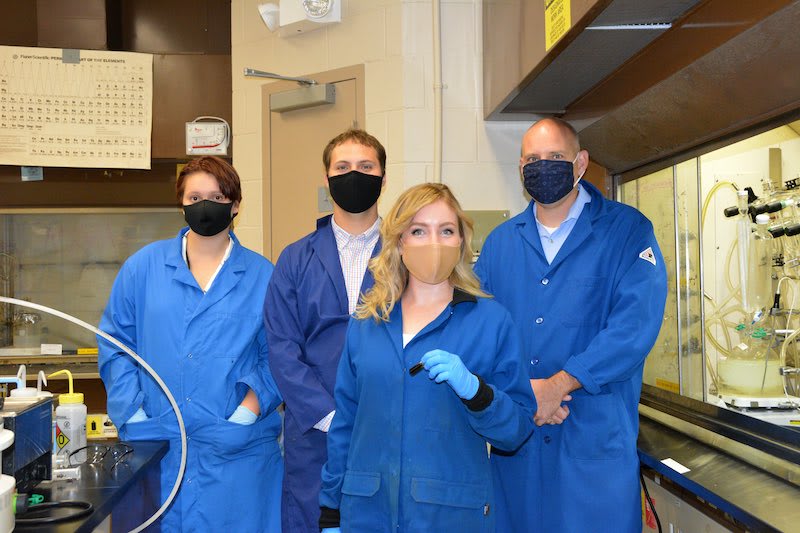
Researchers at Wright-Patterson Air Force Base are seeking to patent a novel process for manufacturing a type of material called preceramic polymer-grafted nanoparticles, or “hairy nanoparticles” (HNP). An HNP is a hybrid material consisting of a polymer shell bound to a solid nanoparticle core. The polymer - a chain of repeating molecules – forms the “hair” around the nanoparticle, which is roughly the size of a small virus.
Although HNPs have been around for many years, what makes this one different is the type of polymer being attached to the core particle. It is a pre-ceramic polymer, a special class of polymer used in the formation of high-performance ceramic fibers and composites.
“The special polymer used in our process is what sets our work apart,” said project lead Dr. Matthew Dickerson. “Researchers have made these sort of hairy nanoparticles in the past, but they’ve used organic polymers like polystyrene. Our polymer is different; it’s inorganic because it contains silicon. It’s a bit like silicones (caulk), which have a backbone of silicon and oxygen repeats, but ours has a backbone of silicon and carbon repeats.”
This silicon and carbon chemistry allows the polymer to convert to a silicon carbide ceramic when heated to high temperatures. The HNPs that result from this special process will be used in the manufacture of aircraft parts made of ceramic composite material. “Ceramic composites are used for high-temperature US Air Force applications that benefit from materials that are lower in density than metals, including jet engine and hypersonic vehicle components,” said Dickerson. “The HNPs we synthesized are envisioned for those type of applications.”
This special hybrid material, however, is not made by simply mixing the polymer and nanoparticles together and hoping for the best. “A simple mixture would result in something like a putty or a brittle mixture,” said Dickerson, “but the hybrid material we end up with flows more like molasses so it will more easily flow into a porous ceramic.”
During the manufacturing of a ceramic matrix composite, the materials used to bind the ceramic fibers together shrink considerably. This shrinking results in cracks and voids that have to be refilled, or infiltrated. One of the most important requirements of the hybrid material made of the HNPs is that it must flow easily so it can infiltrate those voids.
With current state-of-the-art processes, the ceramic has to undergo several cycles (six to ten) of infiltration to attain the desired density. The novel process yields a material that could potentially reduce the number of infiltration cycles by about half, resulting in a more cost-effective, faster-to-produce component. Even with the superior high-temperature properties of ceramic composites over conventional metal components, reducing their cost is key to enabling their widespread use in demanding Air Force applications.
More From SAE Media Group
Aerospace INSIDER
Ceramic Matrix Composites Offer Lighter, More Durable Engine Parts


Aerospace & Defense Tech Briefs
Unlocking the Power of Ceramic Matrix Composites
Aerospace & Defense Tech Briefs
Progress on Zirconia-Polyurea Matrix Hybrid Composites

Tech Briefs
Fiber-Metal Laminate Manufacturing Technique
Medical Design Briefs
3D Printable Polymer Nanocomposite Ink
Tech Briefs
Precision CNT Cutting Mechanism
Tech Briefs
3D Printing Ultrastrong Materials
Tech Briefs
Technique Creates Adaptive Materials

Aerospace & Defense Tech Briefs
Molded RF Materials for Hypersonic Sensors and Seekers


Aerospace Manufacturing and Machining INSIDER
Developing Multifunctional Composite Materials for Aerospace Applications
Aerospace Manufacturing and Machining
Scaling Low-Cost Carbon Fiber Production with Oxidation Technology
Tech Briefs
Solid-State Carbon Dioxide Sensor
Aerospace & Defense Tech Briefs
Thermal Conductivities of Some Polymers and Composites
Aerospace & Defense Tech Briefs
Design of New Piezoelectric Composites Using Nanocellulose
Aerospace INSIDER
NASA Develops Unique Materials for Next Generation Aircraft
Tech Briefs
Thin Heat Shield for Superfast Aircraft
Battery Technology
Tough, Solid Electrolyte Battery Component

Tech Briefs
What is 'Metallic Wood?' Nickel, Plus Nano-Pores
Tech Briefs
Scaling Up Nano for Sustainable Manufacturing
Aerospace & Defense Tech Briefs
Hierarchical Diamond-Based Ceramic Composites
Tech Briefs
Self-Healing, Recyclable, Shape Memory Polymers
Top Stories
NewsSensors/Data Acquisition
 Microvision Aquires Luminar, Plans Relationship Restoration, Multi-industry Push
INSIDERRF & Microwave Electronics
 A Next Generation Helmet System for Navy Pilots
INSIDERWeapons Systems
 New Raytheon and Lockheed Martin Agreements Expand Missile Defense Production
NewsAutomotive
 Ford Announces 48-Volt Architecture for Future Electric Truck
INSIDERAerospace
 Active Strake System Cuts Cruise Drag, Boosts Flight Efficiency
ArticlesTransportation

Webcasts
Aerospace
 Cooling a New Generation of Aerospace and Defense Embedded...
Energy
 Battery Abuse Testing: Pushing to Failure
Power
 A FREE Two-Day Event Dedicated to Connected Mobility
Automotive
 Quiet, Please: NVH Improvement Opportunities in the Early Design Cycle
Electronics & Computers
 Advantages of Smart Power Distribution Unit Design for Automotive &...
Unmanned Systems
 Sesame Solar's Nanogrid Tech Promises Major Gains in Drone Endurance