




Additive Manufacturing Utilizing a Novel In-Line Mixing System for Design of Functionally Graded Ceramic Composites
Exploring the development of a direct ink writing system with multimaterial and in-line mixing capabilities for printing inks composed of high solids-loaded ceramic particulate suspensions.
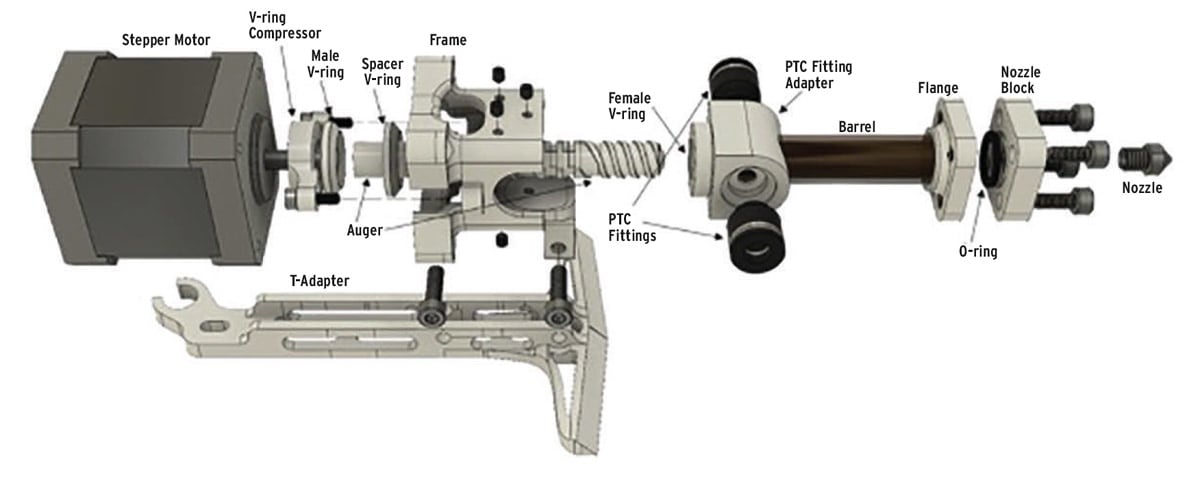
The impetus for advancing brittle ceramic materials used for armor applications has been identified as both an increased mass efficiency for greater weight reduction and enhanced performance against ballistic threats through manipulating the physics of failure.
Development of functionally graded ceramic composites is a potential solution for enabling new dynamic fracture and deformation mechanisms in armor materials, surpassing that of the individual intrinsic material behaviors. However, engineering of these composite structures is currently limited due to the stochastic nature of traditional powder mixing and processing. Thus, additive manufacturing (AM) is being studied as an enabling technology for processing discrete mesostructural features, complex geometries, and compositional variation.
Various traditional ceramic forming technologies exist including pressing, extrusion, slip casting, tape casting, and injection molding. However, these traditional forming techniques often only allow 2-D design freedom, cannot create internal or multiscale features, and require complicated and expensive dies. On the other hand, AM enables the production of parts with complex, multiscale geometries including internal structures. Additionally, multi-material AM allows for the mimicking of biological composites that take advantage of hierarchical structures and compositional gradients to increase their strength and toughness.
Three main categories of AM exist: extrusion-based processes, liquid-bed processes, and powder-bed processes. Extrusion-based processes, such as fused deposition modeling (FDM) and direct ink writing (DIW), raster a print head across the print-bed layer by layer while extruding a continuous trace of material. Liquid- bed processes, such as stereo-lithography, use a laser or other energy source to cure resin layer-by-layer as the build plate further submerges. Powder-bed processes, such as selective laser melting/sintering, use a laser or other high-power energy source to melt/sinter powder in a layer-by-layer fashion as the print-bed moves downward and more powder is spread over the print area.
Exploration of next-generation ceramic armor composites will require high-resolution, multi-material, and mixing capabilities to print structures that have compositional gradients, internal structures, and hierarchical organization. Powder- and liquid-bed processes run into issues with multi-material applications because the powder/liquid vat must be switched for every composition variation. The extrusion-based FDM method of ceramic-filled polymer filament creates parts with low green density, leading to low percent theoretical density following sintering. Ink jetting, a popular commercial solution to ceramic AM, again produces porous parts with low density. DIW, on the other hand, shows significant promise for studying these composites because it fulfills each requirement.
The DIW technique, also known as robocasting, involves extrusion of a line of highly loaded colloidal suspension, termed “ink”, through a small nozzle in a specific pattern layer by layer to produce a 3-D part. Unlike FDM, where printed material solidifies directly after extrusion, DIW relies on the yield-pseudoplastic rheological behavior of the ink for structural integrity following extrusion.
Yield-pseudoplastic rheology gives the ink structural integrity up to its yield stress, followed by shear-thinning behavior. When the ink is designed with this rheological behavior, it can easily flow through the nozzle due to the high-shear environment, but after extrusion (yield stress goes to zero) it can retain its shape due to its yield strength.
Just as important as ink printability is post-print processing performance – namely shape retention and densification characteristics. A postprocessed part must be as close to 100 percent theoretical density as possible to have acceptable ballistic performance.
A prerequisite of high sintered density is high green density, necessitating high particulate-loading and low binder/dispersant content in the ink. However, high solids-loading and low binder/dispersant content leads to dilatant behavior and poor printability. Thus, a balance must be found between printability, yield-point, and post-print processing behavior. These competing factors result in a complex ink design process, where constituent type, content, and interaction are of paramount importance. Although complicated, understanding of colloidal ink processing has advanced to a point where there is flexibility available in terms of binder/dispersant selection, allowing selection of a variety of material systems.
This work was performed by Joshua Pelz, Nicholas Ku, Marc Meyers, and Lionel Vargas-Gonzalez for the Army Research Laboratory. For more information, download the Technical Support Package (free white paper) below.
This Brief includes a Technical Support Package (TSP).
Additive Manufacturing Utilizing a Novel In-Line Mixing System for Design of Functionally Graded Ceramic Composites
(reference ARL-0249) is currently available for download from the TSP library.
Don't have an account?
More From SAE Media Group
Aerospace & Defense Tech Briefs
Streamlining Post-Processing in Additive Manufacturing
Tech Briefs
Executive Roundtable: 3D Printing
Aerospace & Defense Tech Briefs
Evaluation of Additively Manufactured Ultrahard Steels


Tech Briefs
Automated Tow/Tape Placement System
Aerospace & Defense Tech Briefs
Physics-Guided Neural Network for Regularization and Learning Unbalanced Data Sets
Aerospace & Defense Tech Briefs
SAE International Issues First Technical Standards for Aerospace Additive Manufacturing
Aerospace & Defense Tech Briefs
Curing the Porosity Problem in Additive Manufacturing

Aerospace & Defense Tech Briefs
Hierarchical Diamond-Based Ceramic Composites
Tech Briefs
Self-Healing, Recyclable, Shape Memory Polymers
Aerospace Manufacturing and Machining INSIDER
Researchers Push Limits in High-Temp, Polymer Additive Manufacturing
Tech Briefs
Method 3D-Prints Marine-Grade Stainless Steel
Aerospace Manufacturing and Machining
Lightweighting Parts Using 3D Metal Printing
Aerospace & Defense Tech Briefs
Metal-Plated, High-Temperature Plastics
Automotive Engineering
Optimizing Design for Additive Manufacturing

Aerospace INSIDER
Air Force Wind Tunnel Team Takes 3D Printing Program to Next Dimension
Tech Briefs
Technology Remedies 3D Printing’s “Weak Spot”
Tech Briefs
3D-Printed Composites for High-Temperature Uses
Aerospace & Defense Tech Briefs
Unlocking the Potential of 3D-Printed Polymers in Aerospace and Defense
Off-Highway Engineering
EOS Releases Four New Metal Materials for Series Additive Manufacturing

Tech Briefs
Using 3D Printing to Strengthen Jet Engines
Overview
The technical report titled "Additive Manufacturing Utilizing a Novel In-Line Mixing System for Design of Functionally Graded Ceramic Composites" presents research conducted by a team from the Army Research Laboratory and the University of California, San Diego. The report focuses on the development of a direct ink writing (DIW) system designed for additive manufacturing of functionally graded ceramic composites, which are materials with varying properties across their structure.
The primary innovation discussed in the report is a custom DIW system that integrates multimaterial and in-line mixing capabilities. This system is designed to print inks made from high solids-loaded ceramic particulate suspensions. The DIW system consists of two main components: a print head and a feed system. The feed system is responsible for delivering ceramic ink to the print head at a specified composition, while the print head utilizes an auger mechanism to mix and extrude multiple inks through a single nozzle. This auger-based approach allows for precise control over the material flow, resulting in improved start/stop response compared to traditional syringe-based systems.
One of the key advantages of this in-line mixing capability is the ability to create composition gradients within the printed structures. The report details successful printing of silicon carbide and boron carbide composites, demonstrating the system's effectiveness in producing both layered and gradient structures. This capability is particularly significant for applications requiring tailored material properties, such as in aerospace and defense sectors.
The report also includes a comprehensive overview of the design and integration of the DIW system with a low-cost fused deposition modeling (FDM) 3D printer, specifically the LulzBot Taz 6. The methods section outlines the design overview, print head and feed system specifications, control structure, and G-code generation for the printing process.
In conclusion, the research highlights the potential of additive manufacturing techniques, particularly through the use of the novel in-line mixing system, to advance the field of ceramic composites. The findings suggest that this approach can lead to significant improvements in the design and production of functionally graded materials, paving the way for innovative applications in various industries. The report is unclassified and approved for public release, ensuring that the insights gained can be shared with the broader scientific community.
Top Stories
NewsRF & Microwave Electronics
 Microvision Aquires Luminar, Plans Relationship Restoration, Multi-industry Push
INSIDERAerospace
 A Next Generation Helmet System for Navy Pilots
INSIDERDesign
 New Raytheon and Lockheed Martin Agreements Expand Missile Defense Production
INSIDERMaterials
 How Airbus is Using w-DED to 3D Print Larger Titanium Airplane Parts
NewsPower
 Ford Announces 48-Volt Architecture for Future Electric Truck
ArticlesAR/AI

Webcasts
Electronics & Computers
 Cooling a New Generation of Aerospace and Defense Embedded...
Automotive
 Battery Abuse Testing: Pushing to Failure
Power
 A FREE Two-Day Event Dedicated to Connected Mobility
Unmanned Systems
 Quiet, Please: NVH Improvement Opportunities in the Early Design Cycle
Automotive
 Advantages of Smart Power Distribution Unit Design for Automotive &...
Energy
 Sesame Solar's Nanogrid Tech Promises Major Gains in Drone Endurance