




Researchers Push Limits in High-Temp, Polymer Additive Manufacturing
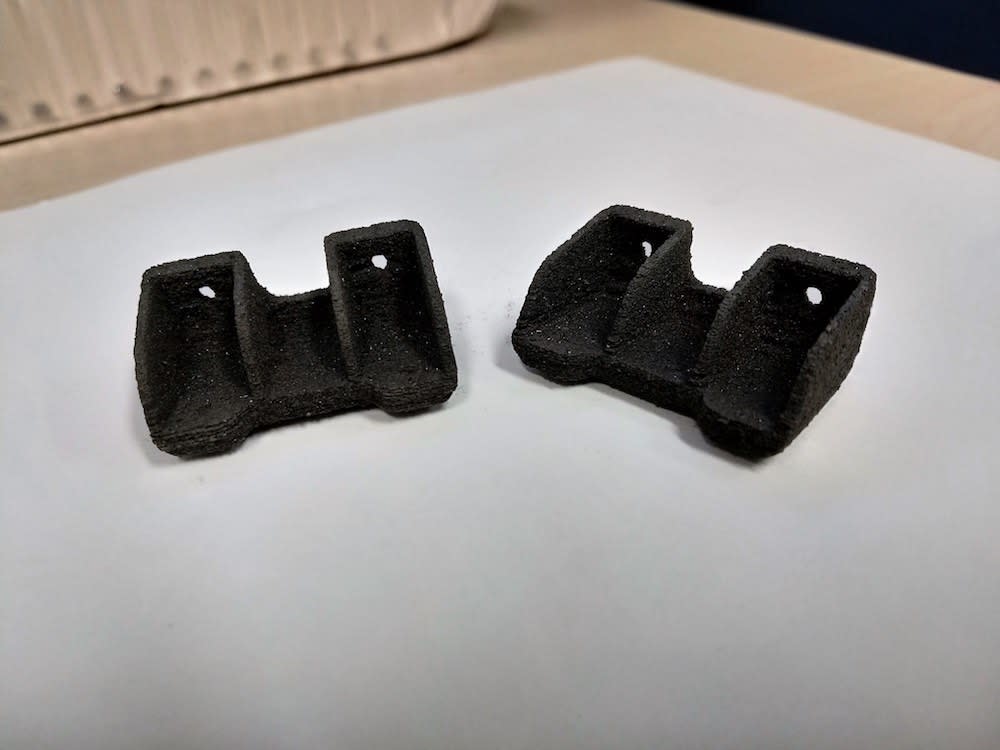
Researchers at the Air Force Research Laboratory’s Materials and Manufacturing Directorate are “turning up the heat” in the field of polymer additive manufacturing. In conjunction with researchers at NASA’s Glenn Research Center and the University of Louisville, the team successfully printed the highest-temperature capable, reinforced polymer composite parts using additive manufacturing. Consisting of a high temperature thermoset resin infused with carbon fiber filaments, this state-of-the art material breakthrough sets the stage for next generation, cost-efficient Air Force manufacturing needs.
“This is an extremely impactful breakthrough in composite material additive manufacturing,” said Dr. Hilmar Koerner, a scientist on the Polymer Matrix Composite Materials and Processing Research Team and the driving force behind the novel discovery. “These 3-D printed parts can withstand temperatures greater than 300 degrees Celsius, making them potentially useful for turbine engine replacement parts or in hot areas around engine exhaust.”
Polymer matrix composites are extremely attractive to Air Force researchers working on next-generation applications due to their light-weight properties and ability to withstand extreme conditions in high temperature environments. This plays an important role in increasing aircraft range while reducing fuel consumption, both of which are key to reducing operating costs over the long term.
Typically, polymer composites consist of a fiber, such as glass, embedded in a matrix or resin made of epoxy or other material. The embedded fibers reinforce the matrix, making the resulting material stronger. During a polymer additive manufacturing technique called laser sintering, a high temperature laser is run across a bed of polymer powder to form a pre-designed, computer generated shape. This process is repeated multiple times with new layers of powder and laser energy until a 3-D part is complete.
While experimenting with high temperature polymer resins, Koerner and his team found that the polymers printed well, but when they removed the pieces from the powder bed for post-processing, the material would essentially “melt into puddles,” proving useless.
To counteract this issue and better enable molecules to entangle and form a shape under the heat of the laser, Koerner suggested adding carbon fiber filler to the resin material as a means of enabling better energy transfer from the laser to the matrix. The carbon fiber would cause the laser to heat the material much faster by absorbing the laser energy and conducting heat much faster than with the polymer alone. As a result, the researchers successfully printed high temperature polymer composite sample pieces in multiple configurations, in what, to their knowledge, are the highest temperature capable, polymer composite parts made by additive manufacturing to this day.
The team successfully printed a number of test coupons and brackets with the novel material and plan to demonstrate the ability to print larger parts as the next step in their process. Preliminary test data indicates that the material can withstand elevated temperatures, but further testing and qualification of the material is needed prior to implementation on Air Force platforms.
More From SAE Media Group
Aerospace Manufacturing and Machining INSIDER
Can This Self-Healing Composite Make Airplane and Spacecraft Components Last for Centuries?
Tech Briefs
3D-Printed Composites for High-Temperature Uses
Aerospace & Defense Tech Briefs
Metal-Plated, High-Temperature Plastics
Aerospace & Defense Tech Briefs
Fiber-Reinforced Thermoplastic Composites
Aerospace & Defense Tech Briefs
Next Generation Carbon Fiber Composites 3D Printer for Hypersonic Research
Aerospace & Defense Tech Briefs
Streamlining Post-Processing in Additive Manufacturing
Tech Briefs
Fiber-Metal Laminate Manufacturing Technique
Aerospace Manufacturing and Machining INSIDER
Thermoplastic Drive Shaft System Developed for Aerospace Applications
Automotive Engineering
Weaving a New Future for Composites
Tech Briefs
Healable Carbon Fiber Composite
Aerospace & Defense Tech Briefs
Unlocking the Potential of 3D-Printed Polymers in Aerospace and Defense
Medical Design Briefs
Smart Fabric Stiffens on Demand

Aerospace & Defense Tech Briefs
New Laser Technique Revolutionizes Ultra-High Ceramic Manufacturing for Spacecraft
Aerospace INSIDER
Air Force Wind Tunnel Team Takes 3D Printing Program to Next Dimension

Aerospace & Defense Tech Briefs
‘Nanostitches’ Enable Lighter and Tougher Composite Materials
Tech Briefs
Conductive Carbon Fiber Polymer Composite
Aerospace & Defense Tech Briefs
Thermoplastic Composites to Play Enhanced Role in Next-Generation Aerospace Applications
Aerospace & Defense Tech Briefs
Thermal Conductivities of Some Polymers and Composites
Aerospace & Defense Tech Briefs
Designing With Plastics for Military Equipment


Tech Briefs
Self-Healing, Recyclable, Shape Memory Polymers
Tech Briefs
Calibration System for Automated Fiber Placement
Top Stories
NewsRF & Microwave Electronics
 Microvision Aquires Luminar, Plans Relationship Restoration, Multi-industry Push
INSIDERAerospace
 A Next Generation Helmet System for Navy Pilots
INSIDERDesign
 New Raytheon and Lockheed Martin Agreements Expand Missile Defense Production
INSIDERMaterials
 How Airbus is Using w-DED to 3D Print Larger Titanium Airplane Parts
NewsPower
 Ford Announces 48-Volt Architecture for Future Electric Truck
ArticlesAR/AI

Webcasts
Electronics & Computers
 Cooling a New Generation of Aerospace and Defense Embedded...
Automotive
 Battery Abuse Testing: Pushing to Failure
Power
 A FREE Two-Day Event Dedicated to Connected Mobility
Unmanned Systems
 Quiet, Please: NVH Improvement Opportunities in the Early Design Cycle
Automotive
 Advantages of Smart Power Distribution Unit Design for Automotive &...
Energy
 Sesame Solar's Nanogrid Tech Promises Major Gains in Drone Endurance
Similar Stories
INSIDERDefense
 Composites Self-Heal at Very Low Temperatures
BriefsAerospace
 New Laser Technique Revolutionizes Ultra-High Ceramic Manufacturing for...
INSIDERMaterials
 Researchers Turn to Carbon Nanotubes to Build Better Heat Shields
INSIDERDefense
 Can This Self-Healing Composite Make Airplane and Spacecraft Components Last...
