




Can Neutrons Improve 3D-Printing of Aluminum Aerospace Components?
How can particularly light yet extremely resilient aluminum components for aerospace be manufactured using industrial 3D printing?
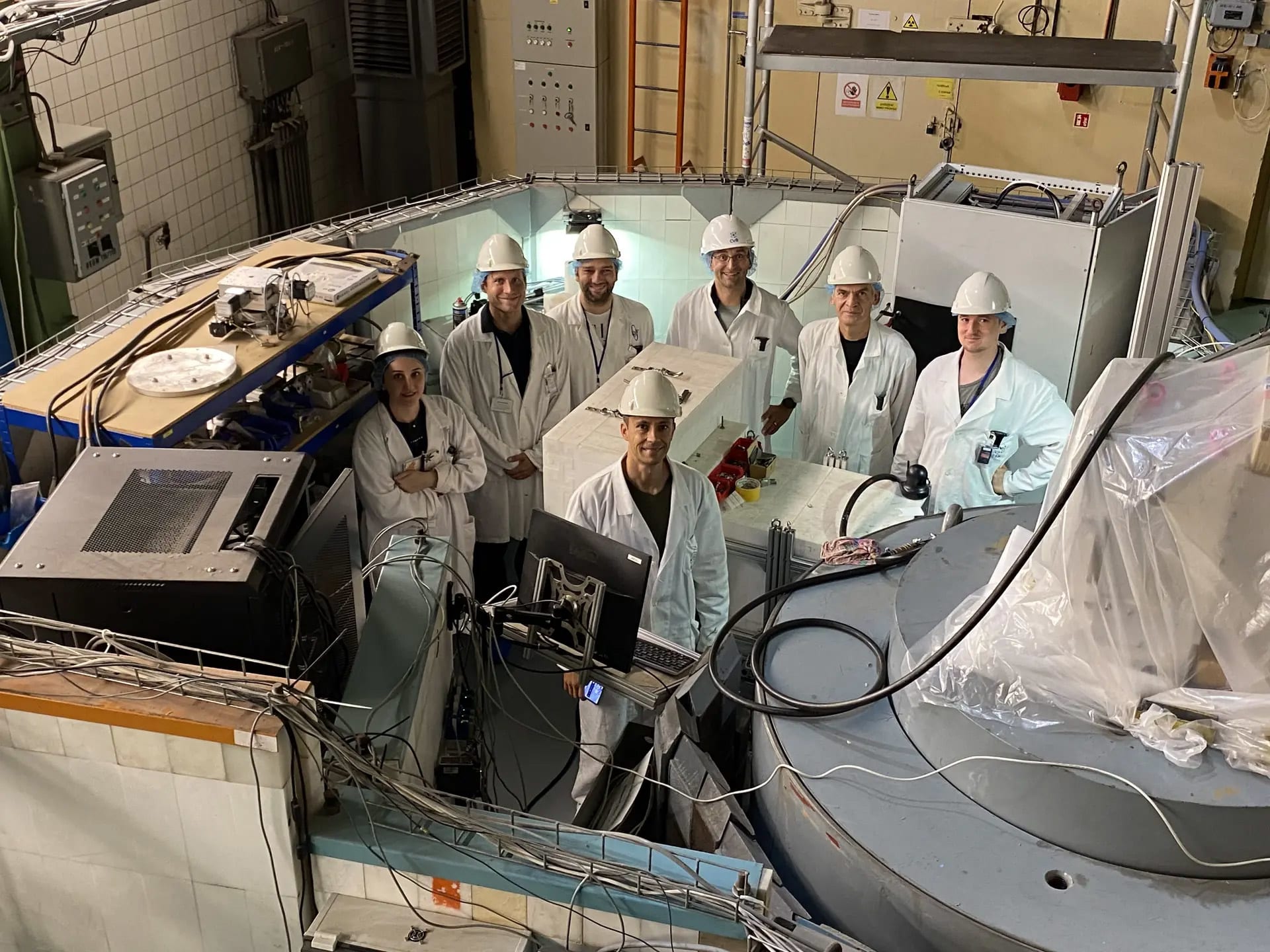
This question is the focus of the new ErUM Transfer research project, AlaAF, which the German government funds. The Technical University of Munich (TUM), with its research reactor FRM II, the company Colibrium Additive, and the Friedrich-Alexander University Erlangen-Nuremberg (FAU) want to jointly develop solutions.
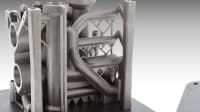
The focus is on the laser powder bed fusion (LPBF) process, an additive manufacturing process in which metal powder is fused layer by layer using a laser to form high-precision components. This process allows for incredible design freedom. However, it could not be used, for example, with high-strength aluminum alloys, such as those required for load-bearing structural elements in aircraft and spacecraft, as they tend to crack when cooled.
Ceramic Particles as Micro-Builders
The project pursues a new approach in which special additives in the metal powder react chemically during the printing process and form finely distributed ceramic particles in the submicrometre range. These particles influence crystal growth in the material by promoting a fine-grained, uniform microstructure, thereby reducing the formation of cracks. This enables the industrial use of aluminum alloys previously considered virtually impossible to print, offering clear advantages such as lower weight, higher load-bearing capacity and more sustainable production through material savings.
Research Partners with Clear Competencies
The three research partners are working closely together on the project, which is funded by the Federal Ministry of Education, Technology and Space (BMFTR) with a total of €1.17 million as part of the Action Plan for Research into the Universe and Matter (ErUM):
The 3D printing company Colibrium Additive is contributing state-of-the-art industrial technology and is working with TUM and FAU to develop the appropriate process parameters for the LPBF process. FAU analyses printed materials and their mechanical properties, in particular using microscopic methods. Researchers at FRM II are responsible for the comprehensive investigation and quality testing of the materials using neutron methods.
Several specialized methods are used at FRM II: Neutron diffraction allows phase distributions and internal stresses to be determined precisely, key parameters for assessing strength and stability. Neutron imaging (radiography and tomography) makes it possible to visualize even the finest cracks or pores deep inside the samples in a non-destructive manner. In general, the greater sensitivity of neutrons compared to X-rays is used to better understand the material's microstructure.
Dr. Habil Ralph Gilles, Project Manager at TUM and spokesperson for the consortium, explains the particular advantage of these methods: “Neutrons have a high penetration depth and are therefore ideal for analyzing large, additively manufactured components for industry – a task that would be impossible with other techniques.”
In addition, the combination of neutron experiments with mechanical loading and temperature variation on a testing machine specially developed at the FRM II allows for a realistic simulation of industrial operating conditions. This makes it possible to record the material behavior under typical operating conditions.
More From SAE Media Group
Aerospace & Defense Tech Briefs
SAE International Issues First Technical Standards for Aerospace Additive Manufacturing


Aerospace & Defense Tech Briefs
Scientists Fuse Simulations and Machine Learning to Accelerate Novel Additively Manufactured Materials
Aerospace & Defense Tech Briefs
Evaluation of Additively Manufactured Ultrahard Steels

Aerospace & Defense Tech Briefs
Additive Manufacturing Adoption Up, Growing Rapidly in Aerospace
NASA Spinoff
3D Printed Engines Propel Next Industrial Revolution
Tech Briefs
Method 3D-Prints Marine-Grade Stainless Steel

Aerospace & Defense Tech Briefs
Physics-Guided Neural Network for Regularization and Learning Unbalanced Data Sets

Aerospace Manufacturing and Machining INSIDER
How Airbus is Using w-DED to 3D Print Larger Titanium Airplane Parts
Aerospace Manufacturing and Machining INSIDER
Machine Learning Makes Light Work of AM Aerospace Alloys
Aerospace Manufacturing and Fabrication
Verifying Structural Integrity of 3D Metal-Printed Parts
Aerospace & Defense Tech Briefs
Finding the Perfect Aluminum for Additive Manufacturing
Aerospace & Defense Tech Briefs
Low Distortion Titanium in Laser Powder Bed Fusion Systems


Photonics & Imaging Technology
Deformation Fingerprints Will Help Researchers Identify, Design Better Metallic Materials
Aerospace Manufacturing and Machining INSIDER
Can This Self-Healing Composite Make Airplane and Spacecraft Components Last for Centuries?
Photonics & Imaging Technology
Additive Manufacturing Using Infrared and X-Ray Imaging
Aerospace & Defense Tech Briefs
New Laser Technique Revolutionizes Ultra-High Ceramic Manufacturing for Spacecraft
Tech Briefs
A New Method to Design Better Metallic Materials
Top Stories
NewsRF & Microwave Electronics
 Microvision Aquires Luminar, Plans Relationship Restoration, Multi-industry Push
INSIDERAerospace
 A Next Generation Helmet System for Navy Pilots
INSIDERDesign
 New Raytheon and Lockheed Martin Agreements Expand Missile Defense Production
INSIDERMaterials
 How Airbus is Using w-DED to 3D Print Larger Titanium Airplane Parts
NewsPower
 Ford Announces 48-Volt Architecture for Future Electric Truck
ArticlesAR/AI

Webcasts
Electronics & Computers
 Cooling a New Generation of Aerospace and Defense Embedded...
Automotive
 Battery Abuse Testing: Pushing to Failure
Power
 A FREE Two-Day Event Dedicated to Connected Mobility
Unmanned Systems
 Quiet, Please: NVH Improvement Opportunities in the Early Design Cycle
Automotive
 Advantages of Smart Power Distribution Unit Design for Automotive &...
Energy
 Sesame Solar's Nanogrid Tech Promises Major Gains in Drone Endurance