




Latest Stories
Briefs RF & Microwave Electronics
NanoAvionics Satellite Suffers Space Debris Impact, Selfie Image Shows Damage
The MP42 satellite, which launched into low Earth orbit two and a half years ago aboard the SpaceX Transporter-4 mission, recently took an unexpected hit from a small piece of space debris or micrometeoroid. The impact created a 6 mm hole, roughly the size of a chickpea, in one of its solar panels. Read on to learn more.

Products RF & Microwave Electronics
New Products
See the new products, including L3Harris Technologies' AMORPHOUS™, its new software that features a single user interface to operate thousands of autonomous assets simultaneously; Rohde & Schwarz's new R&S NRP140TWG(N) thermal power sensor; SBG Systems' expansion of its high-performance inertial navigation systems, Ekinox, Apogee, and Navsight, with new GNSS receiver options; Supermicro, Inc.'s wide range of new systems which are fully optimized for edge and embedded workloads; and much more.

Articles Electronics & Computers
Swarm Robotics: A Requiem for the Assembly Line
Aircraft manufacturing is on the cusp of its most profound transformation since the dawn of powered flight. The assembly line — a staple of industrial production for over a century — is about to be replaced by a far more efficient and cost-effective alternative: Swarm Robotics. Read on to learn more about it.

Articles RF & Microwave Electronics
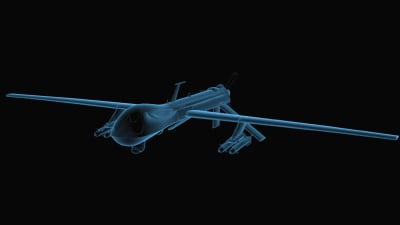
The Evolution of Autonomous Systems in UAV Technology
So, let’s talk about it: What’s happening in 2025? Well, the sky is no longer the limit — it’s just the beginning of a new era in autonomous UAV technology. Read on to learn more.
Articles RF & Microwave Electronics
Reverse Engineering the Security Risks of the AeroScope Drone Detection Module
Da Jiang Innovations' AeroScope drone detection platform has proven to be an effective security tool for military and law enforcement. It identifies and tracks drones in real time, providing AeroScope users with information like flight status, path and pilot location for drones up to 50 kilometers away. Read on to learn more about it.

Articles Weapons Systems
AI Automates Drone Defense With High Energy Lasers
To counter the rapidly mounting threats posed by the proliferation of inexpensive uncrewed autonomous systems, or drones, Naval Postgraduate School researchers and collaborators are applying AI to automate critical parts of the tracking system used by laser weapon systems. Read on to learn more about it.

Articles Manned Systems
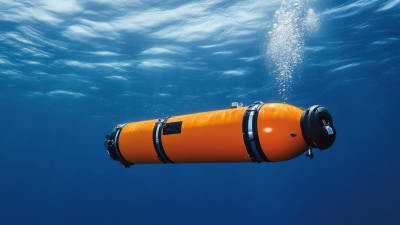
3D Printing Parts for Ships, Submarines and Underwater Vehicles
Additive manufacturing has been a game-changer in helping to create parts and equipment for the Department of Defense’s industrial base. A naval facility in Washington state has become a leader in implementing additive manufacturing and repair technologies using various processes and materials to quickly create much-needed parts for submarines and ships. Read on to learn more.
Briefs Manufacturing & Prototyping
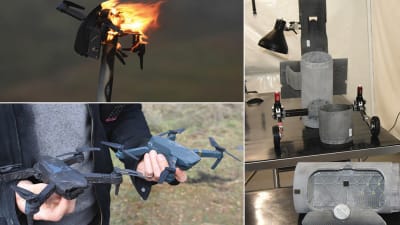
Lasers Destroy Drones as Additive Manufacturing Builds Them
In February, the Joint Interagency Field Experimentation team at the Naval Postgraduate School executed another highly collaborative week of rapid prototyping and defense demonstrations with dozens of emerging technology companies. Read on to learn more about it.
Application Briefs Weapons Systems
The Marines New Installation Counter UAS System
The U.S. Marine Corps awarded a 10-year, $642 million program of record to Anduril Industries to develop and sustain their new Installation-Counter small Unmanned Aircraft Systems (I-CsUAS) technology. I-CsUAS is a platform powered by machine learning (ML) and artificial intelligence (AI) to protect Marine Corps installations globally by detecting, identifying, tracking and defeating small unmanned aircraft systems (UAS). Read on to learn more.

Application Briefs Photonics/Optics
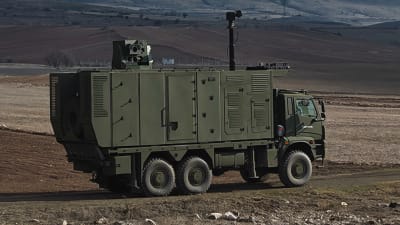
GOKBERK C-UAS Testing
Turkish defense company Aselsan completed testing of its mobile laser counter unmanned aircraft system platform GÖKBERK against first-person view drones in March. Previously proven effective against rotary- and fixed-wing kamikaze drones, GÖKBERK has now demonstrated its capabilities for detecting, autonomously tracking, and eliminating FPV drones across multiple test scenarios. Read on to learn more.
Application Briefs Weapons Systems
BlueHalo Completes Test of Next Generation C-UAS Missile
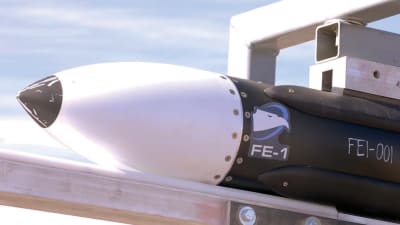
BlueHalo, the company transforming the future of global defense with actively deployed and operationally proven Counter-Uncrewed Aerial System (C-UAS) solutions, announced the successful live fire demonstration of its Next-Generation C-UAS Missile (NGCM) – Freedom Eagle-1 (FE-1), addressing the critical need for munitions industrial base expansion to meet the rapidly evolving advanced aerial threats. Read on to learn more.
Briefs Defense
Human-Focused Research Aims to Enhance UAS Effectiveness, Readiness
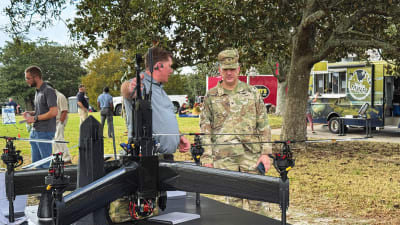
As the capabilities of unmanned aerial systems continue to evolve rapidly in response to the tactical and strategic necessities of the modern battlefield, the U.S. Army Aeromedical Research Laboratory is exploring a unique approach to improving their operational effectiveness – by focusing on the protection and performance of UAS operators. Read on to learn more about it.
Briefs RF & Microwave Electronics
Engineers Enable a Drone to Determine Its Position in the Dark and Indoors
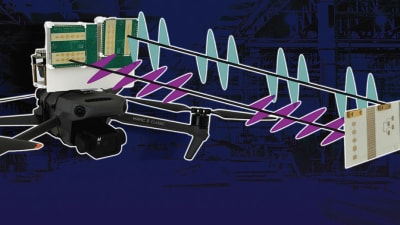
MIT researchers have introduced a new approach that enables a drone to self-localize, or determine its position, in indoor, dark, and low-visibility environments. Self-localization is a key step in autonomous navigation. Read on to learn more about it.
Briefs RF & Microwave Electronics
Low Cost Air Traffic Control for Drones
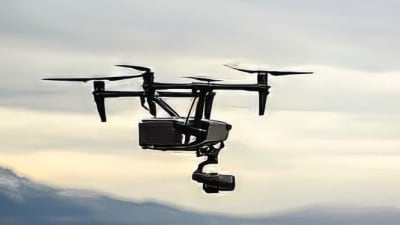
Using a network of small, low-cost radars, engineering professor Cammy Peterson and her colleagues have built an air traffic control system for drones that can effectively and accurately track anything in an identified low-altitude airspace. Read on to learn more about it.
Briefs Test & Measurement
Unmanned Aircraft Systems Help Responders in Urban Environments
In November 2024, the U.S. Department of Homeland Security’s National Urban Security Technology Laboratory teamed up with Mississippi State University’s Raspet Flight Research Laboratory, and DAGER Technology LLC, to conduct an assessment on selected models of cybersecure “Blue UAS.” The drones are cybersecure and commercially available to assist emergency responders with their public safety operations. Read on to learn more.

Products Software
New Products
See the new products, including SemiNex's narrow-linewidth high-power External Cavity Laser with single frequency; Rohde & Schwarz's extended R&S®BBA300 portfolio with two innovative amplifier series, the R&S®BBA300-F and the R&S®BBA300-FG; Teledyne FLIR's Prism™ Supervisor, the latest addition to its Prism embedded software ecosystem; STMicroelectronics' first product of its strategic collaboration with Qualcomm Technologies to simplify development of next-generation wireless solutions for industrial and consumer IoT applications; and much more.

Articles Materials
Manufacturing Spotlight: Advanced Drilling, Threading and Milling Tools Maximize Productivity in Challenging Aerospace Materials
Before threading holes, drilling is a necessary and critical step. Drilling challenging aerospace materials demands an application-specific solution. Stainless, titanium, and nickel- based alloys are highly heat resistant so heat generated during the drilling process is pushed into the cutter. Read on to learn more.

Articles Power
The Power Behind the Growth in Intelligent Munitions
This article describes the technologies enabling the evolution of intelligent munitions and focuses on the importance of stable power supplies. Read on to learn more.

Articles Aerospace
The Future of Aerospace: Embracing Digital Transformation and Emerging Technologies
Most A&D companies are not seeing the ROI they expect from their digital transformation journeys. This does not mean digital transformation is not working, it just means it is not mature. Read on to learn what this means.

Articles Test & Measurement
Physicists Measure a Key Aspect of Superconductivity in ‘Magic-Angle’ Graphene
Physicists at MIT and Harvard University have now directly measured superfluid stiffness for the first time in “magic-angle” graphene — materials that are made from two or more atomically thin sheets of graphene twisted with respect to each other at just the right angle to enable a host of exceptional properties, including unconventional superconductivity. Read on to learn more.

Articles Aerospace
Deep Space Advanced Radar Capability Makes Tremendous Progress in First Year
Just one year after signing a ground-breaking trilateral agreement, the Deep Space Advanced Radar Capability partnership is completing facilities construction at the first of three sites that will host a global network of advanced ground-based sensors. Read on to learn more.

Articles Unmanned Systems
Design Considerations for Rugged Naval Equipment Enclosures
New, efficient approaches to cabinet and console design, fabrication, integration, and qualification are enabling prime defense contractors to equip the Navy faster with better technology while increasing ROI. Read on to learn more.

Briefs Wearables
Fiber Computer Allows Apparel to Run Apps and Understand the Wearer
MIT researchers have developed an autonomous programmable computer in the form of an elastic fiber, which could monitor health conditions and physical activity, alerting the wearer to potential health risks in real-time. Read on to learn more.

Application Briefs Physical Sciences
Robust Quantum Sensors Program
To address quantum sensors' barriers, DARPA is launching the Robust Quantum Sensors (RoQS) program. RoQS will seek to develop quantum sensors that are inherently resistant to environmental disruptions, ensuring they can operate reliably outside of a laboratory without sacrificing their sensitivity. Read on to learn more.

Application Briefs Defense
Eurofighter Common Radar System Upgrade
The Eurofighter Common Radar System Mark 1 project is the next-generation Eurofighter radar that is to be fielded by the air forces of Germany and Spain. This E-Scan radar will enhance the capabilities of the Eurofighter — which Airbus produces for the German and Spanish air forces — in air-to-air and air-to-ground operations and also equip it with electronic warfare capabilities. Read on to learn more.

Application Briefs Defense
6.8 MM Ammunition Production Facility
The U.S. Army’s Joint Program Executive Office for Armaments and Ammunition, along with the Joint Munitions Command, officially broke ground on a new 6.8 mm ammunition production facility in support of the Next Generation Squad Weapon Program at the Lake City Army Ammunition Plant in Missouri. Read on to learn more about the 6.8 mm family of ammunition, set to be produced at the new facility.

Application Briefs Manned Systems
Thailand Army Vehicle Computer System Upgrades
Leonardo DRS received a new contract to provide and integrate the latest Battle Management Systems C4I hardware and software into new Royal Thailand Army combat vehicles. The total value of the award is more than $7 million. The contract was awarded by the U.S. Army through the U.S. Government Grant Assistance program. Read on to learn more.

Application Briefs Aerospace
F/A-18 Infrared Search and Rescue System
The U.S. Navy declared initial operational capability for the F/A-18 E/F Infrared Search and Track (IRST) Block II system in November 2024, providing the fleet with an enhanced capability to search, detect and track airborne targets at long range. Read on to learn more.

Briefs Aerospace
How Generative AI Wargaming Can Accelerate Mission Analysis
A team at the Johns Hopkins Applied Physics Laboratory is creating an artificial intelligence-driven capability that automates much of the work that goes into designing, setting up, developing and running wargames. The effort holds promise to dramatically amplify the impact and value of wargames and similar exercises for the military and other government agencies. Read on to learn more.

Top Stories
INSIDERAerospace
 How Airbus is Using w-DED to 3D Print Larger Titanium Airplane Parts
NewsUnmanned Systems
 Microvision Aquires Luminar, Plans Relationship Restoration, Multi-industry Push
INSIDERRF & Microwave Electronics
 A Next Generation Helmet System for Navy Pilots
ArticlesUnmanned Systems
 Accelerating Down the Road to Autonomy
INSIDERDesign
 New Raytheon and Lockheed Martin Agreements Expand Missile Defense Production
ArticlesUnmanned Systems
 CES 2026: Bosch is Ready to Bring AI to Your (Likely ICE-powered) Vehicle
Webcasts
Automotive
 Advantages of Smart Power Distribution Unit Design for Automotive...
Transportation
 Quiet, Please: NVH Improvement Opportunities in the Early Design...
Electronics & Computers
 Cooling a New Generation of Aerospace and Defense Embedded...
Automotive
 Battery Abuse Testing: Pushing to Failure
Connectivity
 A FREE Two-Day Event Dedicated to Connected Mobility
