




Aftertreatment Comes With Challenging Diagnosis
Diagnosing engine and aftertreatment systems is forcing design teams to look at new ways to diagnose problems over long vehicle lifetimes.

Regulations including U.S. EPA Tier 4 have altered design concepts, ramping up the importance of monitoring fuel usage and emissions. Engines and aftertreatment systems must remain in compliance over vehicle lifetimes, forcing designers to employ a range of diagnostic techniques.
Adding aftertreatment systems brings a major change in the way engines are monitored. Systems that used to tell operators about engine issues must now watch aftertreatment systems. Though an additional system is being monitored, operators don’t want to get any more alerts.

“Firstly, engine manufacturers have had to ensure that any additional technology doesn’t generate a confusing number of diagnostics for the customer and end user,” said Mike Cullen, Product Marketing Manager at Perkins. “Secondly, we’ve had to meet the stringent requirements of inducements related to misuse of, or other malfunctions in, the aftertreatment system.”
Off-highway equipment developers don’t have to comply with the strict onboard diagnostic (OBD) regulations set for commercial trucks. But that doesn’t mean that monitoring systems for this market are easy to develop.
“There are no mandatory diagnostics for off-highway equipment,” said Alan Chewter, Manager, Diesel Systems at IAV Automotive Engineering. “But anything that monitors the aftertreatment system becomes more tricky.”
Now that the industry has migrated to Tier 4 engines, next-generation systems are making their mark. After engineers meet the initial challenges, the refinements for second-generation systems often have a single-minded goal.
“Once you get through a hurdle like Tier 4, the focus shifts to ways to get it done cheaper,” said David Rogers, Commercial Director for Engines at Ricardo. “Companies are looking at material changes for aftertreatment. They’re also doing a lot of modeling and a lot of benchmarking for requirements, correlating with best-in-class systems.”
No additional hardware

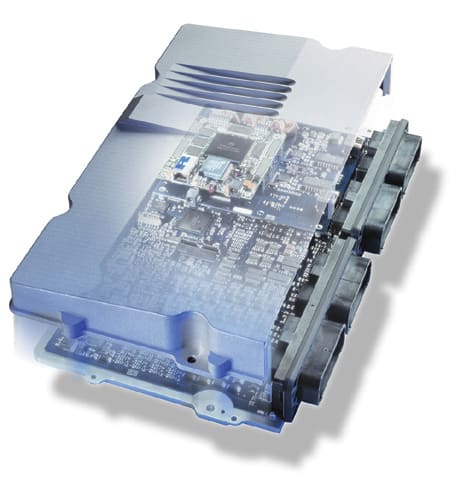
Though adding aftertreatment diagnostics has become an important element in vehicle designs, it can generally be handled without dedicated hardware. State-of-the-art microcontrollers have enough computing power to handle the extra tasks that come with aftertreatment diagnostics.
“The best place for diagnostics is on the CPU of the controller board,” Chewter said.
This approach will probably remain for quite some time. It’s generally expected that at some point, regulators will add off-highway vehicles to the list covered by OBD regulations. If a single circuit board handles control and diagnostic functions, it’s the only one that has to be certified for OBD compliance.
“Aftertreatment diagnostics are generally rolled in with engine diagnostics,” Rogers said. “That will probably remain the same if off-highway becomes subject to OBD requirements. You need to be cautious about making another device that falls under OBD.”
Monitoring the many parameters needed to ensure safe and efficient vehicle operations requires a lot of data movement. Many design teams are moving to higher speed versions of SAE J1939, while others are deploying more networks to spread data transfers across dedicated links. Increasing a vehicle’s data-communications capabilities typically provides more flexibility to meet a wider range of operating conditions and failure mechanisms.
“If there’s more bandwidth to play with, the emissions system can be very robust,” said Michael Taljonick, Technical Director, Electrification and Hybrid at IAV.

This bandwidth is beginning to extend beyond the vehicle’s networks as more operators opt to send data to remote monitoring stations. Telematics makes it possible to transmit vast amounts of information to maintenance facilities that can analyze many vehicles and tweak their schedules to reduce costs and downtime.
“Communications has become more prevalent,” Rogers said. “Companies take information from the engine control unit and dump it to the server. Fleets are particularly interested; they are attempting to use this information to find failures and set maintenance timetables.”
Impact of aging
The focus on reduced emissions continues over the lifetime of the vehicle, so monitoring systems have to ensure that things work as efficiently late in the vehicle’s lifetime as they did on day one. That’s forcing design engineers to study the lifetimes of various system components and take any aging characteristics into account. Both the operating parameters and the monitoring technologies are adjusted to account for these changes.
“We run extensive lab and machine testing to ensure that aging characteristics are captured within the diagnostics,” Cullen said. “We also invest time in improving upon existing diagnostics rather than reinventing them, to minimize risk for the customer.”
Some of the techniques for monitoring performance declines have been addressed by regulators at the California Air Resources Board and at the federal level.
“The full and useful life is something the CARB and OBD guys addressed; we don’t have to re-invent the wheel,” Rogers said. “Some systems will compensate for wear, but the focus is more about verifying that monitoring is still effective for parts at the end of their lifetimes.”
These techniques may eventually be augmented by software updates that occur without complex service calls. Over-the-air updates are still used only rarely in autos, so it may take a while for this simple updating technology to gain acceptance in off-highway markets. But the topic is already being examined as a way to tweak systems for optimal performance.
“As sensors and equipment change, you’ll need to make adjustments to maintain emissions levels,” said Wally Stegall, Technical Lead at Morey Corp. “There’s a lot more you can do with software now. A year into the lifetime of a machine, the company will learn something, and they’ll want to be able to alter the algorithm. Telematics can be used to program the device and ensure that it’s safe and secure.”
Many options
Though off-highway developers can leverage on-highway efforts, they must rework them to fit in this diverse environment. Commercial trucks don’t come with nearly as many options as the typical off-highway equipment line. Diagnostic systems have to be tailored to ensure that equipment works efficiently across all makes and models.
“Companies will take some of the methodologies used for on-highway diesels and apply them to off-highway, but the challenge is to do aftertreatment across the wider product variations seen in off-highway vehicles,” Rogers said. “The diagnostics will vary given the number of permutations.”
That’s expected to become a bigger issue over time. Stricter regulations expected by many will help drive up the cost of compliance. That may force OEMs to reduce the number of available options.
“With the wide variety of vehicle types, the amount of time and money needed to perform all the validation and certifications tests will be very, very significant,” said Tom Patterson, Business Development Director for Engines at Ricardo. “Going forward, it will impact how off-highway lines are discussed. Instead of eight different ratings, you’ll see more common engine types. Companies may drop the number of options they need to validate.”
The complexity of this challenge will also rise as alternative fuels enter the marketplace. System designers will have to ensure that fuel efficiency and emission levels remain at desired levels regardless of the fuel mix.
“A lot of customers ask about alternative fuels,” Patterson said. “A lot of alternative fuel manufacturers want people to consider bolt-on kits. If you’ve got an OBD engine, the idea of a bolt-on will be quite a challenge; the monitor will not be integrated.”
More From SAE Media Group
Off-Highway Engineering
Monarch Unveils AI-Powered Autonomous Platform
Off-Highway Engineering
Over-The-Air Affair
Off-Highway Engineering
Freightliner’s Medium-Duty Makeover
Off-Highway Engineering
Komatsu Augments Intelligent Machine Control in New Excavator
Automotive Engineering
No Hands, Lots of Brains
Off-Highway Engineering
ZM Trucks Starts Production in Fontana, California
Automotive Engineering
Accelerating Down the Road to Autonomy
Off-Highway Engineering
Engine Developers Increase Efforts to Decrease Fuel Usage
Off-Highway Engineering
Softing Supports a Standardized Diagnostic Protocol
Off-Highway Engineering
Nikola Producing Battery-Electric Trucks, Fuel-Cell EVs Coming
Off-Highway Engineering
Connectivity Continues Its Advance
Off-Highway Engineering
Shifting Design of Autonomous Architectures
Off-Highway Engineering
Making Sense of Autonomy
Autonomous Vehicle Engineering
ADAS Computing on a Greater Scale
Off-Highway Engineering
Standards Step Forward in Design of Off-highway Electronics
Off-Highway Engineering
Reshaping the Mobile-hydraulic Ecosystem
Off-Highway Engineering
FEV Simplifies Off-Highway Electrification
Battery & Electrification Technology
Ultracapacitor Solutions to Address Energy-Storage Needs of Vehicles
Automotive Engineering
More Gears, More Challenges
Autonomous Vehicle Engineering
Platform-Agnostic Interface Aims to Accelerate Truck Autonomy
Automotive Engineering
ZF Builds ‘Middleware’ to Address Vehicle Software Escalation
Off-Highway Engineering
Autonomous Quarry Haulage in High Demand
Automotive Engineering
IAA 2025: Qualcomm’s Superbrains Are Here to Help With Automated Driving


Off-Highway Engineering
More Intelligence Equals More Efficiency, Enhanced Functionality
Off-Highway Engineering
Hexagon Bullish on CNG for Long-Haul Trucks
Off-Highway Engineering
Big Data and Next-Gen Prognostics for Heavy-Duty Vehicles
Off-Highway Engineering
Regulatory Landscape Challenges Commercial-Vehicle Engine Development
Automotive Engineering
E Pluribus Unum
Top Stories
INSIDERManufacturing & Prototyping
 How Airbus is Using w-DED to 3D Print Larger Titanium Airplane Parts
INSIDERManned Systems
 FAA to Replace Aging Network of Ground-Based Radars
NewsTransportation
 CES 2026: Bosch is Ready to Bring AI to Your (Likely ICE-powered) Vehicle
NewsSoftware
 Accelerating Down the Road to Autonomy
EditorialDesign
 DarkSky One Wants to Make the World a Darker Place
INSIDERMaterials
 Can This Self-Healing Composite Make Airplane and Spacecraft Components Last...
Webcasts
Defense
 How Sift's Unified Observability Platform Accelerates Drone Innovation
Automotive
 E/E Architecture Redefined: Building Smarter, Safer, and Scalable...
Power
 Hydrogen Engines Are Heating Up for Heavy Duty
Electronics & Computers
 Advantages of Smart Power Distribution Unit Design for Automotive...
Unmanned Systems
 Quiet, Please: NVH Improvement Opportunities in the Early Design...
