




Balancing the RUMBLE and ROAR
Multiphysics simulation is part of the development toolset at Mahindra Two Wheelers, as the Indian motorcycle and scooter maker expands into global markets with larger bikes.

The Two Wheelers division of Indian tractor and automotive giant Mahindra & Mahindra has been riding a strategic growth curve in recent years. With its scooters and small-displacement (up to 300cc) commuter motorcycles popular in the home market, Mahindra is moving into international markets with larger machines under two iconic bike brands: Jawa and BSA, the latter acquired by Mahindra in 2016. Jawa machines are built under license.

To meet the increasingly stringent exhaust emission and noise regulations across global motorcycle markets, engineers at the Mahindra Two Wheelers R&D Centre at Pune adopted numerical simulation tools early in the development cycle of a recent single-cylinder four-stroke, liquid-cooled model. They used multiphysics simulation to study the NVH (noise, vibration, and harshness) performance of the engine, including its intake and exhaust systems. The knowledge gained from these studies enabled the development team to improve the new engine’s structural design and achieve desired noise levels.
The simulation software, COMSOL Multiphysics, also “helped to significantly reduce the number of design iterations that we had to go through, thereby saving time,” noted Niket Bhatia, Deputy Manager R&D, Mahindra.
Achieving optimal noise levels
Internal combustion engines contain many sources of noise, including the intake and combustion processes, pistons, gears, valve train, and exhaust systems. Combustion noise is due to structural vibrations caused by a rapid pressure rise within the cylinders. These vibrations continue from the powertrain to the engine casings through bearings, radiating noise.
Acoustics analysis solely through physical testing can be an expensive and time-consuming process. The team at Mahindra decided to complement physical testing with acoustics modeling to analyze how the engine’s structure might encourage noise radiation. The research goal was to find the parts of the engine that generate the most noise and come up with changes to the structure that could reduce it.
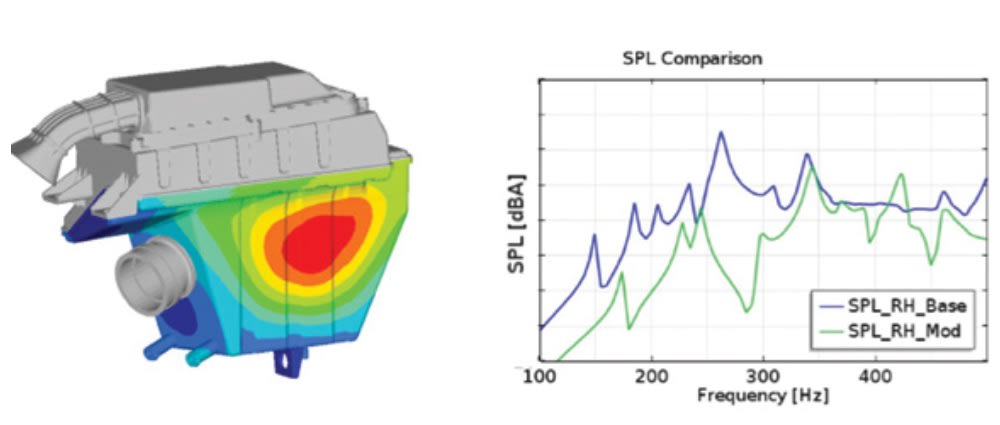
Using the multiphysics software, the researchers performed an acoustic-radiation analysis of a single-cylinder ICE under combustion load. The engineers enclosed the engine ‘skin’ in a computational domain surrounded by a perfectly matched layer (PML). PMLs dampen the outgoing waves with little or no reflections. This allows for accurate results while reducing the size of the computational domain.
The team decided to focus their analysis in the 800 Hz to 2000 Hz frequency range, as physical experiments indicated that the motorcycle’s engine noise radiation under combustion load was dominant in that region of the acoustic spectrum. This choice allowed the team to save computational resources and better understand what areas radiate the most noise.
Based on this analysis, the sound pressure level (SPL) was studied and modifications, such as increasing rib height and wall thickness and strengthening the mounting location, were made to the cylinder head and block. By adjusting these parameters, reduction in SPL was achieved at the targeted frequency range.
Both intake and exhaust noise are major contributors to pass-by-noise. [See SAE J2825, “ Measurement of Exhaust Sound Pressure Levels of Stationary On-Highway Motorcycles .” Noise radiating from the air filter structure, usually made of plastic, is one of the major contributors to intake noise. An acoustic transfer function (ATF) analysis was carried out for the plastic air filter walls. The air filter structure was modified by providing ribs to improve the ATF. This helped in reducing the structural noise of the air filter.
Born to be mild
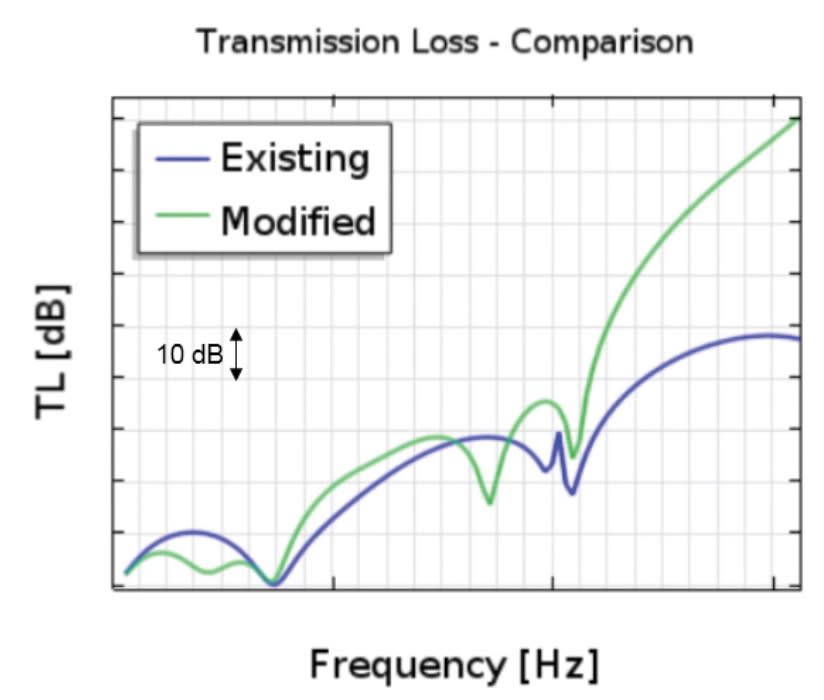
Regulatory requirements are always competing with customer demands in the motorcycle sector. Many riders prefer the louder exhaust note that continues to be perceived as an indicator of the motorcycle’s power, as well as being part of the thrill of two-wheeler ownership. Within the constraint of pass-by noise regulations, the challenge for Mahindra engineers was to increase their machines’ low-frequency exhaust ‘rumble’ while reducing the sound level for higher frequencies.
While attenuation of engine exhaust noise is the primary function of the bike’s muffler, factors such as the ability to provide low back pressure and meet pass-by-noise regulations also need to be considered. The performance of a muffler in an automotive exhaust system is characterized by three parameters: transmission loss, insertion loss, and radiated noise levels. Transmission loss is considered the most important parameter, and it is determined solely by the muffler design and is independent of the pressure source.
The challenge for the Mahindra team was to predict the transmission loss for a motorcycle muffler and then optimize the loss to desired levels for a certain frequency range.
A muffler of a single cylinder, liquid-cooled four-stroke motorcycle engine was considered for the analysis. Transmission loss analysis of the muffler was carried out using COMSOL Multiphysics.
With the Acoustics Module, boundary conditions such as continuity and sound hard wall were applied at appropriate locations. Perforations in pipes were defined by giving porosity details for the perforated area using a built-in transfer impedance model. The inputs required for analysis were the area porosity, baffle and pipe thickness, and diameter of holes.
For porous materials such as the glass wool often used to pack motorcycle mufflers, flow resistivity was defined with a poroacoustic model available in the software. Unit pressure was given as input at the inlet and a plane wave radiation condition was applied to both inlet and outlet boundaries. Based on the results, the muffler design was modified by increasing the pipe length inside the muffler.
With the modified muffler, the team achieved reduced transmission loss at low frequencies. As a result, the desired outcome of increased noise levels at low frequencies — that ‘song of the road’ that so many bike riders love, was achieved.
Benefits of early-design optimization
Mahindra engineering executives praised the software’s flexibility. And available tools such as the COMSOL API allowed the team “to carry out process automation using Java code which, while dealing with acoustic analysis for example, enabled us to use different meshes for different frequency steps to find the right compromise between simulation accuracy and computational times,” said Ulhas Mohite, Manager of R&D.
He noted that the toolset also enabled the automatic export of desired outputs such as surface SPL plots and far-field SPL data in the middle of the simulation run. “This helped save a lot of time with respect to manual postprocessing and exporting the data,” he said. The Application Builder tool available in COMSOL was also found to be useful. The team created a simulation app to compare analysis output files and plot the SPL data — “a great time saver,” Mohite explained.
Analysis results proved to be very closely correlated with physical experiment data. With simulation, the Mahindra engineers were able to take corrective actions by carrying out structural modifications based on analysis results early in the design stage. This helped reduce both time and cost involved in product development.
“When supported with experiments, these simulations lead us in the right direction to find an efficient solution to motorcycle noise issues,” concluded Bhatia.
Author Mads Herring Jensen, Ph.D, is Technical Product Manager, Acoustics at COMSOL.
More From SAE Media Group

Off-Highway Engineering
Komatsu Augments Intelligent Machine Control in New Excavator
Off-Highway Engineering
Engine Developers Increase Efforts to Decrease Fuel Usage
Off-Highway Engineering
Heavy-Duty Engine Design
Off-Highway Engineering
FEV Simplifies Off-Highway Electrification
Off-Highway Engineering
Expediting Engine Design
Tech Briefs
Disrupting the Automobile Design Process
Automotive Engineering
BMW, Classiq Find Better Architectures Through Quantum Computing
Off-Highway Engineering
Reshaping the Mobile-hydraulic Ecosystem


Automotive Engineering
Engineering at the New NVH Frontier
Off-Highway Engineering
Solving Problems and Seeking Big Ideas for Commercial Vehicles
Tech Briefs
New on the Market

Automotive Engineering
IAA 2025: Qualcomm’s Superbrains Are Here to Help With Automated Driving
Off-Highway Engineering
Life-cycle Planning — Design and Calibration for Ultimate Efficiency
Automotive Engineering
The Inside Story on Thermal Management


Motion Design INSIDER
Physics-Aware Neural Networks Improve Camera-Based Machines
Tech Briefs
SAE WCX™ Digital Summit Preview
Off-Highway Engineering
Garrett Two-Stage Turbos Ramp up Off-Highway

Automotive Engineering
Reducing NVH Through Refined Powertrain Measurement
Autonomous Vehicle Engineering
Speeding Thermal Analysis for Autonomous EVs
Motion Design
New Products

Off-Highway Engineering
Cummins Unveils New B7.2 Diesel Engine
Top Stories
INSIDERManufacturing & Prototyping
 How Airbus is Using w-DED to 3D Print Larger Titanium Airplane Parts
INSIDERManned Systems
 FAA to Replace Aging Network of Ground-Based Radars
NewsTransportation
 CES 2026: Bosch is Ready to Bring AI to Your (Likely ICE-powered) Vehicle
NewsSoftware
 Accelerating Down the Road to Autonomy
EditorialDesign
 DarkSky One Wants to Make the World a Darker Place
INSIDERMaterials
 Can This Self-Healing Composite Make Airplane and Spacecraft Components Last...
Webcasts
Defense
 How Sift's Unified Observability Platform Accelerates Drone Innovation
Automotive
 E/E Architecture Redefined: Building Smarter, Safer, and Scalable...
Power
 Hydrogen Engines Are Heating Up for Heavy Duty
Electronics & Computers
 Advantages of Smart Power Distribution Unit Design for Automotive...
Unmanned Systems
 Quiet, Please: NVH Improvement Opportunities in the Early Design...
