




Reducing NVH Through Refined Powertrain Measurement
The C1000 vastly simplifies measuring the mass matrix of heavy, odd shaped engines and powertrains.

Accurate measurements of vehicle centers-of-gravity and inertia are vital for helping NVH engineers further improve their dynamic vehicle models — and thus improve performance and safety. Specialized vehicle test machines are used for NHTSA’s New Car Assessment Program (NCAP) and new variations are entering service for the subsystem level. One of them is the C1000, developed by S-E-A Vehicle Dynamics headquartered in Columbus, Ohio.
As the smallest of S-E-A’s Vehicle Inertia Measurement Facility (VIMF) product line, the C1000 was developed to finally simplify the decades-old issue of measuring the mass matrix of heavy, odd shaped engines and powertrains. The resulting data is crucial to NVH engineers and is now much easier to obtain.
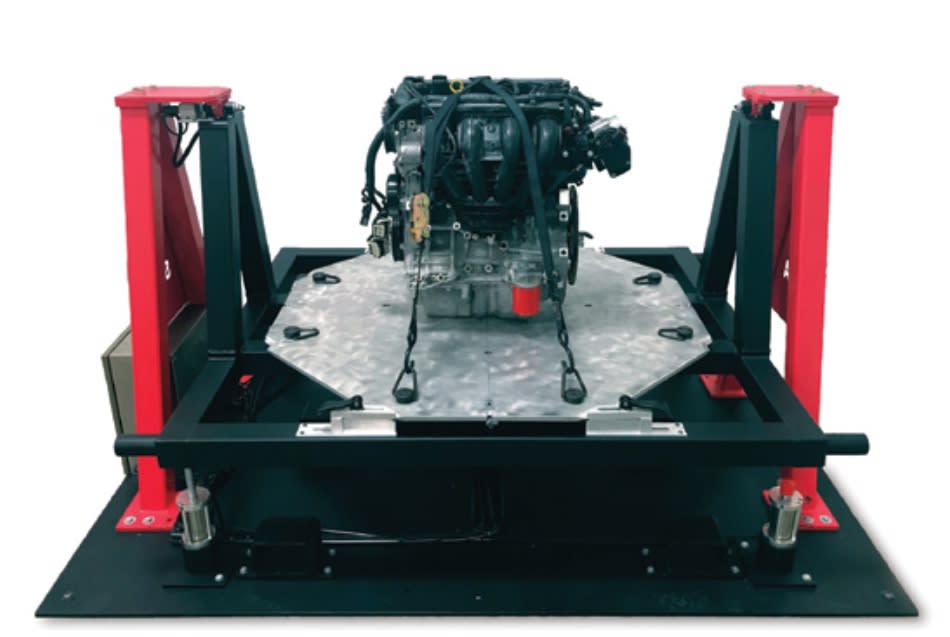
“For decades, automotive engineers have been suspending extremely heavy engines to measure their inertia. We would regularly hear clients lament that the process was labor intensive and produced results that were not easily repeatable,” noted company director Gary Heydinger, Ph.D and PE. He explained that the C1000 was conceived “to make [engineers’] work day easier and provide results they can trust” — with consistent, repeatable fidelity.
Reliable data and the end customer
Most consumers won’t purchase a new vehicle without a test drive. Not only is it their one occasion to evaluate the cabin features offered by the manufacturer, but also their sole opportunity to experience the vehicle’s ride performance. Does the suspension deliver a good balance of compliance and accurate roadholding? Or is it too floaty — or too hard? As part of this naturalistic evaluation, the combined noise and vibration is immediately apparent when assessing the feel of a vehicle.
Noise control, however, is not just about making cars quieter for a more relaxing ride, but about enhancing the overall cabin experience. NVH characteristics are high among the factors consumers use to judge a vehicle’s quality.
What causes NVH, and more importantly, how is it mitigated? One source is the engine, where vibrations are generated and then travel through the engine mounts, into the structure, and through the car seat into the driver. Alternatively, vibrations from the same source can take a similar path through the structure to become acoustic noise when it is amplified by the cabin. Optimizing these factors is therefore of utmost importance for the overall experience of a vehicle.

Engine mounts play a crucial role in a vehicle’s comfort, while protecting the engine from excessive movement and forces due to low frequency road and high frequency engine excitations. This has led to significant interest in computer-aided predictive techniques for NVH, such as a frequency response function (FRF) model of a vehicle to evaluate the optimum types and locations of engine mounts. Others use finite element (FEM) and multi-body dynamic modeling, or a combination of them, to tune their mounts to achieve specific objectives.
In these models, an engine block is modeled as a rigid body attached to the neighboring parts to study how to reduce the transmitted vibrations to the occupants. Engineers need to know the mass matrix of the engine with a high level of accuracy to best evaluate the system computer models.
Saving testing time
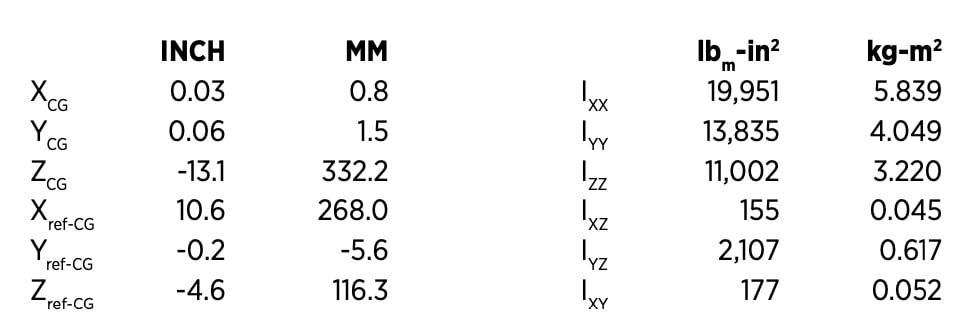
S-E-A’s C1000 measures the complete inertia matrix: mass, center of gravity location (XCG, YCG, ZCG), and all moments and products of inertia (IXX, IXY, IZZ, IXY, IYZ, IXZ). These quantities are imperative in studying engine vibrations, calculating the torque roll axis (TRA), and in determining the placement of engine mounts. A key feature of the C1000 is that the engine, once placed on the test table, is never reoriented during the test process. This reduces the testing time to an hour or less. Previous inertia test methods were inefficient, requiring up to five reorientations, separate CG measurements, and several days to complete.
Below is a sample data set output from the C1000. The machine measures the CG of the system (XCG, YCG, ZCG), which is then adjusted based on the desired reference point of the engine (Xref-CG, Yref-CG, Zref-CG):
The unit was designed with test time and accuracy in mind. Like S-E-A’s VIMF, this machine is robust and repeatable. If you place a known fixture on it today, then again in five years, the same result within about 2 millimeters would be expected.
The physical principles are as old as Isaac Newton, although modern electronics and software aid the process. The C1000 uses a stable pendulum arrangement to obtain the CG location, two moments and one product of inertia. The test plate rests on a bearing allowing it to rotate relative to the pendulum. The third moment is measured using the torsional spring method, while the final two products of inertia use the torsional spring method combined with a load cell.
For a typical passenger vehicle engine, accuracy is on the order of 2.5 mm for CG, 1-2% for moments of inertia, and products of inertia are 2% of the smallest moment of inertia.

With this equipment, NVH engineers can input reliable and repeatable data into their vibration models to determine the optimum engine mount locations. Getting the locations correct early in the process saves time and money, the company claims, while the end result improves the entire vehicle experience for the driver and passengers.
“S-E-A has always provided customized testing solutions. Our products have helped to establish standards when there is no standard, and our Vehicle Dynamics specialists continuously innovate by using cutting edge technology to develop new and unique test equipment and methods,” commented Dan Buss, the company’s global sales director.
Author Scott Zagorski, Ph.D, PE, is a mechanical engineer who has been performing vehicle testing/vehicle dynamics for 15 years. He has been with S-E-A for four years.
More From SAE Media Group
Off-Highway Engineering
Taking on NVH Reduction Techniques
Power Electronics INSIDER
Highly Conductive Aluminum Can Equal Copper
Motion Design
Built-In Vibration Control to Soundproof Spaces
Tech Briefs
A Self-Powered Trailer
Battery & Electrification Technology
The Rechargeable Renaissance
Off-Highway Engineering
AxleTech Develops Electric Independent Suspension Concept for Vehicles Up to 58,000-lb GCWR
Motion Design
Multi-Axis Motion Controller Accelerates Gear Testing
Off-Highway Engineering
EV Startup Prepares to Enter Commercial Market with Novel EAxle
NASA Spinoff
NASA Gives the World a Brake
Off-Highway Engineering
FEV Simplifies Off-Highway Electrification
Battery & Electrification Technology
Manufacturing Advances in Solid-State Batteries
Off-Highway Engineering
Active Vibration Damping for Construction Machines
Tech Briefs
Origami-Inspired Material Softens Impact Forces

Off-Highway Engineering
Freightliner’s Medium-Duty Makeover
Automotive Engineering
The Inside Story on Thermal Management
Off-Highway Engineering
Reshaping the Mobile-hydraulic Ecosystem

Tech Briefs
Modal Vibration Analysis of Large Castings
Tech Briefs
Laser-Light-Based Accelerometer
Off-Highway Engineering
Komatsu Targets Productivity, Operator Comfort With New WA480-8 Wheel Loader

Tech Briefs
Disrupting the Automobile Design Process
Motion Design INSIDER
Megawatt Electrical Motor Could Help Electrify Aviation
Off-Highway Engineering
Mahle Advances 3D Printing Capabilities

Off-Highway Engineering
Heavy Duty Lightweighting
Off-Highway Engineering
Komatsu Augments Intelligent Machine Control in New Excavator
Top Stories
INSIDERManufacturing & Prototyping
 How Airbus is Using w-DED to 3D Print Larger Titanium Airplane Parts
INSIDERManned Systems
 FAA to Replace Aging Network of Ground-Based Radars
NewsTransportation
 CES 2026: Bosch is Ready to Bring AI to Your (Likely ICE-powered) Vehicle
NewsSoftware
 Accelerating Down the Road to Autonomy
EditorialDesign
 DarkSky One Wants to Make the World a Darker Place
INSIDERMaterials
 Can This Self-Healing Composite Make Airplane and Spacecraft Components Last...
Webcasts
Defense
 How Sift's Unified Observability Platform Accelerates Drone Innovation
Automotive
 E/E Architecture Redefined: Building Smarter, Safer, and Scalable...
Power
 Hydrogen Engines Are Heating Up for Heavy Duty
Electronics & Computers
 Advantages of Smart Power Distribution Unit Design for Automotive...
Unmanned Systems
 Quiet, Please: NVH Improvement Opportunities in the Early Design...
