




Heavy Duty Lightweighting
Optimization of tractor-trailer systems and component design helps to reduce overall vehicle mass, a key strategy in improving fuel economy and meeting upcoming Phase 2 GHG regulations.

Passenger cars and light-duty trucks are not alone in the quest to shed pounds in an all-out effort to meet stricter fuel efficiency requirements. Lightweighting is cited by the U.S. EPA and the National Highway Traffic Safety Administration (NHTSA) as a key strategy to help medium and heavy trucks and trailers meet the first phase and Phase 2 greenhouse gas (GHG) and fuel efficiency standards. Cutting weight from trucks offers the bonus of potentially increasing payload capacity.
Altair and the Center for Automotive Research (CAR) recently recognized vehicle mass-reduction innovations for the fifth consecutive year, bestowing Enlighten Awards on four winners (read: articles.sae.org/15545/). Though the top honors went to automotive companies, the awards are open to the commercial vehicle segment — and this year saw three finalists sharing their lightweighting work related to medium and heavy truck applications.
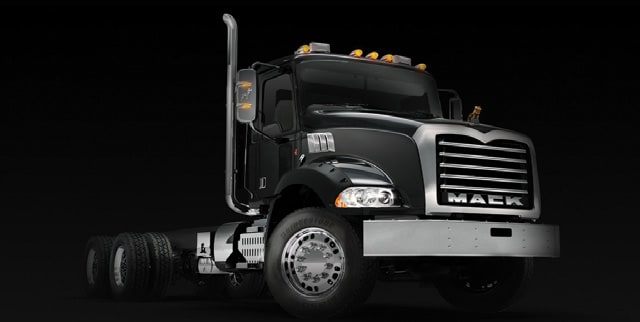
While none of these technologies is particularly earth-shattering, they do illustrate the industry’s efforts — as with their automotive brethren — to continually evaluate every system and component of the vehicle to optimize their designs for comparable (or better) performance at a reduced weight. Details of the three finalists are highlighted here.
Lost foam enables optimized ‘goalpost’ bracket
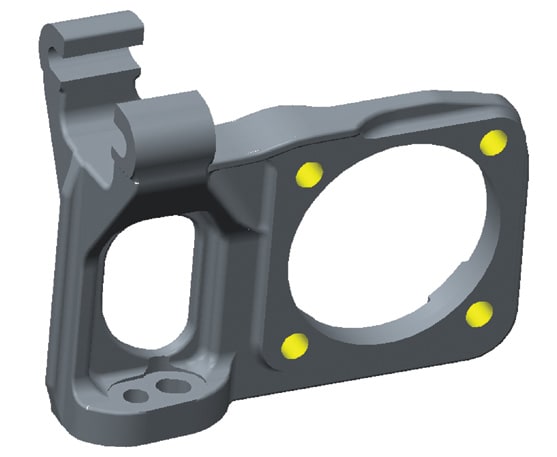
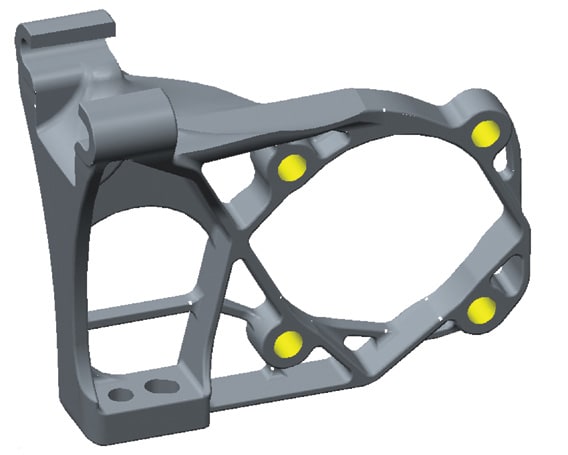
Mack Trucks recently introduced a new torque rod bracket for the rear axle — i.e., a “goalpost” bracket — on its vocational vehicles such as the Granite, representing a 42% weight savings compared to the previous part. The new bracket, made of cast ductile iron like its predecessor, enables easier installation, contributes to increased payload capability, and “greatly reduces” cost by creating an as-cast part that is optimized. The company explains how its design solution achieved these marks:
“To achieve this goal, we used software to create a structure that maintained load on the bolt at or below the current loading while attempting to equalize the loading as much as possible. That is the reason for the [unique] shape around the bolt face. By directing the load where we wanted, we were able to achieve a better overall distribution than the part it replaces. As a result, the stress concentrations are actually lower than the original part in most places and under most loadings, but always less than peak stress of the original part. By putting material only where it is needed, we have actually improved the life of the part as well.”
Greater movement capability due to better part clearance is yet another benefit of the new design.
Mack engineers used Altair’s OptiStruct in this project “to not only show us the most weight-reduced result, but also to use the bolt loading as the main constraint rather than the stiffness. This caused some unconventional shapes to emerge,” the company noted.
The result is a very open mesh with many through holes. “As a green sand casting, this would be nearly impossible to produce cost effectively, but by using the lost foam method, with no machining, we were able to produce very clean consistent parts that have no sharp edges from the tooling. This allowed for maximum weight reduction.”
This type of solution could easily be employed in any load-bearing structure, according to Mack, but is “excellent” in this type of application, as the loading is purely axial with a slight rotational input from the bushing.
BorgWarner fan drive cuts weight, cost
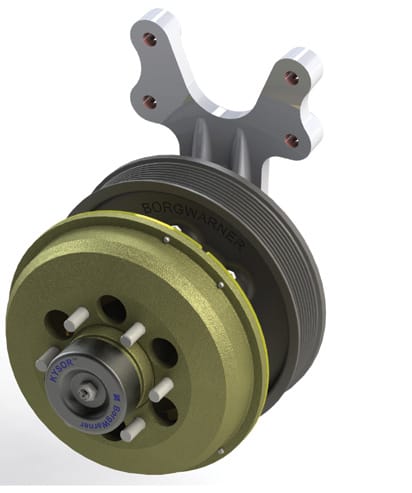
An optimized on/off fan drive supplied by BorgWarner Thermal Systems on the 2017 Freightliner M2 with Cummins ISL platform saves 1.6 kg (3.5 lb) compared to the baseline system. Weight reduction stems from optimizing the engine base casting and pulley castings, which also minimized the amount of post-process manufacturing operations that are required on these components.
BorgWarner’s Cadillac, MI, plant is producing the system for the Daimler ISL platform, at an annual volume of approximately 10,000 units per year. A significant cost savings per drive was realized, according to BorgWarner.
The fan hub is customized by engine application for the OEM, so the optimizations specific to this program were made in the fan hub assembly’s base and pulley castings, the company noted. A universal fan clutch assembly mounts to all customized hub applications.
The reduced-weight components were developed from previous best practices and “innovative design” in reducing the engine base casting’s overall footprint, according to BorgWarner. The smaller footprint accounts for the lighter weight.
“Simulation technologies are playing a leading role in this [lightweighting] effort, with almost all of the full-vehcle and module entries [in this year’s Enlighten Awards] citing the use of design optimization technologies for innovative, material efficient products,” said Richard Yen, Senior VP, Automotive and Global Markets Team at Altair. “I believe this momentum will continue apace.”
No vehicle assembly changes were required to accommodate the solution; the optimized fan drive is a drop-in replacement for the baseline product. Utilization of an Auto-deposition coating (A-Coat) versus the previous blue paint finish results in better corrosion resistance, according to salt spray testing conducted at an external laboratory.
Finite element analysis (FEA) and modal analysis were completed on the weight-reduced designs to ensure that the safety factor was still within the production release criteria.
The weight-reduction practices and addition of A-Coat are applicable to all BorgWarner fan drives, the company claims.
VECV optimizes 8x2 suspension, shedding 16 kg
A bell crank assembled with suspension mounting bracket from VE Commercial Vehicles, a Volvo Group and Eicher Motors joint venture, was applied to a MY2016 8x2 vehicle, resulting in a total mass savings of 16 kg (35 lb). The assembly translates the vertical motion of the wheel into horizontal motion, allowing the suspension to be mounted transversely or longitudinally.
Optimization of four bell cranks — cutting out material from the center of the design — and two rear suspension mounting brackets accounted for the weight reduction. The cross section of the components was identified as design variable for the optimization run, the result being optimized parts with the same mounting positions as before.
A fully manufacturable design solution was obtained directly from the results, VECV claims. Design optimization was performed at the CAD stage using SolidThinking Inspire software from Altair.
“Deciding the lower and upper limits for the design variables was a very challenging task. They were chosen keeping in mind the limits of our manufacturing capabilities,” according to VECV.
No vehicle assembly changes were required with the redesign; VECV engineers kept the component mounting locations out of the scope of optimization. Parameters were chosen in such a way that VECV could achieve maximum output with minimum changes in the manufacturing and tooling compared to the baseline axle.
The company plans to use this optimized bell crank and suspension mounting in its other vehicles including 10x2 and other heavy-duty vehicles.
More From SAE Media Group
Off-Highway Engineering
ZM Trucks Starts Production in Fontana, California
Off-Highway Engineering
Freightliner’s Medium-Duty Makeover
Off-Highway Engineering
AxleTech Develops Electric Independent Suspension Concept for Vehicles Up to 58,000-lb GCWR
Off-Highway Engineering
Daimler Trucks' Lessons Learned from SuperTruck Program
Off-Highway Engineering
SuperTruck REDUX
Off-Highway Engineering
FEV Simplifies Off-Highway Electrification
Off-Highway Engineering
Miserly Power Systems
Off-Highway Engineering
First Drive: Drifting in the Electric 2027 Mercedes GLC 400
Off-Highway Engineering
EV Startup Prepares to Enter Commercial Market with Novel EAxle
Off-Highway Engineering
ZF Premieres AxTrax 2 Electric Axle Platform at ACT Expo
Power Electronics INSIDER
Highway Segment Charges Electric Vehicles

Off-Highway Engineering
REE Unveils P7-C Chassis Cab at ACT Expo
Automotive Engineering
Engineering ‘Electron Guzzlers’
Off-Highway Engineering
Hydrogen Shows Increased Commercial Interest
Off-Highway Engineering
Western Star Adds ‘Weight Sensitive’ 47X to Vocational Lineup
Automotive Engineering
Cadillac ATS-V Bulks up for Track Duty
Off-Highway Engineering
Math to Road Cycle Is Similar Yet Diverse for Trains, Trucks, and Tractors
Battery & Electrification Technology
Ultracapacitor Solutions to Address Energy-Storage Needs of Vehicles
Autonomous Vehicle Engineering
Autonomy and Electrification: A Perfect Match?
Off-Highway Engineering
Komatsu Targets Productivity, Operator Comfort With New WA480-8 Wheel Loader
Automotive Engineering
Delphi’s Multi-domain Mindset
Off-Highway Engineering
Detailing Kenworth’s Sleek SuperTruck 2
Off-Highway Engineering
Electrification’s Impact on Commercial-Vehicle Chassis Design
Off-Highway Engineering
Yanmar CE Adds to Growing Compact Track Loader Segment
Automotive Engineering
Getting a Grip on AWD Efficiency
Automotive Engineering
Climate Control Engineers Face New CAFE Test
Automotive Engineering
Flywheel Hybrids Offer New Efficiency Potential
Automotive Engineering
Inside Honda’s New Two-motor 50-mpg Accord Hybrid
Off-Highway Engineering
Digital Tech a Las Vegas Headliner
Top Stories
INSIDERManufacturing & Prototyping
 How Airbus is Using w-DED to 3D Print Larger Titanium Airplane Parts
INSIDERManned Systems
 FAA to Replace Aging Network of Ground-Based Radars
NewsTransportation
 CES 2026: Bosch is Ready to Bring AI to Your (Likely ICE-powered) Vehicle
NewsSoftware
 Accelerating Down the Road to Autonomy
EditorialDesign
 DarkSky One Wants to Make the World a Darker Place
INSIDERMaterials
 Can This Self-Healing Composite Make Airplane and Spacecraft Components Last...
Webcasts
Defense
 How Sift's Unified Observability Platform Accelerates Drone Innovation
Automotive
 E/E Architecture Redefined: Building Smarter, Safer, and Scalable...
Power
 Hydrogen Engines Are Heating Up for Heavy Duty
Electronics & Computers
 Advantages of Smart Power Distribution Unit Design for Automotive...
Unmanned Systems
 Quiet, Please: NVH Improvement Opportunities in the Early Design...
