




Delphi’s Multi-domain Mindset
From tackling the cyber threat to putting 48-volt hybrids with Dynamic Skip-Fire on the road, Engineering VP Mary Gustanski is harnessing a technology powerhouse.
Mary Gustanski lives in a James Bond movie. It hasn’t yet been released but she’s certain it will be at some future date. In her film-nightmare, the evil-genius villain on the remote island has hacked into the ‘cloud’ to wreak havoc on the world’s vehicles and their drivers. Chaos is rampant on the highways, streets and in every parking garage and car wash.
“That’s actually how we look at the security threat as we develop advanced vehicle technologies,” said Gustanski, the Vice President of Engineering & Program Management at Delphi Automotive Systems. “The one thing we know for sure is, someone is going to get in. We start out with that premise.”

Gustanski acknowledges that despite intense analysis and discussion of this hottest of industry topics, there is no single solution yet to the cybersecurity challenge. And every vehicle OEM “is in a different place” in terms of their approach. Delphi’s approach, she says, is different.
“We’re going to protect the easy things — the phone, Bluetooth, cellular — but we also want to know when someone’s hacked in,” she noted in a wide-ranging and lively interview with Automotive Engineering at Delphi’s Troy, MI, offices. “That requires robust intrusion detection on your communication, so that you’re monitoring the intruder. Then we want you, the OEM, to be able to put the intruder into a ‘box’ before it touches your safety-critical elements.”
Rise of the MDC
Development of such cyber-detection technology and related countermeasures, in addition to advanced propulsion systems, connected car and autonomous-driving programs, are transforming megasupplier Delphi into an organization that is resembling, to a degree, a tech company — one that last year conducted the first successful coast-to-coast driverless-car transit of the U.S.
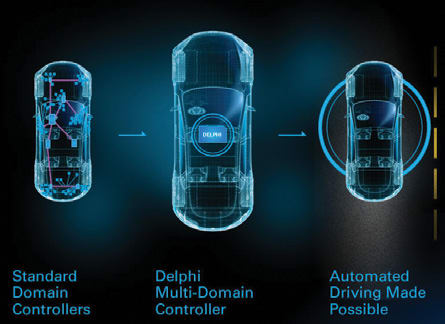
While discussing the cyber threat, Gustanski noted that some OEMs are moving toward networked multi-domain controllers (MDC) — essentially a single ‘brain’ that has authority over various subsystems. Audi, for example is using Delphi’s recently introduced MDC, based on Nvidia multi-core processor technology, to oversee the entire automated-driving sensor array in its electric eTron Quattro.
“There are segments of the vehicle — safety-critical is one and Powertrain is another — that are kept under separate control for a reason, including redundancy,” she asserted. “Above all else, the vehicle must be safe to operate 100% of the time.” And regarding the debate over government access to vehicle data and its potential role in anti-cyber defense, Gustanski believes “the consumer will eventually warm up to it.”
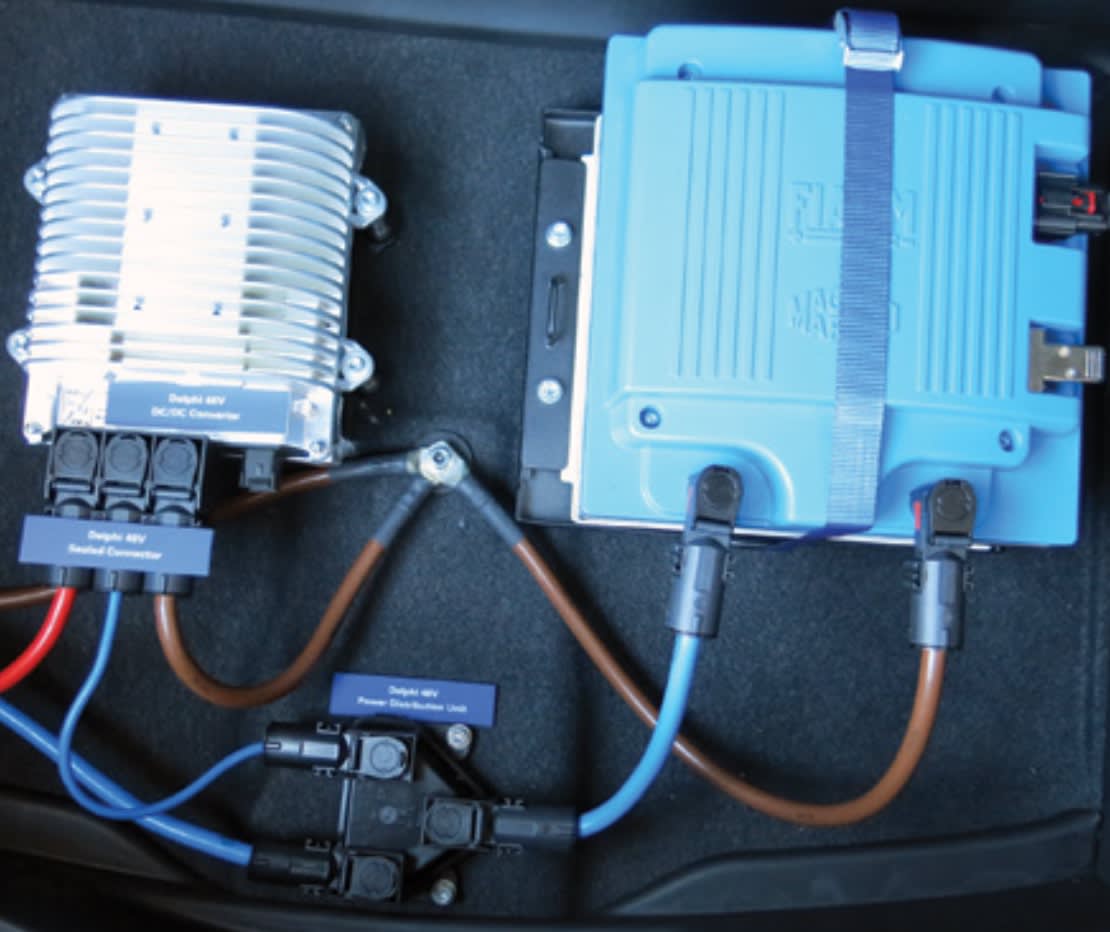
When the question of what assets differentiate Delphi from its competitors such as Bosch and Continental arises, Gustanski points to a longstanding staple in the technology portfolio: Electrical architecture (EEA) supply, right down to the wiring harness and connectors. It’s not-so-simple stuff anymore, and still a pillar of Delphi’s revenue. She noted that there are, on average, 11⁄2 miles (2.4 km) of wiring in the harness of a typical vehicle. “But when you realize it’s 11⁄2 miles of copper and 280 connectors, it gets heavy,” she said.
Next year Delphi is launching a novel thin-walled harness technology featuring aluminum wire in some sections. In a typical vehicle application the new-tech harness will be longer overall but it enables the copper sections to be down-gauged. The end result will be a 50% mass savings over an all-copper harness, Gustanski explained.
Still, the explosion of vehicle electronics hardware is overdriving system complexity and creating a challenge not only of power and signal, but of data speed. And that means the move beyond incumbent CAN-based technology, in many cases, to Ethernet.
“We’re going from 65 megabits-per-second today to 1.5 gigabits/second — and an advanced project we kicked off this year is going for 6 giga-bits/second,” she reported. How fast is 65 megabits/second? Gustanski’s engineers calculated it to be 65,000 pieces of data in the blink of an eye.
Next step: 48-V plus DSF
In addition to connected-vehicle and automated-driving systems, faster data speed also plays a role in the ongoing development of two key Delphi programs: 48-V hybrids and Dynamic Skip-Fire (DSF) which will soon be together in the same propulsion system for OEM demonstrations.
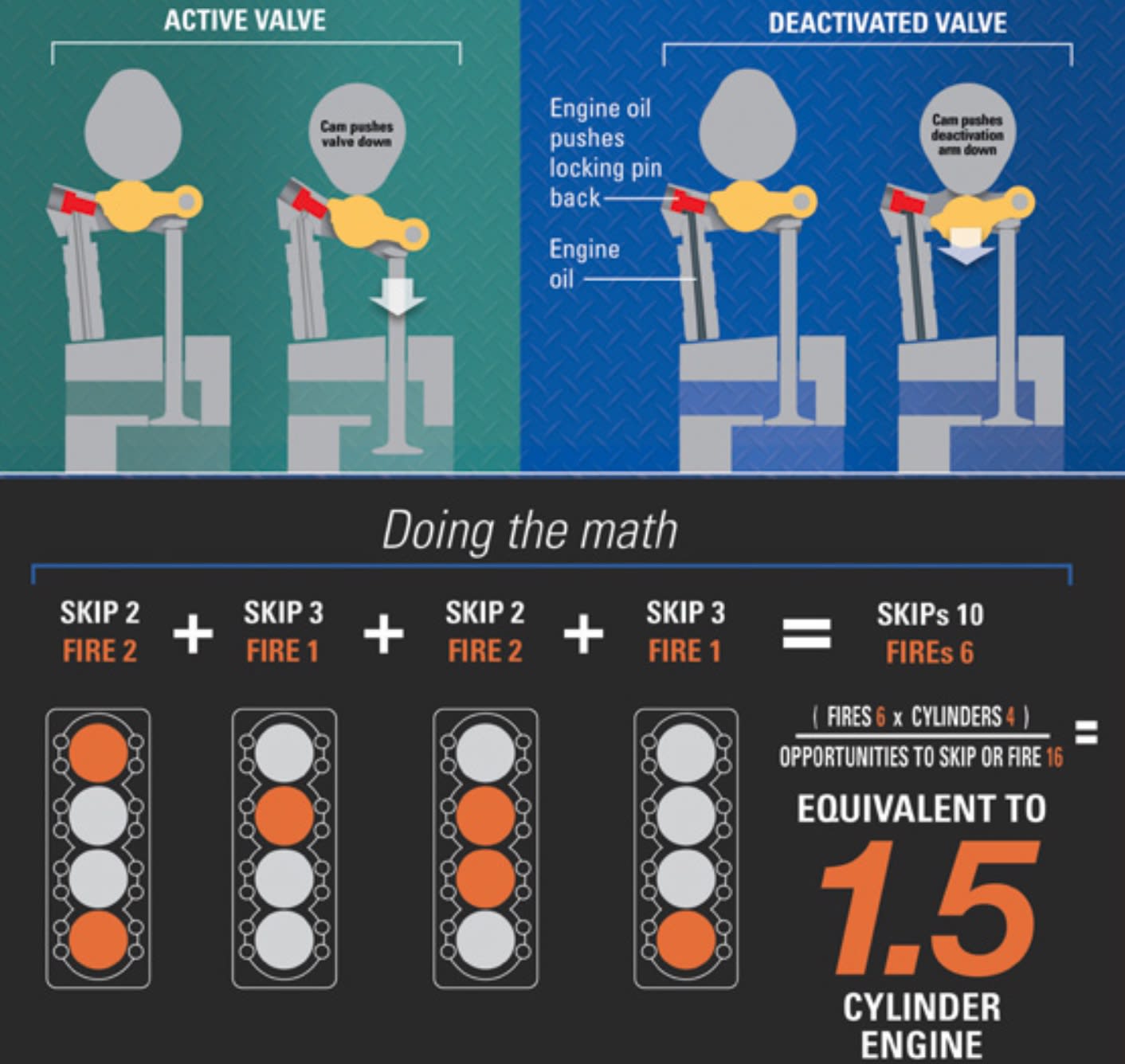
The DSF, being productionized by Delphi, was invented by San Diego-based Tula Technologies in which Delphi holds an investment stake. Based on digital-signal processing, it is the industry’s first individual-cylinder deactivation system. DSF has demonstrated 10-15% fuel efficiency gains versus engines without cylinder deactivation. Delphi has had V8 engines equipped with DSF under vehicle test and recently added I4-powered vehicles, Gustanski said.
With global OEMs increasingly interested in 48-V technology — next month’s Automotive Engineering will cover this in detail — Delphi’s two converted European model Honda Civic diesels are getting a workout in customer demonstrations, Gustanski reported. The Phase-2 demo vehicles being completed by Delphi will also feature DSF gasoline engines. She expects the demo cars to be ready by early 2017.
“It’s an internally-funded program,” she said. “We’ve modeled it and typically our modeling of fuel efficiency is conservative when compared to real world. I can say that we’ve demonstrated 15% gains for the 48-V and 10% or better for DSF, separately.”
EEs going software
The “revolution in engineering” Gustanski sees propelling new emissions, safety and automated-driving developments with greater demand for software expertise is reshaping the technical workforce.
“We have 20,000 engineers working at Delphi today,” she noted. “About 5,500 of those are in software and the associated competencies including systems engineering. That’s about 1 in 4 working in software. A few years ago we were about 1 in 5. Tomorrow it’s going to be 1 in 3.”
Delphi is still hiring mechanical and electrical engineers — in fact, it is actually hiring more MEs and EEs and training them to be software engineers, she said, for two reasons.
One is there aren’t enough software engineers coming out of universities to fill the pipeline — “and the ones who are typically want to work in IT,” she revealed. Second, Delphi prefers computer-engineering majors over computer science, “because when you grow to be a systems engineer you have to have some understanding of how a vehicle works. You need some engineering mindset,” Gustanski believes. “So we’d just as well take an EE and teach them to be a software or system engineer. We have an internal development track for that.”
More From SAE Media Group

Off-Highway Engineering
ZM Trucks Starts Production in Fontana, California
Off-Highway Engineering
Freightliner’s Medium-Duty Makeover
Automotive Engineering
Inside Honda’s New Two-motor 50-mpg Accord Hybrid
Automotive Engineering
Bosch’s EV Efficiency Upgrade: Continuously Variable Transmissions
Automotive Engineering
CES 2026: Bosch is Ready to Bring AI to Your (Likely ICE-powered) Vehicle
Autonomous Vehicle Engineering
AV Powers Bring May Flowers
Automotive Engineering
Riding Along With Mercedes and Its in-city Driver Assistance System
Off-Highway Engineering
Daimler Trucks' Lessons Learned from SuperTruck Program
Battery & Electrification Technology
Ultracapacitor Solutions to Address Energy-Storage Needs of Vehicles
Automotive Engineering
Gearing Dana for the EV Future
Automotive Engineering
Packaging Honda’s all-new Insight
Automotive Engineering
Transforming Propulsion with Tula’s Digital-Control Magic
Automotive Engineering
Preparing for a 48-volt Revival
Off-Highway Engineering
FEV Simplifies Off-Highway Electrification

Automotive Engineering
GM Announces SAE Level 3 Autonomy and SDV Technology
Automotive Engineering
CES 2021: GM Creates BrightDrop, a New Electrified Delivery and Logistics Company
Automotive Engineering
Electrifying ‘The Ultimate Driving Machine’
Automotive Engineering
The Future of “Core” Vehicle Systems
Automotive Engineering
MAGNA Say Some Hurdles of Seat-reconfiguration System to Be Addressed by OEMs
Automotive Engineering
Full Speed Ahead for Second-Generation Indy Autonomous Racers
Autonomous Vehicle Engineering
Hopeful but Closer Scrutiny for SAE Level 4 Automation

Automotive Engineering
Testing Audi’s New E-Booster Reveals Turbocharging's Future
Autonomous Vehicle Engineering
Lockered and Loaded
Off-Highway Engineering
AxleTech Develops Electric Independent Suspension Concept for Vehicles Up to 58,000-lb GCWR
Autonomous Vehicle Engineering
Autonomy and Electrification: A Perfect Match?
Tech Briefs
Autonomous Vehicles and the Burden of Testing
Top Stories
INSIDERManufacturing & Prototyping
 How Airbus is Using w-DED to 3D Print Larger Titanium Airplane Parts
INSIDERManned Systems
 FAA to Replace Aging Network of Ground-Based Radars
NewsTransportation
 CES 2026: Bosch is Ready to Bring AI to Your (Likely ICE-powered) Vehicle
NewsSoftware
 Accelerating Down the Road to Autonomy
EditorialDesign
 DarkSky One Wants to Make the World a Darker Place
INSIDERMaterials
 Can This Self-Healing Composite Make Airplane and Spacecraft Components Last...
Webcasts
Defense
 How Sift's Unified Observability Platform Accelerates Drone Innovation
Automotive
 E/E Architecture Redefined: Building Smarter, Safer, and Scalable...
Power
 Hydrogen Engines Are Heating Up for Heavy Duty
Electronics & Computers
 Advantages of Smart Power Distribution Unit Design for Automotive...
Unmanned Systems
 Quiet, Please: NVH Improvement Opportunities in the Early Design...
