




GM Announces SAE Level 3 Autonomy and SDV Technology
The Escalade IQ will support hands-off and eyes-off driver assistance in 2028.

While full autonomy continues to be a work-in-progress, automakers have been rolling out various degrees of SAE Level 2 driver assistance, including hands-off, eyes-on systems from BMW, Ford, and GM. In New York City in October, GM announced that it was working towards SAE Level 3 driver assistance capabilities that will launch on the Escalade IQ electric SUV in 2028.
The news expands the driver assistance development that the automaker has been refining since its launch of Super Cruise in 2017. Super Cruise requires the driver to keep their eyes on the road while driving hands-free. This evolution of that system to what's launching in 2028 will allow drivers to take their eyes off the road and hands off the wheel in certain driving environments. GM shared examples of drivers being able to reply to emails, read books, or watch videos while the SAE Level 3 system is engaged. It's not a completely autonomous driving experience; those behind the wheel will still need to drive the vehicle outside of the system's operational domain. But for highway driving, it could potentially erase one of the pain points of driving: the time lost during the daily commute.
GM notes that the launch of its SAE Level 3 system is still three years out and was sparse on details concerning the number of sensors that will reside on each vehicle and the exact operating domain. Still GM's senior vice president of Software and Services Product Management, Program Management, and Design, Baris Cetinok, told SAE Media that the plan is to launch the system on highways and at speeds up to the speed limit of the highways. "This is not a traffic jam pilot," Cetinok said. When asked that if the speed limit was 70 mph (113 km/h), the system would drive at that speed, Cetinok replied, "Exactly.
When launched, GM will be competing with Mercedes, which currently has its own Level 3 system called Drive Pilot. It's available on the S-Class in Nevada and California and operates on certain mapped highways and at speeds under 40 mph (64 km/h).
SAE J3016 Level 3 notes that when engaged, the vehicle is doing the driving in limited and specific driving conditions and that the human driver is in the driver's seat. When the vehicle exits its operation domain (for example, driving in an urban environment), the human takes over control of the vehicle.
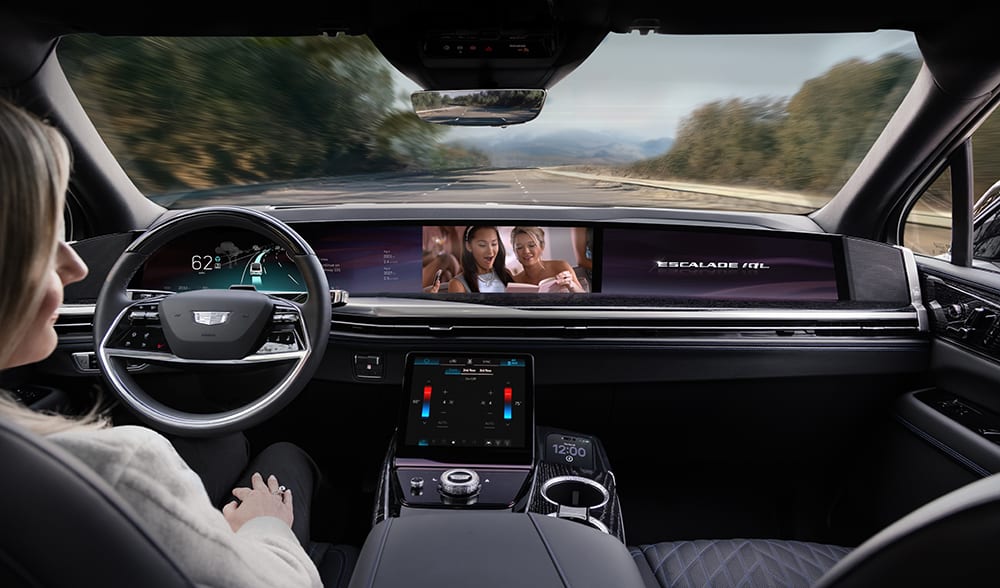
Cetinok said that GM is still working on how its future system will alert the driver to get ready to take over control. As for situations that require evasive moves, Cetinok said, "We will not count on a human to take over to be safe. That's a false expectation. It is our job to get into a comfortable state where the vehicle is driving on your behalf, because in those moments, you are going to start doing other things."
An example of a deer leaping onto the road demonstrated the vehicle slowing down and adjusting lane position in relation ot the animal wandering on the roadway. GM is designing the vehicle to be in control even in these circumstances, instead of trying to find a way to quickly relinquish control to the driver who may be watching a TV show and wouldn't be able to react quickly enough.
To pull this off, GM said it will tap into the technology developed by its autonomous vehicle subsidiary, Cruise. The automaker will use Cruise’s technology stack to develop its Level 3 system. Outside, the automaker will use a combination of cameras, radar, and lidar. Redundancy is the name of the game, as this is paramount for a system that will be controlling all aspects of driving while engaged.
SDV it all

The Level 3 driver assistance system will be built upon an upcoming centralized computing platform. The plan is to assemble the automaker's software-defined vehicle (SDV) platform with a liquid-cooled central computer using NVIDIA Thor processors. The master computer will then be connected to aggregators that act like smart circuit breaks. These will control and distribute power to elements. The aggregators will determine how much power each element, needs based on the state of the vehicle.
GM says that by centralizing its computing and adding a high-speed Ethernet backbone, its future vehicles will be able to handle the high amount of data needed to properly support the Level 3 driver assistance and AI systems the automaker plans to introduce into its vehicles.
The software-defined vehicle model will allow GM to isolate components from the software layer, giving the company the ability to integrate new elements or swap out elements without having to touch its base-level code. It will also reduce the number of computing hubs in vehicles, with aggregators acting as smart junction boxes. Components would connect to those junction boxes instead of having to create hundreds of point-to-point connections. The aggregators will control power sent to components, determining how much, and if, electricity is needed by each individual part.
The automaker also intends to deploy its own AI system into the vehicles. AI is notoriously power hungry, yet GM doesn't believe that its deployment will reduce vehicle efficiency in any meaningful way. There is no announced timeline for the deployment of the in-house AI. In the meantime, GM announced that Google's Gemini AI would be introduced to vehicles beginning next year for "more natural conversations" with the infotainment system.
All the powertrains
[GM says that it will deploy all this upcoming technology initially on the Cadillac IQ. The rest of the GM lineup will then be tapped to support the new SDV architecture as vehicles are refreshed. The automaker intends to add its upcoming SAE Level 3 system to vehicles quicker than it rolled out Super Cruise. In an interesting note, GM said that the SDV platform will be used on both EV and ICE vehicles. Gas-powered vehicles are notoriously difficult to integrate onto an SDV platform due to the higher number of mechanical parts required in that powertrain. GM has three years to figure it out.
The Escalade IQ will support hands-off and eyes-off driver assistance in 2028. (Roberto Baldwin)
More From SAE Media Group
ADAS & Autonomous Vehicle Engineering
The Subscriptions Are Coming for Your Wallet
Off-Highway Engineering
WCX 2021: Top Engineers Talk Industry Transformation
Automotive Engineering
Taking ‘Eyes-Off’ the ADAS Future
Autonomous Vehicle Engineering
Going the Last Mile
Autonomous Vehicle Engineering
Hopeful but Closer Scrutiny for SAE Level 4 Automation
Automotive Engineering
The Navigator: Traversing the Autonomous Trust Gap
Autonomous Vehicle Engineering
Waymo, GM and Ford Pegged as Autonomous “Leaders” by Latest Navigant Report
Autonomous Vehicle Engineering
Harman Using Empathy to Help Elevate the User Experience
Autonomous Vehicle Engineering
C-2VX Is Finally Gaining Momentum in the U.S.
Automotive Engineering
In-Vehicle Software and Services Are Transforming the Industry
ADAS & Autonomous Vehicle Engineering
AV Life After Argo AI
Autonomous Vehicle Engineering
Aptiv’s Satellite Route to ‘Democratizing’ Autonomous Tech
Autonomous Vehicle Engineering
Delivering on Autonomous Transport
ADAS & Autonomous Vehicle Engineering
Lidar Vs. Everybody in the Onboard Sensor Race
ADAS & Autonomous Vehicle Engineering
Automated Driving’s Journey: One Step Forward…
Automotive Engineering
Mercedes Kicks off Dedicated EV Lineup with Flagship EQS
Autonomous Vehicle Engineering
AV and ADAS Testing from out of the Box
Automotive Engineering
CES 2020: VW Creates New Autonomous Subsidiary
Automotive Engineering
Integrating Sensor Data: Selecting an ADAS Decision-Making Process
Autonomous Vehicle Engineering
Purpose, Perceptions for Driver-Assist Tech Solidify
Automotive Engineering
Ford Approved for Hands-Off Driving on German Autobahn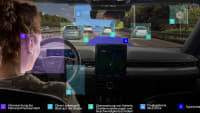
Autonomous Vehicle Engineering
Ford Gets in the ‘Hands-Free’ Game with BlueCruise
ADAS & Autonomous Vehicle Engineering
The Road to Zero Prototypes
ADAS & Autonomous Vehicle Engineering
Tesla’s FSD Recall Impacts AV Industry
ADAS & Autonomous Vehicle Engineering
Mercedes-Benz Architecting Its Own Operating System
Autonomous Vehicle Engineering
The Navigator: Mapping the Way to Safe Automated Driving
Autonomous Vehicle Engineering
Honda, Toyota Intro More-Advanced Driver-Assistance Systems
Autonomous Vehicle Engineering
Velodyne Preps for Volume Lidar
Automotive Engineering
Preview: SAE 2021 WCX
Automotive Engineering
Autonomous Future Will Require New Product Development Approaches
Top Stories
INSIDERManufacturing & Prototyping
 How Airbus is Using w-DED to 3D Print Larger Titanium Airplane Parts
INSIDERManned Systems
 FAA to Replace Aging Network of Ground-Based Radars
NewsTransportation
 CES 2026: Bosch is Ready to Bring AI to Your (Likely ICE-powered) Vehicle
NewsSoftware
 Accelerating Down the Road to Autonomy
EditorialDesign
 DarkSky One Wants to Make the World a Darker Place
INSIDERMaterials
 Can This Self-Healing Composite Make Airplane and Spacecraft Components Last...
Webcasts
Defense
 How Sift's Unified Observability Platform Accelerates Drone Innovation
Automotive
 E/E Architecture Redefined: Building Smarter, Safer, and Scalable...
Power
 Hydrogen Engines Are Heating Up for Heavy Duty
Electronics & Computers
 Advantages of Smart Power Distribution Unit Design for Automotive...
Unmanned Systems
 Quiet, Please: NVH Improvement Opportunities in the Early Design...
