




Getting a Grip on AWD Efficiency
The safety and performance benefits of all-wheel drive are undeniable, but so are the penalties of added weight, friction losses, and complexity. Clever axle disconnects and E-axles are driving future AWD developments.

All-wheel drive is becoming a must-have feature for drivers who face slippery roads and daunting grades in winter. The growing popularity of the technology is fueled by the worldwide boom in B- and C-segment crossover utilities. Globally, AWD production volumes are expected to increase 6% annually through 2020, according to Magna Powertrain Global Production Manager, Ron Frawley. In the north-eastern U.S. and upper Midwest, and in Canada, AWD can penetrate up to 70% of sales volume, depending on vehicle model, while sales may barely reach 15% in regions with more moderate climates and topography.
Along with its all-weather/all-season capability, AWD also offers performance attributes on dry pavement, optimizing the tractive force of four driven wheels rather than two. But with its inherent dynamic and safety benefits come challenges.
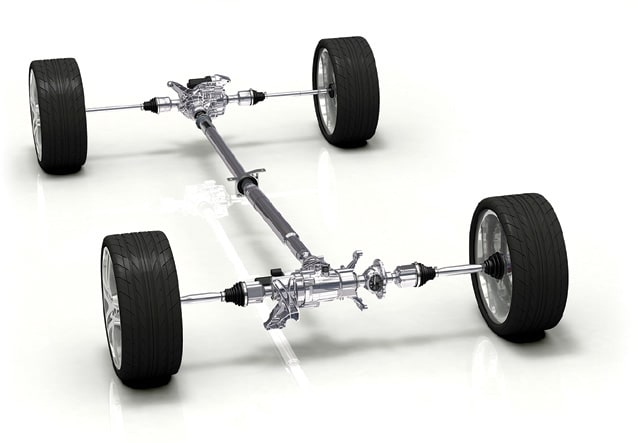
AWD typically reduces vehicle fuel efficiency by up to 5% (typically 1 to 3 mpg), compared with a 2WD baseline, Frawley noted. And that’s got the industry’s powertrain engineers and vehicle planners aggressively searching for solutions, said Dave Leone, General Motors’ Executive Chief Engineer for Luxury and Rear-Drive vehicles.
“System weight and the drivetrain parasitic losses associated with AWD are what everybody is working hard to reduce,” Leone told Automotive Engineering during the 2014 Los Angeles Auto Show. “The weight penalty of a standard AWD system is about 90 kilos (about 200 lb) versus a comparable rear-drive car; that’s an order-of-magnitude. And AWD is expensive. So our ongoing focus is on how to reap the benefits without the pain.”
It’s not a stretch to state that Audi wrote the book on AWD with its Quattro system and the company’s Board Member for Technical Development, Dr. Ulrich Hackenberg, said his engineers are “working intensely to bring the all-wheel drive into our CO2 emission-reductions program.”
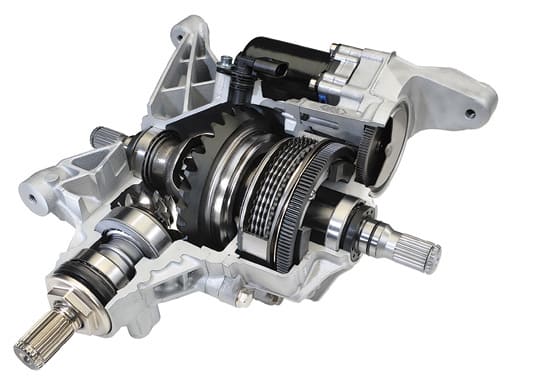
According to Dr. Hackenberg, VW-Audi is developing AWD systems that are “fully controllable per wheel, with axle disconnection [no torque transfer to the secondary axle] and re-connection based on the specific driving situation.” In a brief interview at the L.A. show, he said he expects future AWD systems to eventually employ e-axles — “electric motors in the rear or in the front, in addition to the combustion engine.” And, he said mass will continue to be extracted through careful component and systems development (wall thicknesses of case castings precisely tailored to stresses and loads, for example), and potentially through premium materials as well.
But light alloys such as magnesium (used for decades by VW for gearbox housings) to replace today’s aluminum driveline castings means higher cost.
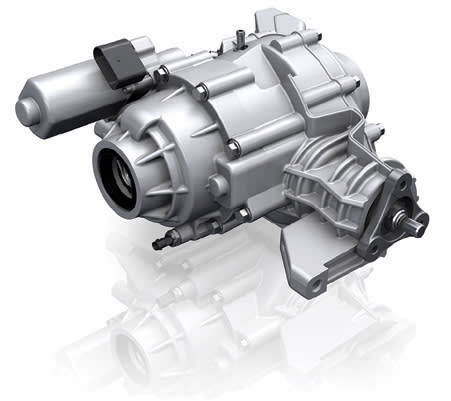
“There’s no free lunch in this business — but in some cases that additional cost is well worth it as we work to comply with 54.5 mpg by 2025,” Leone noted. He explained every GM vehicle development program is viewed in terms of dollars per gram of CO2 saved over the life cycle of the vehicle. Engineers thus look at how many dollars they must spend to save each gram of CO2 for 150,000 mi (250,000 km). Additional material cost in transfer cases and power take-off units might enable CO2 savings at a lower cost per gram than other alternatives.
In terms of designing the mechanism, sizing gears and bearings for example, “it’s about designing to the duty cycle — but not overdesigning,” offered Robert Genway-Haden, Global VP Product Technology – AWD Systems at GKN Driveline Americas. “Even in non-disconnecting systems we’re looking closely at everything that can reduce weight, friction, and drag on the system. Even fluid levels and different viscosity fluids are important.”
CVT-like differential performance
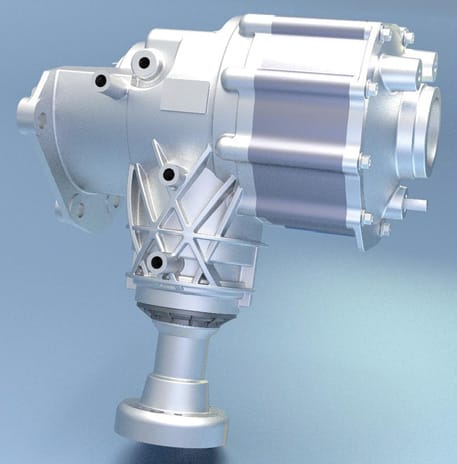
Recent vehicle introductions show the path of AWD systems co-developed with powertrain and driveline suppliers — a space that is becoming increasingly crowded in terms of intellectual property and patent activity. AAM, BorgWarner, Dana, GKN, Magna Powertrain, Schaeffler Group, and ZF are, in the eyes of a Ford program manager, “the predominant players in the powerflow competition” to further innovate, evolve, and refine the control electronics and internal mechanisms, including bearings, seals, and lubricant strategies, that will help improve system efficiencies. “Axle disconnects are the hot technology in the next product cycle,” the engineer (who asked not to be identified) told Automotive Engineering.
Much of the AWD systems space, in terms of volume, is occupied by proven performers. BMW’s 2015 X4, for example, marks the 20th vehicle application for Magna’s Actimax AWD “active” transfer case, which is branded XDrive by BMW and is used across the X-Series utility range. A two-speed version is used in the Jeep Grand Cherokee and Chevrolet Silverado. Fully active transfer cases “perform like a continuously-variable differential,” explained Ajit Khatra, Magna Powertrain’s Manager of Vehicle Verification and Testing, during a winter-test session attended by Automotive Engineering in northern Michigan.
A pump-less design which offers more than 30% lower spin losses than pump types, Actimax uses a multiplate wet clutch actuated by a servo motor to provide modulated variable torque split between the front and rear axles. Normally 60% rear-biased on the BMWs, when wheel slip is detected by the ABS/stability control the system can react within .10 s to redistribute up to 100% of engine torque to the front or rear axle. The system can brake each wheel individually to help regain traction or directional stability.
An evolution of Actimax that will debut in 2016 on a front-drive-based AWD vehicle is Flex4, which adds a rapid-disconnecting mechanism on the PTU. Flex4 enables the traction-coupling clutch to be fully opened, disconnecting the drive axle from the driveshaft. Drag torque is claimed to be in the 1 N·m (.7 lb·ft) range, said Khatra, and the system is capable of providing a 4-7% fuel economy gain, depending on vehicle type.
RDMs (rear-drive modules) are becoming more sophisticated in the latest AWD systems, as seen in the new ProActive RDM fitted to Mercedes-Benz’ GLA, CLA, and A45 AMG utilities. Developed by Magna specifically for C-segment utilities, ProActive integrates an AWD coupling with the RDM for reduced weight by 10% (more than 2 kg/4.4 lb), the companies claim. The system features a common oil circuit to improve coupling functionality in extreme conditions while minimizing the overall package size. The design also eliminates bearings and seal rings to reduce internal drag by approximately 14%.
No ‘one size fits all’
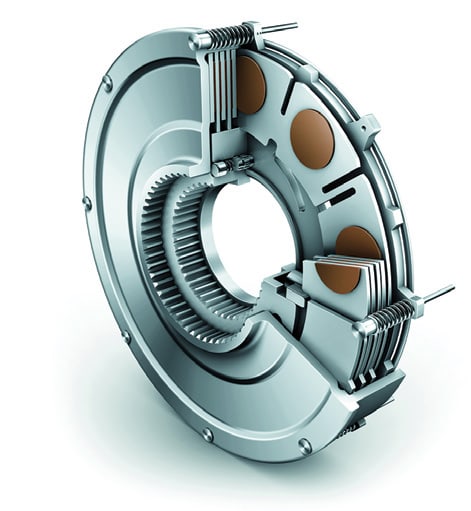
The crossover-utility market is driving demand for “smart” axle disconnects, experts said, after impacting the light truck segment — the Ram 1500 pickup features a front axle disconnect as part of its fuel-efficiency technology suite. Jeep’s 2014 Cherokee, based on an FCA front-drive architecture instead of a traditional rear-drive configuration, offers rear-axle disengagement (via AAM driveline technology) when 4x4 capability is unnecessary.
“In a perfect world you want to disconnect the PTU, the prop shaft, the RDM and the half shafts, but to do that is going to be more costs and more weight. Some OE customers want no end-customer interaction while others want an AWD select function,” observed Paul Olexa, Vice President of Sales and Marketing for Driveline of ZF North America, which supplies the Ram’s set-up. His company has developed a portfolio of AWD disconnects, from relatively simple viscous-clutch-based types to electronically-controlled systems that disengage and engage in milliseconds.
“The market is really expanding and it’s not one-size-fits-all,” he noted. Reducing spin losses and overall internal friction was the design direction behind ZF’s ECOnnect, a variety of AWD driveline solutions with an available disconnect capability. The product range, including both single- and twin-clutch RDMs, targets FWD-based AWD architectures and is aimed at significantly reducing the fuel-efficiency delta between the 2WD base vehicle and the AWD version. Compared to a conventional hang-on AWD system, the disconnect system therefore reduces the friction losses in the AWD driveline by up to 90% in the disconnected mode, ZF engineers claim.

Coupling and decoupling actions are accomplished using electro-mechanical or electro-magnetic actuators tuned for optimum balance between shifting speed and seamless operation. For details, see SAE Technical Paper 2013-01-0362, “AWD Disconnect Solutions, ZF ECOnnect,” that covers specific design elements, performance and control, and test results.
“We’ve picked a lot of the low-hanging fruit with the base AWD technologies and now comes disconnect systems and, on some vehicles, electric rear axle drives which allow you to launch electrically and maybe recover some braking energy,” Olexa said. ZF’s electric rear-axle drive (e-RAD) currently under development is a stand-alone, designed to work with a conventional FWD powertrain. Olexa said some OE customers are looking for a conventional rear axle that offers some degree of electric assist.
Scaling for A and B segments
Great attention to detail in systems engineering is paramount to creating excellence in AWD systems, explained Ray Kuczera, Ph.D., VP of Engineering at GKN Driveline Americas. “Making sure the AWD system can communicate with the rest of the vehicle, how you control it and making sure it works with the ABS and traction control, and how you integrate the system, are critical. Also, how you tune the system to get specific brand DNA.”
He cited GKN’s new compact, disconnecting AWD system for A-, B-, and C-segment vehicles that is shared by two FCA platform mates — the 2015 Fiat 500X, marketed as a “soft-roader,” and the 2015 Jeep Renegade that is “Trail Rated” by Chrysler and is said to be quite capable off road.
In the system, the PTU is linked to the vehicle’s final-drive differential and contains a rapid-disconnect capability and a braking system to stop the AWD system upstream of the unit’s hypoid gears. An electro-mechanically-actuated clutch located on the rear axle biases drive torque and disengages the AWD system downstream of the hypoid gears in low-load cruise conditions. Torque vectoring is used between the vehicle’s rear wheels, torque-biasing handles front/rear axle distribution when AWD is engaged.
AWD reconnection can be established in 300 ms, according to company engineers.
“How a disconnecting AWD is programmed, how it disconnects and reconnects AWD and how often and how quickly it does it, that’s where a lot of the development is taking place,” said Genway-Haden. “It’s very critical you shift out of AWD into 2WD so the driveline stops rotating as often as possible, and hold it there as long as possible until the driving environment dictates that AWD should be available — while doing it as imperceptibly to the driver as possible.
“That’s a huge amount of work wherein taking the systems approach makes a vast difference,” he said.
More From SAE Media Group
Automotive Engineering
Top Transmission Engineers Project Big Future for E-Axles, Advanced Motors
Automotive Engineering
Flex4 System Leads Magna's Wave of New Fuel-Saving Technologies
Off-Highway Engineering
First Drive: Drifting in the Electric 2027 Mercedes GLC 400
Automotive Engineering
2019 Vehicle Technology Review
Automotive Engineering
Integrated and Open Development Platform (IODP)
Automotive Engineering
Toyota Stretches SUV Line-Up with World Debut of Grand Highlander
Off-Highway Engineering
ZM Trucks Starts Production in Fontana, California
Off-Highway Engineering
EV Startup Prepares to Enter Commercial Market with Novel EAxle
Automotive Engineering
Schaeffler Tech Demonstrator Achieves 15% CO2 Reduction
Automotive Engineering
Jeep's B-Segment Renegade: U.S. Developed, Built in Italy
Off-Highway Engineering
Freightliner’s Medium-Duty Makeover
Off-Highway Engineering
FEV Simplifies Off-Highway Electrification
Automotive Engineering
Ford Approved for Hands-Off Driving on German Autobahn
Automotive Engineering
Tremec-Trification
Automotive Engineering
Electrifying ‘The Ultimate Driving Machine’
Automotive Engineering
First Drive: 2027 Mercedes-Benz CLA Hybrid
Off-Highway Engineering
Workhorse Group Unveils W-15 E-REV Fleet Truck and Partners with Ryder
Battery & Electrification Technology
Ultracapacitor Solutions to Address Energy-Storage Needs of Vehicles
Off-Highway Engineering
AxleTech Develops Electric Independent Suspension Concept for Vehicles Up to 58,000-lb GCWR
Automotive Engineering
GKN Demos ETwinster, World’s-First 2-Speed Torque-Vectoring BEV Transmission
Automotive Engineering
Bentley Takes SUV to Super Premium Level
Automotive Engineering
Gearing Up Drive Axle Innovations
Off-Highway Engineering
ZF Premieres AxTrax 2 Electric Axle Platform at ACT Expo
Automotive Engineering
Welcome to the Automotive Engineering Podcast
Autonomous Vehicle Engineering
Predicting the Road to Efficiency
Off-Highway Engineering
Kia Takes Aim at Commercial Vans with PBV Concepts
Automotive Engineering
TRD Spells Capability for Toyota’s Latest Tundra
Autonomous Vehicle Engineering
Volvo Leads the Shift to ‘Driver Understanding’
Automotive Engineering
New XF Moves to Jaguar's Aluminum Architecture
Automotive Engineering
GKN Readies New 2-Speed E-Axle for 2020
Top Stories
INSIDERManufacturing & Prototyping
 How Airbus is Using w-DED to 3D Print Larger Titanium Airplane Parts
INSIDERManned Systems
 FAA to Replace Aging Network of Ground-Based Radars
NewsTransportation
 CES 2026: Bosch is Ready to Bring AI to Your (Likely ICE-powered) Vehicle
NewsSoftware
 Accelerating Down the Road to Autonomy
EditorialDesign
 DarkSky One Wants to Make the World a Darker Place
INSIDERMaterials
 Can This Self-Healing Composite Make Airplane and Spacecraft Components Last...
Webcasts
Defense
 How Sift's Unified Observability Platform Accelerates Drone Innovation
Automotive
 E/E Architecture Redefined: Building Smarter, Safer, and Scalable...
Power
 Hydrogen Engines Are Heating Up for Heavy Duty
Electronics & Computers
 Advantages of Smart Power Distribution Unit Design for Automotive...
Unmanned Systems
 Quiet, Please: NVH Improvement Opportunities in the Early Design...
