




Schaeffler Tech Demonstrator Achieves 15% CO2 Reduction

Technical specialists retrofitted a MY2013 Ford Escape with Schaeffler technologies, and the payback is a double-digit-percentage fuel-economy improvement compared to the production SUV’s original mpg ratings.
“Our target in phase one was to get under $40 per percent of fuel-economy improvement and meet the 2020 CAFE (corporate average fuel economy) regulation requirements," Jeff Hemphill, Vice President and Chief Technology Officer for Schaeffler Group North America, told Automotive Engineering Jan. 13 at the 2014 North American International Auto Show in Detroit. "We almost exactly matched our initial simulation projections, which are more than a 15% improvement in fuel economy.”
Schaeffler’s SUV demonstrator has been accumulating real-world miles since September 2013. Fuel-economy improvements of more than 15% and CO2 emissions reductions of approximately 15% as determined by Schaeffler testing were later confirmed by an independent testing institute in Ohio, Hemphill said.
Powered by a 2.0-L EcoBoost four-cylinder mated to a six-speed automatic transmission, the demonstration 4WD SUV (known as the Efficient Future Mobility North America) received friction-reducing modifications to the belt drive, valvetrain, and balance shaft. It also was equipped with low-rolling-resistance tires and other fuel-conserving technologies.
A thermal-management module, similar to a Schaeffler unit used by Audi on certain production vehicles, enables the demonstration vehicle to reach optimal engine temperature quickly. The module also provides a precisely controlled temperature balance for other integrated components and delivers a 1% reduction in fuel consumption for city and highway driving.
Depending on the driving situation, Schaeffler’s North American-developed AWD disconnect clutch decouples the drivetrain from the rear axle at the power transfer unit (PTU). A second disconnection point in the rear axle prevents torque from being transferred by the rotating rear wheels to the drivetrain. Consisting of a hydraulically operated synchronizer clutch integrated in the PTU’s input shaft and electronically operated rear-axle dog clutches, the AWD disconnect clutch system can generate fuel savings of up to 2% in city driving and up to 6% in highway driving.
Schaeffler’s permanently engaged starter, which uses a wrap spring one-way clutch for connecting the starter to the torque converter’s housing, can provide up to 6% fuel savings in city traffic, Hemphill said. Complementing the stop-start system is Schaeffler’s latching valve, which stores hydraulic pressure to keep the transmission in first gear.
The AWD disconnect clutch, the permanently engaged starter, and the latching valve are all second-generation technologies that "will be production-ready for the 2017 model year," he noted.
The currently configured demonstration vehicle was designed to meet 2020 CAFE requirements without additional electrification of the powertrain. The same vehicle will undergo further modifications.
“Phase two has already started with a 48-volt mild hybrid system," said Hemphill. "There will be other technologies as well, but we haven’t determined the final package yet. The plan is to bring the vehicle in line with the 2025 CAFE requirements."
More From SAE Media Group
Automotive Engineering
Fuel Efficiency SUV Notches 10 Mpg Improvement Vs. Baseline Vehicle
Automotive Engineering
Mazda’s 2024 CX-90 Offers Turbo I-6, PHEV Propulsion
Automotive Engineering
EPA: Engine, Transmission Advances Make 2025 CAFE Regs Attainable, Affordable
Automotive Engineering
Schaeffler Electrifies Its Fuel-Efficiency Demonstrator, Aims for 35 Mpg Combined Rating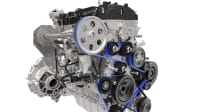
Automotive Engineering
New-Gen Torque Converter Aims at 2017 Vehicle Intro
Automotive Engineering
2024 Lincoln Nautilus: The Brand’s First Global SUV
Automotive Engineering
GKN Readies New 2-Speed E-Axle for 2020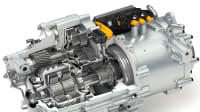
Automotive Engineering
Toyota Stretches SUV Line-Up with World Debut of Grand Highlander
Automotive Engineering
Engineers Balance Today’s Programs with Tomorrow’s Mobility Future
Automotive Engineering
GKN Spins a New Compact AWD Disconnect System for Small SUVs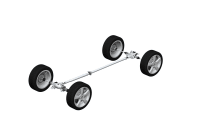
Automotive Engineering
Doing It Again — This Time With 10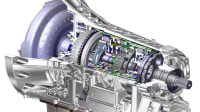
Automotive Engineering
High-Performance Hybrid Headlines Lexus’s Re-Engineered RX Lineup
Automotive Engineering
Ford Tests Cylinder Deactivation on Its 1.0-L EcoBoost Triple
Automotive Engineering
2019 Chevrolet Blazer: Sharply Styled and Right-Sized for the Voracious SUV Market
Automotive Engineering
Dana’s Twin-Clutch Axle Boosts Bronco Sport’s Off-Road Cred
Automotive Engineering
2022 Toyota Tundra: V8 Out, Twin-Turbo Hybrid Takes Over
Automotive Engineering
Bridging the Power Gap with 48 Volts
Automotive Engineering
Nissan’s New VCR Engine: Worth the Effort?
Automotive Engineering
Nissan Variable-Compression Engine Gets First Shot at Volume with New 2019 Altima
Off-Highway Engineering
Paccar Announces TX-18 Automated Transmission
Automotive Engineering
EV Motor Development Is on the Move
Automotive Engineering
GKN Puts Electric-Drive TV System for 2019 on Ice
Automotive Engineering
Honda's New 8-Speed DCT Uses a Torque Converter
Automotive Engineering
Mercedes-Benz Replaces M-Class with GLE, Adds Plug-In Hybrid
Automotive Engineering
Kia Reveals Electric AWD Trail'ster Concept
Automotive Engineering
What We’re Driving: 2020 Range Rover Sport HST
Automotive Engineering
Getting a Grip on AWD Efficiency
Automotive Engineering
First Drive: 2027 Mercedes-Benz CLA Hybrid
Autonomous Vehicle Engineering
Volvo Leads the Shift to ‘Driver Understanding’
Automotive Engineering
First Drive: 2026 Hyundai Palisade
Top Stories
INSIDERManufacturing & Prototyping
 How Airbus is Using w-DED to 3D Print Larger Titanium Airplane Parts
INSIDERManned Systems
 FAA to Replace Aging Network of Ground-Based Radars
NewsTransportation
 CES 2026: Bosch is Ready to Bring AI to Your (Likely ICE-powered) Vehicle
NewsSoftware
 Accelerating Down the Road to Autonomy
EditorialDesign
 DarkSky One Wants to Make the World a Darker Place
INSIDERMaterials
 Can This Self-Healing Composite Make Airplane and Spacecraft Components Last...
Webcasts
Defense
 How Sift's Unified Observability Platform Accelerates Drone Innovation
Automotive
 E/E Architecture Redefined: Building Smarter, Safer, and Scalable...
Power
 Hydrogen Engines Are Heating Up for Heavy Duty
Electronics & Computers
 Advantages of Smart Power Distribution Unit Design for Automotive...
Unmanned Systems
 Quiet, Please: NVH Improvement Opportunities in the Early Design...
