




Off-highway Engines Advance Beyond Tier 4
With Tier 4 Final/Stage IV needs met, engine OEMs direct their focus and competitive energies toward optimizing competitive solutions. At the same time, they need to keep a weather eye out for future regulations, which many expect.
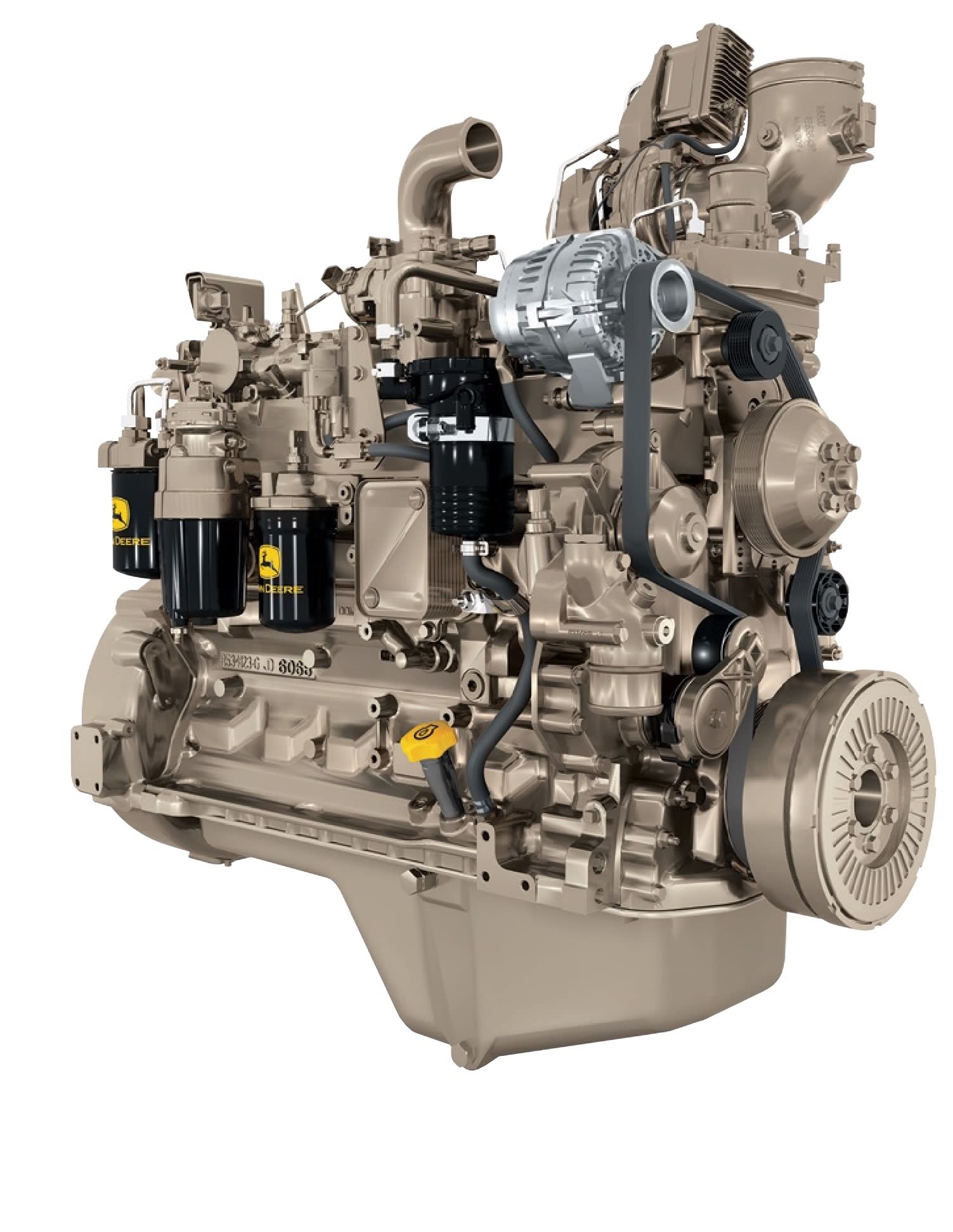
"The technical solutions for Tier 4 Final are all there and in production,” said Andy Noble, Head of Heavy Duty Engines for Ricardo,
during an interview with Off-Highway Engineering. “Engine manufacturers are now looking at taking cost out, for a more competitive solution.”
He explained there are four approaches for meeting the U.S. Tier 4 Final and EU Stage IV emissions regulations for engines with power ratings greater than 56 kW (75 hp). The first is to use only selective catalytic reduction (SCR). SCR removes NOx, but not other emissions such as particulates or soot. The second is to use a moderate amount of exhaust gas recirculation (EGR) coupled with an SCR system. He describes moderate EGR as 15% to 20% recirculation at full load. The third strategy is to use high EGR with aftertreatment that includes SCR, a diesel oxidation catalyst (DOC), and a diesel particulate filter (DPF). The fourth is to use very high amounts of cooled EGR with DOC and DPF while skipping the SCR.

“To date, the preferred strategy in most applications is moderate EGR coupled with SCR,” said Noble. He believes this optimizes engine efficiency and aftertreatment complexity — and hence cost. Low soot emissions are produced through “clean combustion schemes,” where the design of the piston bowl, air and fuel motion are combined with higher injection pressures. Coupled with moderate EGR, this can produce engine-out emissions that are nearly soot-free. The trade-off is that these result in higher NOx, which requires scrubbing from an SCR.
New era, same priorities
While off-highway engines are meeting regulatory requirements, other factors remain and influence engine design. “It depends on the market, but our customer priorities are roughly the same as they were five or ten years ago,” said Geoff Stigler, Manager of Worldwide Marketing for John Deere Power Systems (JDPS). The top three he lists sound familiar: reliability, durability, performance, and total cost of ownership.

“Reliability and durability is number one for us,” he said. A close second in priority at JDPS is performance. “Powerful, efficient engines mean more productive work... For example, a wheel loader that lifts more and has a faster transient response is more productive.” These priorities plus total cost of ownership drove their design targets. Especially important were the trade-offs between performance, fuel efficiency, and consumables such as diesel exhaust fluid (DEF), or AdBlue, according to Stigler.
He admits the challenge for a company like JDPS is optimizing these priorities over a customer set with sometimes widely different applications. The company delivers engines for 160 different internal applications for Deere as well as hundreds more for OEM customers. “The technology path JDPS chose to meet these challenges includes DOC plus DPF for Tier 4 Interim, to which we added SCR to meet Tier 4 Final,” said Stigler. For engines with power ratings greater than 55 kW (74 hp), cooled EGR is also standard.
Stigler notes their advanced engineering experience indicates the JDPS solution is optimized for total cost of ownership through fluid economy — that is, both fuel and DEF consumption efficiency. Even though from time to time it must squirt a small quantity of diesel fuel into the exhaust stream for active regeneration, their research shows impact on fuel economy is negligible.
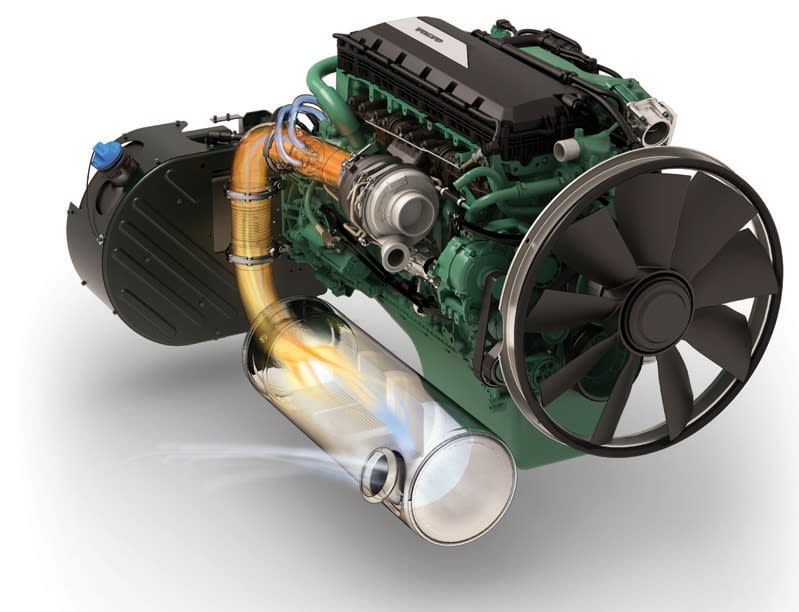
“The impact of active regeneration is typically less than half of a percent at most. In many applications it is difficult to even measure it,” he said. The SCR needs less DEF when combined with a DPF and DOC, according to Stigler. “The DPF and DOC together are about the size of a muffler and now we add SCR [for Tier 4 Final.] However, our SCR system is smaller because of the DPF and DOC. It is not as if manufacturers gain an enormous packaging benefit simply by eliminating the DOC and DPF” because the resulting SCR system will be larger.
Flexible, scalable architectures
Nick Stephenson, Product Marketing Manager at Perkins agrees that the key priorities for any OEM include productivity, transient response, reliability, as well as flexibility. “Increased power density is also a key objective for our customers,” he said. Stephenson stressed the collaborative approach Perkins employs with its OEM customers. “[In our] Technology Integration Workshops (TIW)...we’ve invited OEMs’ engineers to work side-by-side with our engineers to create the optimal solution for each application.”
Perkins’ engines employ differing levels of turbocharging and aftertreatment, depending on engine size, power output, and requirements. Perkins uses DPFs, DOCs, and SCRs in different combinations over its range of engines.
For example, the 850 Series turbocharged four-cylinder 3.4-L model uses SCR and a DOC to meet Tier 4 Final. This new design allows the engine to deliver power of up to 90 kW (121 hp) and torque performance up to 490 N·m (360 lb·ft) at 1400 rpm, according to Stephenson. It does this while retaining the 8% improvement in specific fuel consumption (SFC) the company introduced in the previous design that met Tier 4 Interim. “Diesel fuel consumption will improve and will be partially offset by DEF consumption, with a net fluid consumption improvement overall,” he said.
At the top end of its power range, the 1200 Series 6-cylinder engines that deliver 61.5 kW to 225 kW (82 hp to 301 hp) use all three aftertreatment devices. However, the company sought to minimize the aftertreatment needed to meet Tier 4 Final, according to Stephenson. They did this by using a single, integrated DOC and DPF canister along with an SCR system in one module. “[This] can be positioned remotely in a machine chassis or directly on top of the engine,” he said. “The DPF now uses passive regeneration, which is totally transparent to the operator and is service-free, so reducing maintenance costs over the life of the machine,” he said with the added benefit of not requiring ash removal. At the same time, he notes the 1204F models use no DPF, only DOC coupled with SCR. “By offering a no-DPF option on the 1204F, we have given OEMs flexibility as to how they wish to configure their machines, without compromising machine performance,” he said.
The benefits of simplicity
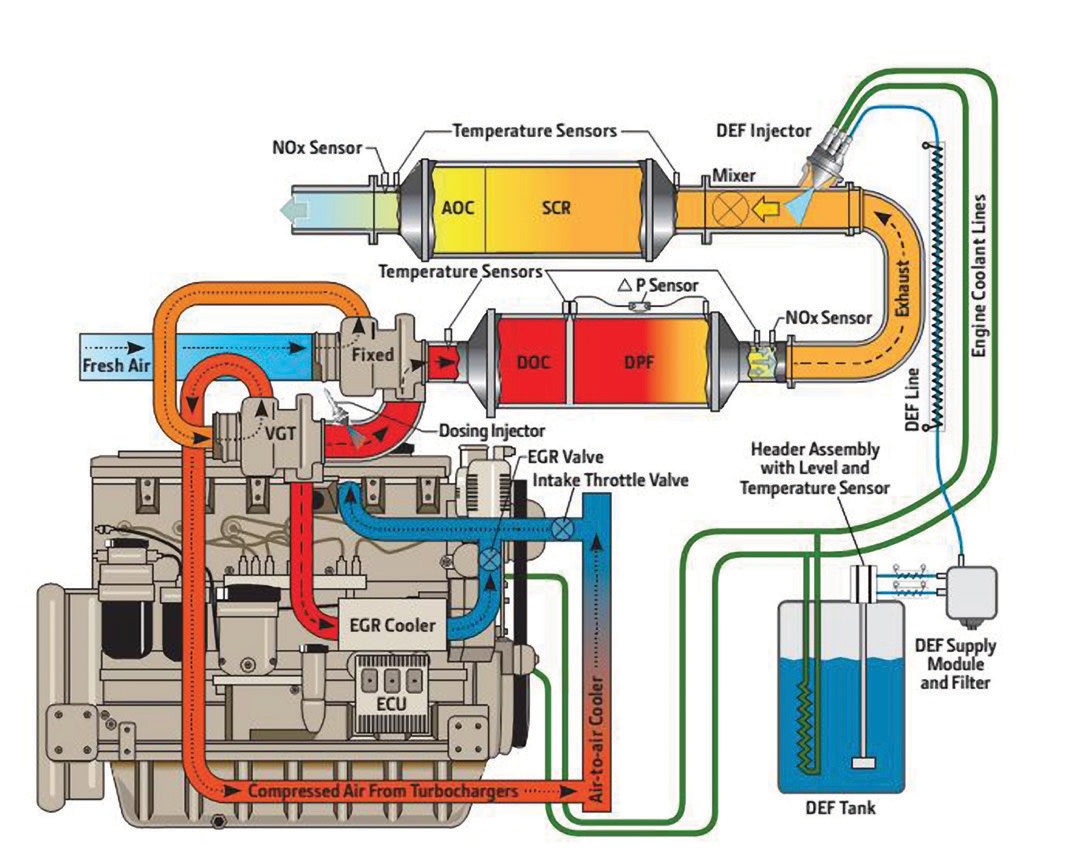
Meeting Tier 4/Stage IV without either DPF or DOC is the strategy for Volvo Penta. The company’s priorities for its customers include durability, total cost of ownership, and ease of engine integration into OEMs’ machines, according to Darren Tasker, Director of Off-Road Engine Sales.
To meet these priorities “we chose — starting with Tier 4 Interim — to use SCR alone for NOx reduction. When we moved to Tier 4 Final, we evolved that SCR system and used it as the primary way of reducing NOx,” Tasker said. Also, to achieve Tier 4 Final, Volvo Penta added light EGR to cool combustion and reduce NOx further.
Its engines include 5-, 8-, 11-, 13-, and 16-L options. “We have light EGR on our 5- and 8-L engines,” he said, while the 11-, 13-, and 16-L engines use a hot, or non-cooled, EGR with un-conditioned exhaust gases. Why not cooled EGR?
“Our prime motivation is to provide vehicle OEMs with an engine and an installation around the engine that will cause them as few challenges as possible with the lowest operating costs,” he said. Hot EGR means lower heat rejection and a smaller radiator, while an aftertreatment with only SCR provides its own simplicity. “Lower heat rejection can mean improved fuel economy.”
Tasker noted that Volvo Penta engineers have the advantage of being part of the Volvo Group. Their on-highway brethren had to meet the Euro IV regulations in 2006, well ahead of the Tier 4/Stage IV regulations.
“In fact they were the first OEM certified using SCR to meet on-highway U.S. EPA 2010. The EU truck regulators required a lower level of NOx in 2006 when we went to Euro IV. In that time, the Volvo group used SCR to achieve Euro IV,” he said. “Since then the Volvo Group has made significant investments in SCR technology to meet ever-more demanding emissions regulations.”
Future regulations — a Tier 5/Stage V?
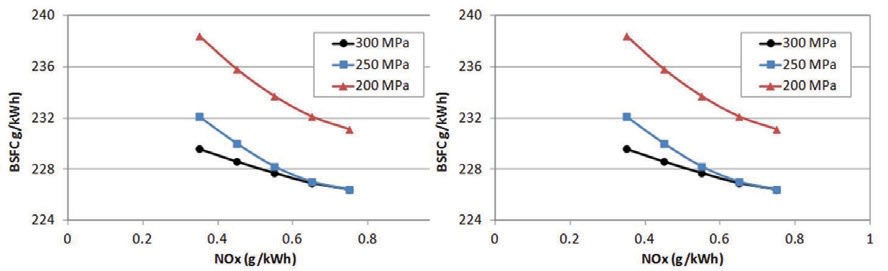
Many interviewed for this article believe there is a future “Tier 5” or European “Stage V” level of emissions regulations looming. These future regulations may well lean toward fuel economy.
They might include soot particle count regulations as well.
“It is not just the mass of particles that the engine is emitting that is important, but also the number,” said Ricardo’s Noble. “This recognizes the fact that a large number of smaller particles might be more dangerous to human health than the same mass of larger particles.”
One speculation is that the particle number limit might be in the range of 1 x 10¹² particles/kW·h. The practical implication of this is that, in Noble’s opinion, all engines will need a DPF if this regulation emerges.
“The emissions from even the cleanest of engines are one to two orders of magnitude greater than that,” he said. “There is some activity to see if you can effectively clean up engine-out emissions to meet that particle number limit without a DPF. However, most manufacturers believe that a DPF will be mandatory.”
More From SAE Media Group
Automotive Engineering
Toyota Stretches SUV Line-Up with World Debut of Grand Highlander
Power Electronics INSIDER
Highly Conductive Aluminum Can Equal Copper
Battery & Electrification Technology
The Rechargeable Renaissance
Battery & Electrification Technology
Manufacturing Advances in Solid-State Batteries
Automotive Engineering
Reducing NVH Through Refined Powertrain Measurement
Automotive Engineering
2019 Vehicle Technology Review
Off-Highway Engineering
Iveco Pursues Natural Gas in Stralis NP Models
Off-Highway Engineering
AxleTech Develops Electric Independent Suspension Concept for Vehicles Up to 58,000-lb GCWR
Off-Highway Engineering
Komatsu Targets Productivity, Operator Comfort With New WA480-8 Wheel Loader
Automotive Engineering
Slick Solutions for Friction Reduction
Automotive Engineering
Powering a Drive to Higher Voltages
Off-Highway Engineering
Reshaping the Mobile-hydraulic Ecosystem
Off-Highway Engineering
FEV Simplifies Off-Highway Electrification
Off-Highway Engineering
Cummins Unveils New B7.2 Diesel Engine
Automotive Engineering
Wrecking Ball
Automotive Engineering
Taiwan Suppliers Look Around the World for Solutions
Tech Briefs
Rising Star Awards 2025 Judges

NASA Spinoff
NASA ‘RAMPT’ Up 3D Printed Engine Size
Automotive Engineering
2026 Toyota RAV4 Review: All Hybrid, All the Time
Off-Highway Engineering
ZM Trucks Starts Production in Fontana, California
Off-Highway Engineering
Off-highway Innovators to Demo Digital Prowess at CES 2026
Off-Highway Engineering
Komatsu Augments Intelligent Machine Control in New Excavator
Off-Highway Engineering
First Drive: Drifting in the Electric 2027 Mercedes GLC 400

Tech Briefs
Shape Memory Alloy Tubular Structure

Power Electronics INSIDER
World’s Strongest Battery Paves Way for Light, Energy-Efficient Vehicles
Off-Highway Engineering
Yanmar CE Adds to Growing Compact Track Loader Segment
Automotive Engineering
2024 Lexus GX Ready for Off-Road Adventure with New Platform, E-KDSS
Top Stories
INSIDERManufacturing & Prototyping
 How Airbus is Using w-DED to 3D Print Larger Titanium Airplane Parts
INSIDERManned Systems
 FAA to Replace Aging Network of Ground-Based Radars
NewsTransportation
 CES 2026: Bosch is Ready to Bring AI to Your (Likely ICE-powered) Vehicle
NewsSoftware
 Accelerating Down the Road to Autonomy
EditorialDesign
 DarkSky One Wants to Make the World a Darker Place
INSIDERMaterials
 Can This Self-Healing Composite Make Airplane and Spacecraft Components Last...
Webcasts
Defense
 How Sift's Unified Observability Platform Accelerates Drone Innovation
Automotive
 E/E Architecture Redefined: Building Smarter, Safer, and Scalable...
Power
 Hydrogen Engines Are Heating Up for Heavy Duty
Electronics & Computers
 Advantages of Smart Power Distribution Unit Design for Automotive...
Unmanned Systems
 Quiet, Please: NVH Improvement Opportunities in the Early Design...
