




Powering a Drive to Higher Voltages
48-V systems are likely to power a new generation of functions including stop-start technology.
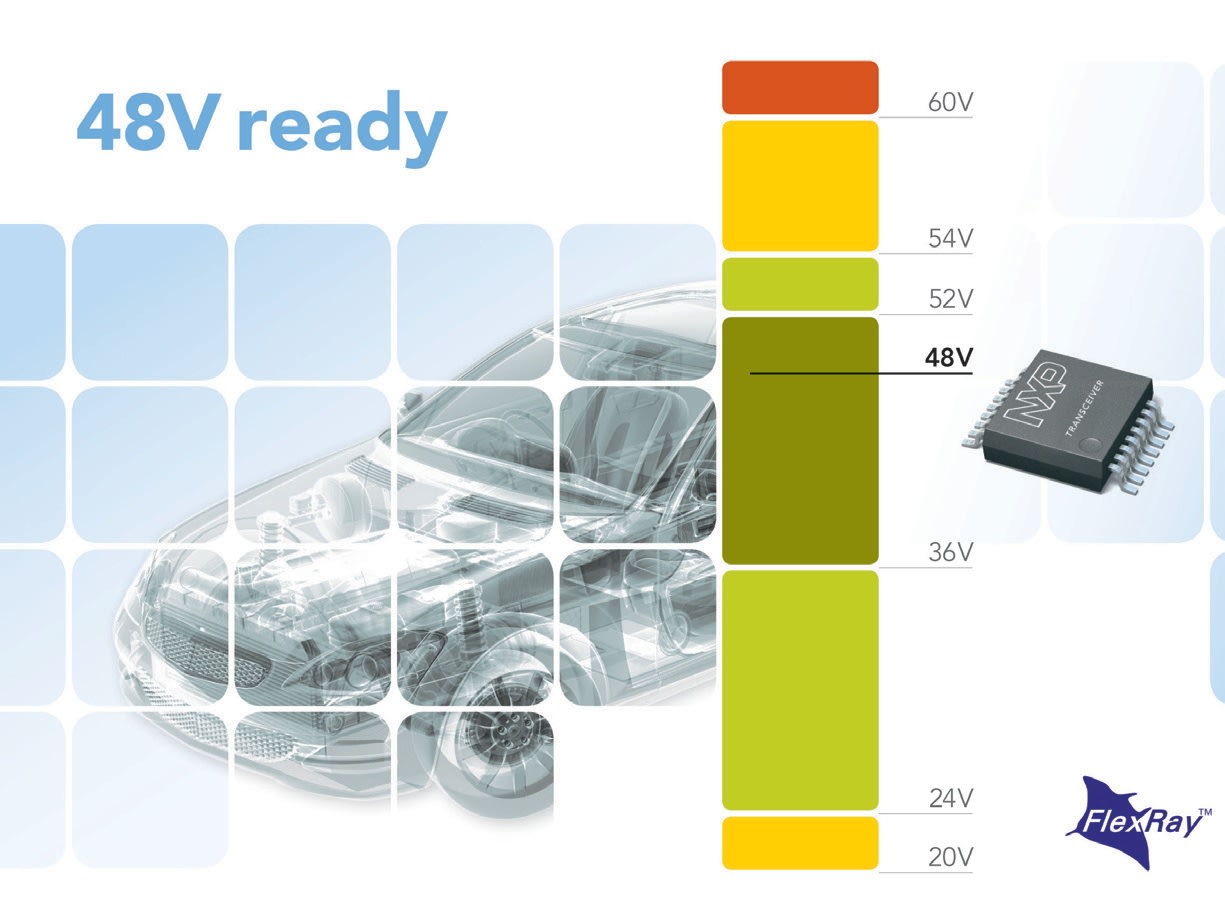
A push to convert conventional automobiles to high-voltage power systems was a flop back in the 1990s. But a number of factors have prompted many technical strategists to once again promote the benefits of higher voltages.
This time, 48 V will be an auxiliary power architecture, not the sole power architecture. Most electronic components will continue to leverage the huge 12-V infrastructure. Stop-start is a major driver, though many other functions are creating demand for higher voltages.
“Today, 48-V systems are offering the OEM [an opportunity] to implement functions that are difficult to realize with 12-V batteries,” said Joseph Notaro, Vice President, Global Automotive Sales and Applications, Fairchild Semiconductor GmbH. “It allows for passive coasting—shutting down some cylinders at cruising speeds—and allows several convenience loads (such as air-conditioning) to function during stop-start operation.”

Many observers link the emergence of 48-V power systems to stop-start technology, sometimes considered a mainstay of microhybrid technology. Stop-start capabilities are expected to see significant acceptance in North America in coming years, following a trend that’s well under way in Europe. Compared to hybrids, stop-start technology is relatively inexpensive, and it provides fuel savings that are significant and fairly easy to justify.
“A microhybrid can provide a better economic return than a hybrid because it avoids high voltages and all the cost that entails,” said Craig Rigby, Vice President of Product Management and Strategy at Johnson Controls Power Solutions. “Microhybrid technology 48 V will impact the cost, but it’s hundreds of dollars more instead of thousands more for a hybrid.”
Just as they led the way with stop-start technology, Europeans are expected to spearhead the adoption of 48-V technology.
“In Europe, microhybrids still use 12 V, but the five largest OEMs are looking at 48 V,” said Jifeng Qin, Product Manager for Automotive MOSFETs (metal oxide semiconductors field effect transducers) at International Rectifier. “Several Tier 1s have started building 48-V systems. They will start ramping up in 2017, hitting the market in mass production in calendar year 2018.”
The transition to 48 V lets design teams add more fuel-saving techniques. Higher voltage ensures that there’s enough power for all functions even when the engine is constantly being restarted in rush-hour traffic.

“The introduction of 48-V bus for mild-hybrid diffusion is enabling more options for new electric functions such as power steering, interior heating, and electric cooling systems,” said Gaetano Pignataro, Technical Marketing Manager at STMicroelectronics Power Transistor Division. “The 48-V bus is now strategic and not only linked to simple load increases as it was some years ago.”
Though the adoption of stop-start technology is expected to help increase the role of 48-V systems, not all U.S. companies are jumping on the bandwagon. Some plan to use 12-V systems, noting that European auto-makers have fared well with the combination of 12 V and stop-start.
“Depending on which OEMs you’re talking to, some are pretty skeptical and some have a renewed interest, saying there’s no other option,” said Ron Timmermans, Product Marketing Manager IVN, CAN Segment, NXP Semiconductors.
Isolationist policies
When automakers add 48-V systems, they have to ensure that voltage surges from these systems don’t damage electronics that run on 12-V buses. For 12-V systems, the breakdown voltage for surges is 40 V. It rises to 75 V for 48-V batteries, forcing chipmakers to redesign some power devices.
“MOSFETs and other power devices for 40-V breakdown voltages are very mature; now devices have to go well beyond that level,” IR’s Qin said. “We’re already working on a 100-V platform. That’s not an easy task, especially when you’re talking about meeting automotive requirements.”
Typically, networking cables will be the link that opens the channel for these surge voltages. That puts some of the onus for isolation on suppliers of networking chips. Many of them have already geared up for the move to high-voltage architectures.
“You’ve got some ECUs working on the high-voltage side and some ECUs working on the low-voltage side, but they’ve still got to communicate,” NXP’s Timmermans said. “If there’s a breakdown or ground loss, ECUs connected by the same CAN bus can see significant changes in voltage on the CAN bus. We’ve integrated isolation on CAN transceivers to prevent this type of high-voltage breakthrough.”
High-voltage surges are not the only worry for designers. When engines shut down, voltages can drop below acceptable levels. Drivers won’t accept any disruptions when engines are shutting down and restarting. Radios and displays can’t turn off.
“Start-stop is a critical step towards improving fuel efficiency, but the challenge is that when this mode is engaged, the battery voltage can dip as low as 3 V to 4 V, and all downstream electronics must be modified to operate through this mode,” said Jim MacDonald, Marketing Director for Texas Instruments’ Infrastructure Power Business Unit. “Automotive manufacturers are developing start-stop stabilizer systems that are designed to protect downstream equipment from disruption of the battery voltage.”
Many devices

The transition to high voltages is forcing suppliers to rethink many different technologies. Even if 48 V becomes a standard technology, 12-V components aren’t going to go away. That means voltages must be converted from 48 to 12 V.
“You’ve got to have good dc-to-dc converters so you can get the 12-V levels you need for the radio, LEDs, and other things that will remain at 12 V,” IR’s Qin said.
Packaging will also change. Multichip packages, already common in the world of power devices, will continue to evolve to meet changing demands. Combining power devices and power conversion controllers is on International Rectifier’s road map.
“Integration is a key trend,” said Qin. “We want to combine the MOSFET and the driver that basically syncs with the converter so you can get the voltage you need. We have discrete solutions, but we’re working on ways to integrate two MOSFETs and a driver into one package.”
Other companies are also focusing on power modules that house several power devices, drivers, and passive components. Going forward, a single molded package will hold many components, giving system designers many benefits.
“Modules bring several advantages in standard and mechatronic applications: more efficient electrical coupling with the mechanical load, less power losses, higher efficiency, increased system reliability, and simplified system manufacturing and assembly,” Fairchild’s Notaro said.
More From SAE Media Group
Automotive Engineering
WCX 2025: Vicor’s New Power Modules Arrive with 48V

Power Electronics INSIDER
Medium-Voltage Circuit Breaker Unlocks Electricity Abundance, Savings
Tech Briefs
Trial, Error, Repeat

Medical Design Briefs
Product of the Month
Medical Design Briefs
4kW High Voltage Power Supply Family
Medical Design Briefs
“V” Series High Voltage DC/DC Converter
Green Design & Manufacturing
Isolated Monolithic Flyback Regulator
Green Design & Manufacturing
Power Conversion for Reduced Cost, Volume, and Weight - and Increased Efficiency
Green Design & Manufacturing
Hybrid and Electric Vehicle Test System
Off-Highway Engineering
Off-Highway Vehicle Electrification Surges Ahead
Medical Design Briefs
Product Focus: Power Supplies
Medical Design Briefs
Battery Gas Gauge
Power Management INSIDER
High Efficiency Power Manager

Motion Design
Avoiding Electrical Damage with Conductive Lubrication
Tech Briefs
Hybrid Transformer


Sensor Technology
IC and Module

Medical Design Briefs
High Voltage Magnetics
Medical Design Briefs
RNV14 High Voltage Metal Film Resistor
Medical Design Briefs
Ultra-Miniature Converters

Autonomous Vehicle Engineering
Creating Safe, Reliable Circuits for Next-Gen EVs
Aerospace & Defense Tech Briefs
600W Programmable Power Supplies
Sensor Technology
Direct-Current Detector for Emergency Responder Safety
Top Stories
INSIDERManufacturing & Prototyping
 How Airbus is Using w-DED to 3D Print Larger Titanium Airplane Parts
INSIDERManned Systems
 FAA to Replace Aging Network of Ground-Based Radars
NewsTransportation
 CES 2026: Bosch is Ready to Bring AI to Your (Likely ICE-powered) Vehicle
NewsSoftware
 Accelerating Down the Road to Autonomy
EditorialDesign
 DarkSky One Wants to Make the World a Darker Place
INSIDERMaterials
 Can This Self-Healing Composite Make Airplane and Spacecraft Components Last...
Webcasts
Defense
 How Sift's Unified Observability Platform Accelerates Drone Innovation
Automotive
 E/E Architecture Redefined: Building Smarter, Safer, and Scalable...
Power
 Hydrogen Engines Are Heating Up for Heavy Duty
Electronics & Computers
 Advantages of Smart Power Distribution Unit Design for Automotive...
Unmanned Systems
 Quiet, Please: NVH Improvement Opportunities in the Early Design...
