




Hydraulics Still in Control of Off-highway Needs
Engineers continue to master electronic controllers and software to help systems manage engine speeds and boost efficiency to the ultimate benefit of both OEMs and end users.
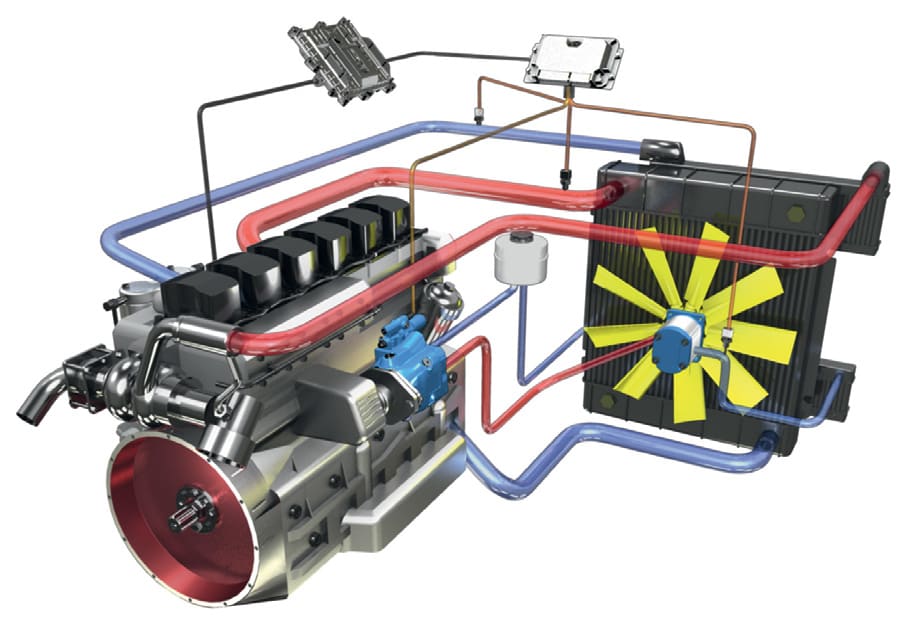
Electrohydraulic controls continue to evolve rapidly, helping OEMS improve fuel efficiency and performance while also enhancing safety. Developers are tightening integration with engines, altering pump, valve, and networking schemes while also designing systems that meet functional safety requirements.
Forging tighter links between the engine and hydraulics is a dominant trend. More electrohydraulic controllers are communicating with engines to increase efficiency and meet Tier 4 emissions and fuel consumption requirements.

“We’re seeing more powerful onboard controllers and more I/Os that let the ECU more closely control power management, anticipating stalls and communicating with the engine and hydrostatic transmissions to ensure that everything’s operating at the highest efficiency level,” said Kevin Lingenfelter, Senior Advanced Systems Engineer at Danfoss Power Solutions.
There are benefits beyond increased efficiency. However, the gains require plenty of analysis during the design phase and lots of communication while operating. Advanced software is needed to analyze conditions and manage the moving parts. Equipment suppliers try to reuse software to ensure that quality and consistency are maintained.
“Depending on the design of the equipment and its operation, IPM (intelligent power management) may be realized in a myriad of ways, which requires flexibility,” said David Eckerd, Product Management Director for Mobile Electronics, Bosch Rexroth. “This is realized by special software developed for the electrohydraulic ECU, which is easily configurable for the equipment to which it is applied.”
Engines typically have an optimal operating spot, so coordinating hydraulics and engines can ensure the best system performance. Hitting this sweet spot can be easier when engine suppliers and hydraulic developers work closely together.
“This can be a delicate balance, protecting sensitive intellectual property of the components while sharing enough information to optimize system operation,” said Steve Zumbusch, Advanced Platform Systems Engineering Director, Hydraulics, Eaton. “One example where we are seeing success is where Eaton is collaborating with an engine manufacturer on a mechanical transmission to develop improved shifting and driving capabilities.”
Developers are also revising the designs of pumps to help maximize the joint efforts of electrohydraulic and engine controllers. When there’s a valve command, the pump has to produce a certain flow to meet that demand. If that demand can be met at a lower engine speed, the engine can be slowed down.
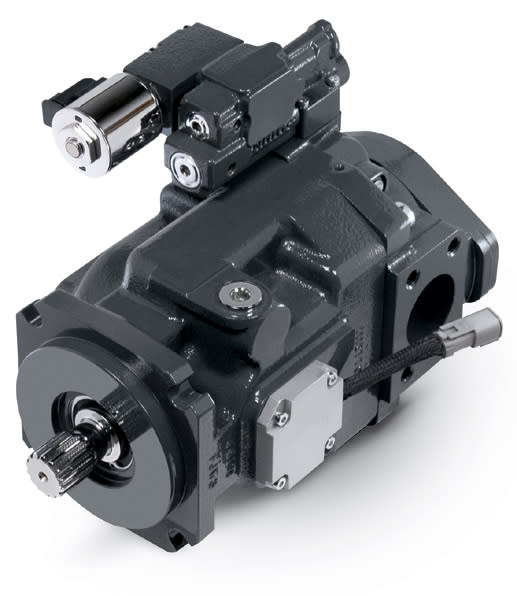
“If the pump operates at a slower speed, it needs a higher angle to meet that demand request, which also lets the pump run more efficiently,” Lingenfelter said. “We added an angle sensor to the pump so the ECU knows the exact displacement of the pump.”
Network news
Though engine and hydraulic controllers work together, there’s little interest in merging them into a single controller. Integration isn’t a huge goal for off-highway developers, who mostly use separate controllers for engines and transmissions. Gaining the flexibly offered by dedicated controllers highlights the need for an overall system view.
“Complete hydraulic system solutions can often be better accomplished with their own controllers, but all the controllers on the machine need to communicate with the engine and supervisory controllers,” Zumbusch said.
“Machines can have two, three, or even more controllers, but they need to work well together to provide the needed machine control, productivity and efficiency.”
SAE J1939, a specialized version of CAN, is widely used by engine and electrohydraulic controller manufacturers, simplifying integration. However, the volume of data being sent by increasingly sophisticated controllers is forcing engineers to devise ways to boost bandwidth.
“The use of CAN data has driven up the amount of data on the CAN bus, resulting in more concern about bus loading,” said Kirk Lola, Business Development Manager at Parker Hannifin’s Electronic Controls Division. “One approach to help manage this bus loading is to use gateways and multi-master systems. This allows the control system designer to support multiple CAN buses on the vehicle and limit the amount of data that is sent on each bus. Multi-master systems can be much more complex than single master systems, so more design thought has to be put into how the control logic is split between the various masters on the system.”
This additional bandwidth makes it easier to link all the controllers scattered around the vehicle. That’s becoming more important as microcontrollers are embedded into more pumps and valves.
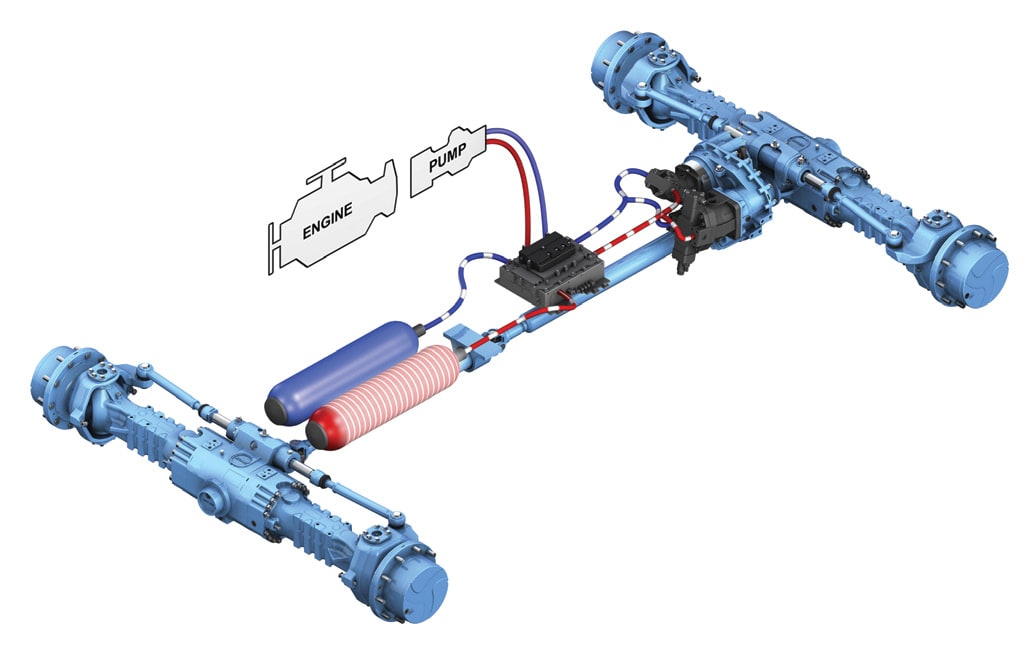
“All the valves can communicate with all of the controllers and other valves, as well as the engine, transmission, and any other components on the bus,” Lingenfelter said. “It’s helpful for advanced machine management and control to be able to get the same data to multiple controllers. As equipment uses more networking, it opens the doors to letting systems do exactly what the operator wants, nothing more, nothing less.”
Safe and sane
Safety is becoming one of the foremost challenges for controls developers. Functional safety requirements are transforming design programs, especially for machines built for European markets. Engineers are devising techniques that let hydraulic functions fail in ways that don’t put people in danger or damage the machine. Meeting those requirements is no simple task.
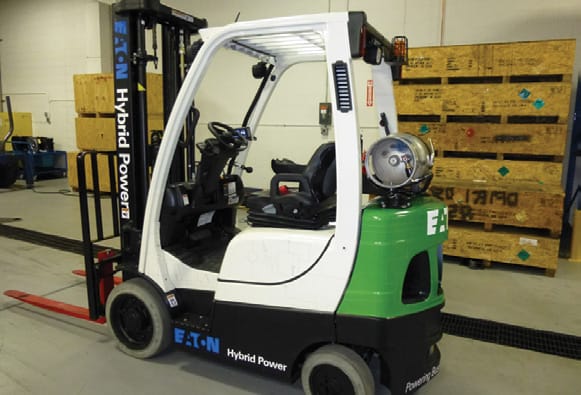
“The impact of functional safety requirements can be significant,” said Giulio Ornella, Advanced Engineering Manager for Dana Off-Highway Driveline Technologies. “These include hardware requirements like redundant I/O, ECU quality mean-time-to-failure assessment, and software development with respect to safety functions development. Moreover, a second watchdog controller also needs to be present nowadays to achieve the required safety integrity level for numerous safety-relevant applications.”
One bright spot is that the safety requirements are driven by standards such as ISO 13849 and IEC 61508. These specifications set varying safety integrity levels (SIL) for systems based on the potential for causing injury or severe damage. When electrohydraulic suppliers certify controls, OEMs can more easily merge them into their design plans.
“Machine designers can use the certification and reliability data for our IQAN MC3 controller to help them design a SIL-compliant machine,” Lola said. “This also allows the machine designer to consider not only the probability of a failure, but also what fault conditions need to be monitored, and in some cases redundancy needs to be designed in.”
Redundancy is a central aspect of functional safety. Eliminating single points of failure is an important requirement that can often be met with fault-tolerant designs.
“SIL-compliant architectures ensure that components continue to function, even if part of the machine or component is damaged,” Zumbusch said. “These redundancies are seen on sensors and control architectures — and as they become more advanced, there is increasing need for machine OEMs and component suppliers to work together to ensure optimal machine builds.”
More From SAE Media Group
Off-Highway Engineering
Standards Step Forward in Design of Off-highway Electronics
Off-Highway Engineering
More Intelligence Equals More Efficiency, Enhanced Functionality
Off-Highway Engineering
Aftertreatment Comes With Challenging Diagnosis
Off-Highway Engineering
Making Sense of Autonomy
Automotive Engineering
No Hands, Lots of Brains

Off-Highway Engineering
Komatsu Augments Intelligent Machine Control in New Excavator
Autonomous Vehicle Engineering
ADAS Computing on a Greater Scale
Automotive Engineering
More Gears, More Challenges

Off-Highway Engineering
Freightliner’s Medium-Duty Makeover
Automotive Engineering
To Serve and Protect
Off-Highway Engineering
Machines Working Remotely
Off-Highway Engineering
Reshaping the Mobile-hydraulic Ecosystem
Automotive Engineering
A Proactive Approach to Hydraulic Health in Class 8 Trucks
Motion Design
Automated X-Ray Inspection
Automotive Engineering
Manufacturers Must Take the Wheel to Scale SDV Success
Off-Highway Engineering
Autonomous Quarry Haulage in High Demand
Sensor Technology
New Products
Off-Highway Engineering
Off-highway Innovators to Demo Digital Prowess at CES 2026
Automotive Engineering
IAA 2025: Qualcomm’s Superbrains Are Here to Help With Automated Driving
Battery & Electrification Technology
Ultracapacitor Solutions to Address Energy-Storage Needs of Vehicles
Battery & Electrification Technology
Micro-Supercapacitors Enable Fast Charging

Tech Briefs
Electronics Cooling Using Additive Manufacturing

Automotive Engineering
Cameras Look to Go the Distance

Automotive Engineering
E Pluribus Unum
Top Stories
INSIDERManufacturing & Prototyping
 How Airbus is Using w-DED to 3D Print Larger Titanium Airplane Parts
INSIDERManned Systems
 FAA to Replace Aging Network of Ground-Based Radars
NewsTransportation
 CES 2026: Bosch is Ready to Bring AI to Your (Likely ICE-powered) Vehicle
NewsSoftware
 Accelerating Down the Road to Autonomy
EditorialDesign
 DarkSky One Wants to Make the World a Darker Place
INSIDERMaterials
 Can This Self-Healing Composite Make Airplane and Spacecraft Components Last...
Webcasts
Defense
 How Sift's Unified Observability Platform Accelerates Drone Innovation
Automotive
 E/E Architecture Redefined: Building Smarter, Safer, and Scalable...
Power
 Hydrogen Engines Are Heating Up for Heavy Duty
Electronics & Computers
 Advantages of Smart Power Distribution Unit Design for Automotive...
Unmanned Systems
 Quiet, Please: NVH Improvement Opportunities in the Early Design...
