




Mercedes Adopts Harman UX for A-Class
The ‘smart’ architecture is capable of OTA updates and features more-accurate voice recognition.
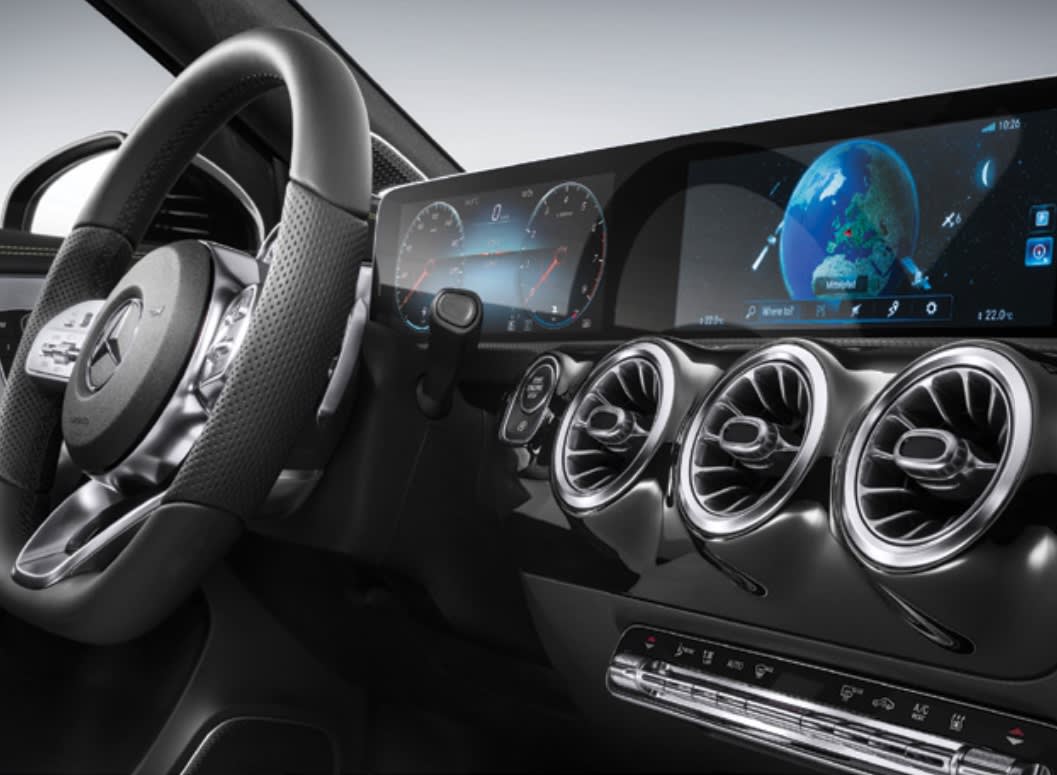
Mercedes-Benz’s ‘User Experience’ digital cockpit, previewed at the 2018 CES, is entering production in the new 2018 A-Class (W177). The cockpit is the first in a new generation of instrumentation and infotainment packages that will be rolled out in all future M-B models.
“It was vital that we took a multi-generational approach with smart architecture,” a Mercedes-Benz representative told Automotive Engineering at the show. “More computing power is needed with each generation of car, meaning a new CPU every three to five years — without big changes to the system’s basic infrastructure.”
Developed in conjunction with Harman, a unique feature of this system is its ability to learn, thanks to Artificial Intelligence. MBUX can be individualized and adapts to suit the user, creating “an emotional connection between the vehicle, driver and passengers.” At the same time over-the-air updates are possible.
Further strengths of the MBUX include a high-resolution Widescreen Cockpit with touchscreen operation, navigation display with augmented-reality technology plus intelligent voice control with natural-speech recognition, activated by the keywords, “Hey, Mercedes.”
With a degree of AI, it can interpret simple commands and questions such as “I am cold” rather than specific requests. A verbal question such as “Will the sun be shining tomorrow in Miami?” is now as easily understood as, “Do I need sunglasses tomorrow in Miami?”
As the MBUX was being rolled out at CES, Harman displayed its next-generation digital fascia developed in conjunction with its new parent. Samsung’s acquisition helped open up new ideas of what can be achieved to further enhance the cockpit experience, Harman reps explained. As an example, they cited the real-life video where the camera sees the street and then street names, house numbers and other details are added to the display. Such software technology is complex, as the tag has to stay on the house as the car is moving.”
Presented in a Maserati GranCabrio the new fascia featured a curved ‘S’ shape OLED screen in the center stack and a Quantum Dot Light Emitting Diode screen developed from Samsung’s proprietary television technology — both industry firsts.
A joint development between Harman and Samsung engineers, the car also incorporated forward and backward-facing Samsung cameras, the latter replacing door mirrors which automatically widened their angle of vision as the steering wheel is moved. This helps to make visible other road users such as motorcyclists.
While the MBUX uses Nvidia’s Reilly PX as the basic graphics chip and a Parker 128 for the top graphics chip, the Maserati system shown at CES was powered by Samsung chips, although the specification wasn’t revealed.
The Maserati’s AI also is further-advanced than the MBUX. It’s linked to the engine-management system and thus can recommend/remind the driver to have the oil changed. Or it could automatically book the car in for its next service when most convenient.
“We couldn’t have developed and built this without Samsung,“ a Harman engineer told AE. “All the technology you see here is off the shelf and ready for production. This system could be on the road within two years.”
More From SAE Media Group
Automotive Engineering
CES 2019: Blueprint for Future Auto Shows?
Off-Highway Engineering
Making Sense of Autonomy
Battery & Electrification Technology
Ultracapacitor Solutions to Address Energy-Storage Needs of Vehicles
Off-Highway Engineering
Freightliner’s Medium-Duty Makeover
Automotive Engineering
No Hands, Lots of Brains
Automotive Engineering
E Pluribus Unum
Automotive Engineering
MAGNA Say Some Hurdles of Seat-reconfiguration System to Be Addressed by OEMs

Off-Highway Engineering
Autonomous Quarry Haulage in High Demand
Off-Highway Engineering
Digital Tech a Las Vegas Headliner
Automotive Engineering
Riding Along With Mercedes and Its in-city Driver Assistance System
Off-Highway Engineering
New Mercedes-Benz Actros Loaded with ADAS, Active Safety Tech
Off-Highway Engineering
ZM Trucks Starts Production in Fontana, California
Autonomous Vehicle Engineering
Ensuring No Child Left Inside
Off-Highway Engineering
Yanmar CE Adds to Growing Compact Track Loader Segment
Off-Highway Engineering
Aftertreatment Comes With Challenging Diagnosis
Automotive Engineering
Cameras Look to Go the Distance

Sensor Technology
What Will 5G Do for the IoT/IIoT?
Tech Briefs
SAE WCX™ Digital Summit Preview


Automotive Engineering
CES 2021: Mercedes-Benz Hyperscreen Brings Dash-Wide Displays to Production
Automotive Engineering
Ford EV Engineers ‘Always On’ for Customer Feedback
Motion Design
Self-Contained Wheel Unit
Tech Briefs
Are In-Wheel Motor Systems Catching On?
Motion Design
Avoiding Electrical Damage with Conductive Lubrication
Automotive Engineering
Wrecking Ball
Off-Highway Engineering
Connectivity Continues Its Advance
Top Stories
INSIDERManufacturing & Prototyping
 How Airbus is Using w-DED to 3D Print Larger Titanium Airplane Parts
INSIDERManned Systems
 FAA to Replace Aging Network of Ground-Based Radars
NewsTransportation
 CES 2026: Bosch is Ready to Bring AI to Your (Likely ICE-powered) Vehicle
NewsSoftware
 Accelerating Down the Road to Autonomy
EditorialDesign
 DarkSky One Wants to Make the World a Darker Place
INSIDERMaterials
 Can This Self-Healing Composite Make Airplane and Spacecraft Components Last...
Webcasts
Defense
 How Sift's Unified Observability Platform Accelerates Drone Innovation
Automotive
 E/E Architecture Redefined: Building Smarter, Safer, and Scalable...
Power
 Hydrogen Engines Are Heating Up for Heavy Duty
Electronics & Computers
 Advantages of Smart Power Distribution Unit Design for Automotive...
Unmanned Systems
 Quiet, Please: NVH Improvement Opportunities in the Early Design...
