




Cluster-Assembled Soft Magnets for Power Electronics Applications
Inert-gas condensation was used to fabricate nanostructured systems to understand the mechanisms responsible for decreasing coercivity in soft magnetic materials.
This technique uses nanocluster assembly to produce model soft magnetic materials with simpler chemical composition than existing materials and well-controlled nanostructure, and to use these materials to improve understanding of the fundamental mechanisms responsible for the soft magnetic properties. An inert-gas condensation deposition chamber was developed, and transition-metal, rare-earth, and alloy nanoparticles with mean grain size D from 5 - 50 rim were deposited.
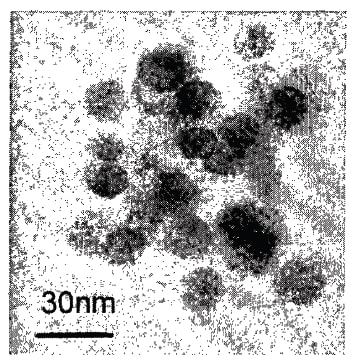
The figure shows a transmission electron micrograph of IGC-Fe nanoparticles. Deposition conditions were optimized to be able to produce 10-40 mg/h of nanoparticles with a size dispersion ΔD/D~0.1-1.0. The integrated system includes in-situ compaction and a transfer chamber to move samples to an inert-gas atmosphere without exposure to air. Ni, FeCo, Gd, GdN, Gd1-xFex, and Tb clusters were studied, as well as Gd:GdN compacts. Grain sizes varied-from less than 5 nm to over 50 nm by a combination of changing the deposition conditions and post-deposition annealing. This is a powerful method for studying grain-size dependence in soft magnets because it can produce large enough quantities of materials for extensive structural characterization and magnetic measurements, while maintaining precise control over the nanostructures.
Gd-based nanomaterials were studied extensively to examine the mechanisms responsible for exchange coupling changes at the ferromagnetic transition. The 293 K room-temperature Curie temperature of Gd enabled tracking of the magnetic behavior through the ferro-magnetic transition without changing the nanostructure by applying high temperatures. The coercivity exhibited unexpected temperature dependence, including non-zero magnetization and coercivity temperature (K) on the order of 100 Oe, well above the Tc of Gd.
Similar behavior was observed in GdN measured at 100 Oe (open squares) and the nanocompacts. GdN has a lower Tc and allows coercivity (closed circles) to measure at temperatures far above Tc, again temperature for an IGC-Gd compact without changing the nanostructure.
Coercivity was observed in the nitride sample at temperatures up to 400 K, which is significantly higher than the Tc of 60 K. The cause of this unexpected behavior was difficult to identify. X-ray diffraction, energy-dispersive x-ray spectroscopy, and electron diffraction did not indicate the presence of any secondary phases. Atomic Absorption Spectroscopy (AAS) showed that very small (0.5-2 wt. %) amounts of Fe were present in the samples. The culprit ultimately was identified as failure of the sputtering gun to confine the plasma to the target.
The decrease in the coercivity suggests that there are two phases. One is the Gd or Gd-N phase that orders at its expected Tc, although Tc may be depressed from the bulk value if the grain size is small. The second phase is ordered above Tc. When the Gd or GdN phase orders, anisotropy averaging decreases the coercivity. It remains unclear why very small amounts of iron have such a significant effect on the magnetic properties; however, the system enables investigation of the behavior of the exchange averaging as the ferromagnetic temperature is reached.
To understand the mechanism, Gd-Fe samples were fabricated with Fe concentrations ranging from 1 wt. % to 40 wt %. The intermediate part of this range has not been studied because of the limited solubility of Fe in Gd. Samples were made using IGC and melt spinning (another non-equilibrium fabrication technique) to overcome the limited solubility and understand how iron affects the magnetic properties. X-ray diffraction shows only peaks from hcp-Gd crystallites in Gd1-xFex for x up to 0.70. A combination of x-ray diffraction, electron microscopy, and electron diffraction suggested that there is a glassy GdFe phase in which hcp-Gd crystallites are embedded. The glassy Gd-Fe phase is magnetic at temperatures up to at least 400 K.
Determining the details of the nanostructure is critical to understanding the origin of the magnetic behavior. This is especially complex because the second phase is not evident in x-ray or electron diffraction. Studies show significant changes in the positions of the Gd and Fe atoms as the composition is changed. Coercivity data for different values of x were taken. Importantly, these data are taken at 310 K, above Tc of Gd. The shape of the loop also indicates the sensitivity of the magnetic properties to the presence of iron.
This work was done Diandra Leslie- Pelecky of the University of Nebraska for the Office of Naval Research.
ONR-0013
This Brief includes a Technical Support Package (TSP).

Cluster-Assembled Soft Magnets for Power Electronics Applications
(reference ONR-0013) is currently available for download from the TSP library.
Don't have an account?
More From SAE Media Group
Aerospace & Defense Tech Briefs
Gold-Based Nanoparticle Liquids for Electronic Applications
Aerospace & Defense Tech Briefs
Abrasion Testing of Products Containing Nanomaterials
Photonics & Imaging Technology
New Electron Microscopy Technique Offers First Look at Previously Hidden Processes

Medical Design Briefs
Convergence Nanoparticles for Multi-Modal Biomedical Imaging
Battery & Electrification Technology
Emerging Plasma FIB-SEM Techniques Advancing Battery Innovation
Aerospace & Defense Tech Briefs
Epitaxial Growth of Rhenium with Sputtering
Aerospace & Defense Tech Briefs
Self-Lubrication of Hot YSZ-Ag-Mo Nanocomposite Coatings
Aerospace & Defense Tech Briefs
Templated Synthesis of Aluminum Nanoparticles for Stable Energetic Materials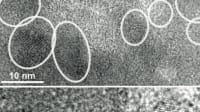
Tech Briefs
Scaling Up Nano for Sustainable Manufacturing
Photonics & Imaging Technology
Deformation Fingerprints Will Help Researchers Identify, Design Better Metallic Materials

Tech Briefs
Metallic Hollow Nanoparticle Fabrication
Aerospace & Defense Tech Briefs
Improved Dielectric-Breakdown Property of POSS-Filled Epoxy
Tech Briefs
One-Atom-Thin 2D Magnet
Aerospace & Defense Tech Briefs
Modeling and Experimenting with 2D Materials for CMOS Type Devices and Digital Integrated Circuits
Tech Briefs
Fabrication of Multilayer Ferritin Arrays

Battery & Electrification Technology
Designing Safer, Higher-Performance Lithium Batteries
Tech Briefs
Synthesizing Complex Optical Materials
Tech Briefs
Hybrid Material is an Efficient Photodetector
Medical Design Briefs
New Thermofluidic Improves Lab-On-a-Chip Applications
Aerospace & Defense Tech Briefs
Formation and Characterization of Gold Nanoparticles
Overview
The document titled "Cluster-Assembled Soft Magnets for Power Electronics Applications" presents a research project led by Diandra L. Leslie-Pelecky at the University of Nebraska, focusing on the development and investigation of nanostructured soft magnetic materials. The project, funded by the Office of Naval Research (ONR), aimed to enhance the understanding of the fundamental mechanisms that govern the soft magnetic properties of materials, particularly in the context of power electronics.
The primary objectives of the project were twofold: first, to utilize nanocluster assembly techniques to create model soft magnetic materials with simpler chemical compositions and well-controlled nanostructures; and second, to leverage these materials to gain insights into the mechanisms responsible for the soft magnetic properties. The research involved the design and construction of an inert-gas condensation (IGC) chamber, which enabled the deposition of transition-metal, rare-earth, and alloy nanoparticles with precise control over their grain sizes, ranging from less than 5 nm to over 50 nm.
A significant focus of the study was on Gd-Fe nanostructures, which were extensively examined to understand the exchange coupling mechanisms and their changes at the ferromagnetic transition. The research highlighted the unique temperature dependence of coercivity in Gd-based materials, allowing for the observation of magnetic behavior at temperatures significantly above the Curie temperature (Tc) of Gd. This was achieved without altering the nanostructure, providing valuable data on the magnetic properties of GdN and Gd-based nanocompacts.
The document also notes personnel changes during the project, which impacted progress. Despite these challenges, graduate student David Schmitter continued the research and is expected to contribute to three papers acknowledging ONR support, which are anticipated to be submitted by the end of the year.
Overall, the project successfully demonstrated the potential of IGC techniques in producing soft magnetic materials suitable for power electronics applications. The findings are expected to contribute to a deeper understanding of soft magnetism and may lead to advancements in the design and application of magnetic materials in various technological fields. The research outcomes are intended for publication in scientific journals, ensuring that the information will be accessible to the broader scientific community.
Top Stories
NewsSensors/Data Acquisition
 Microvision Aquires Luminar, Plans Relationship Restoration, Multi-industry Push
INSIDERRF & Microwave Electronics
 A Next Generation Helmet System for Navy Pilots
INSIDERWeapons Systems
 New Raytheon and Lockheed Martin Agreements Expand Missile Defense Production
NewsAutomotive
 Ford Announces 48-Volt Architecture for Future Electric Truck
INSIDERAerospace
 Active Strake System Cuts Cruise Drag, Boosts Flight Efficiency
ArticlesTransportation

Webcasts
Aerospace
 Cooling a New Generation of Aerospace and Defense Embedded...
Energy
 Battery Abuse Testing: Pushing to Failure
Power
 A FREE Two-Day Event Dedicated to Connected Mobility
Automotive
 Quiet, Please: NVH Improvement Opportunities in the Early Design Cycle
Electronics & Computers
 Advantages of Smart Power Distribution Unit Design for Automotive &...
Unmanned Systems
 Sesame Solar's Nanogrid Tech Promises Major Gains in Drone Endurance