




Templated Synthesis of Aluminum Nanoparticles for Stable Energetic Materials
Structural cavities in membrane films could serve as ideal templates for stable energetic materials.
Reactive nanoparticles as energetic materials have received much recent attention for a variety of existing and/or potential applications. Among more extensively investigated are nanosized (sub-100-nm) aluminum (Al) particles. Their large specific surface area and energy density, when coupled or mixed with oxidative species, make them unique combustible additives in propellant formulations. Nanoscale Al particles are also studied as high-capacity hydrogen storage materials. Therefore, significant effort has been made in the development of synthetic methodologies for Al nanoparticles of desired properties.
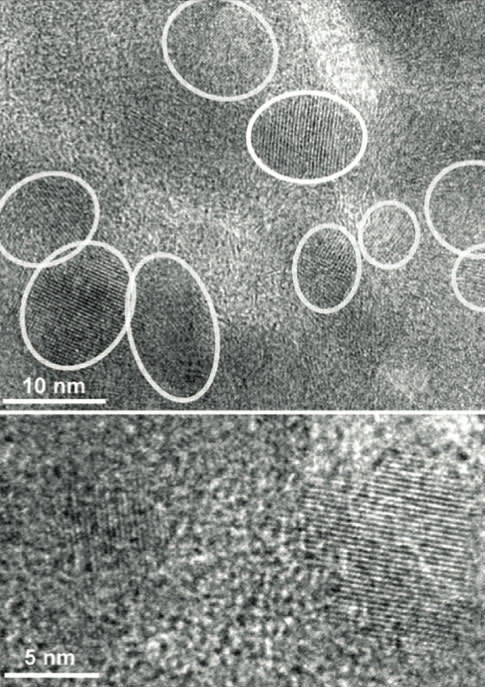
The chemical route based on thermal and/or catalytic decomposition of alane in the presence of a surface passivation agent for particle protection and stabilization has been identified as being particularly promising. The passivation agent for Al nanoparticles could be a metal coating or organic molecules such as perfluorinated carboxylic acids, which could also serve as an oxidant source under energetic conditions. This method has generally yielded Al particles of 50-200 nm in average size, though smaller particles have been obtained recently in a sonochemical environment with oleic acid as the surface passivation agent. Ideally, very small Al nanoparticles (thus, an extremely high surface area) of a narrow size distribution are desired for their distinctive advantages in energetic materials or for more effective hydrogen generation, but their bulk production in a consistent fashion and their protection for stability under ambient conditions present special challenges.
Nanoscale cavities in perfluorinated ionomer membrane were used as templates for the facile synthesis of small Al nanoparticles (diameters on the order of 10 nm) via catalytic decomposition of an alane precursor. While hosted in the cavities, for which the perfluorinated membrane structures should phenomenologically serve the same passivation function and also as a source of oxidant under energetic conditions, the Al nanoparticles were found to be mostly stable in ambient air. The effective hydrogen generation by the nanoparticles was used to determine the reactive Al content in the Al-in-membrane composite.
The results demonstrated that the structural cavities in ionomer membrane films could serve as ideal templates for facile production of well-dispersed small Al nanoparticles. The membrane structure could apparently protect the embedded Al nanoparticles from any significant oxidation, which made the reactive Al-in-Nafion composite films stable in ambient air. On the other hand, the Al nanoparticles could be used to produce hydrogen from water in a nearly quantitative fashion. The ability to incorporate a larger amount of reactive Al into Nafion membrane (up to more than 50% by weight in the resulting composite film) is fundamentally interesting and potentially technologically valuable, though a clear understanding of the structures in these composite films of very high Al loadings requires more investigation. The templated synthesis may represent a new route for stable Al nanoparticles and related energetic nanomaterials.
This work was done by Heting Li, Fushen Lu, and Ya-Ping Sun of Clemson University; Christopher E. Bunker of the Air Force Research Laboratory; and Elena A. Guliants of the University of Dayton Research Institute. For more information, download the Technical Support Package (free white paper) at www.defensetechbriefs.com/tsp under the Materials category. AFRL-0146
This Brief includes a Technical Support Package (TSP).
Templated Synthesis of Aluminum Nanoparticles for Stable Energetic Materials
(reference AFRL-0146) is currently available for download from the TSP library.
Don't have an account?
More From SAE Media Group
Aerospace & Defense Tech Briefs
‘First of Its Kind’ Composite Material to Help Space Vessels Travel Longer Distances



Battery & Electrification Technology
Enhancing the Performance of All-Solid-State Batteries
Aerospace & Defense Tech Briefs
Nanoparticle AlxMoyOz/Al Thermites

Automotive Engineering
Hydrogen Storage Tank Options: Not Everything Need Look like a Sausage


Aerospace & Defense Tech Briefs
Fast Reacting Nano-Composite Energetic Materials: Synthesis and Combustion Characterization

Aerospace & Defense Tech Briefs
Abrasion Testing of Products Containing Nanomaterials
Photonics & Imaging Technology
Deformation Fingerprints Will Help Researchers Identify, Design Better Metallic Materials
Tech Briefs
Stable, Efficient, Anode-Free Sodium Battery
Battery Technology
Tough, Solid Electrolyte Battery Component
Battery Technology
Sustainable Aluminum-Anode Batteries



Photonics & Imaging Technology
New Electron Microscopy Technique Offers First Look at Previously Hidden Processes

Tech Briefs
Aluminum as a Fuel
Aerospace & Defense Tech Briefs
SAE International Extends Call for Abstracts, Seeks Submissions for AeroTech Conference
Aerospace & Defense Tech Briefs
Reactive, Multifunctional, Micellar, Composite Nanoparticles for Destruction of Bio-Agents

Battery & Electrification Technology
Improving and Increasing Energy Density of Batteries
Overview
The document discusses a novel approach to synthesizing aluminum nanoparticles using a templated method that leverages nanoscale structural cavities in ionomer membrane films. This innovative technique allows for the catalytic decomposition of an alane precursor to produce small aluminum nanoparticles, which can constitute over half the weight of the composite film. The resulting nanoparticles are effectively protected from oxidation by the membrane structure, ensuring their stability in ambient air. This stability is crucial for applications in energetic materials, where the performance and safety of the materials are paramount.
The synthesis process involves the use of Nafion-117 membrane films, which are purified and converted to the sodium form through established procedures. The films are treated with concentrated nitric acid and then sequentially immersed in diluted nitric acid solutions before being soaked in a sodium hydroxide solution. This treatment results in clear and optically transparent films that can host the aluminum nanoparticles.
The document also details the measurement techniques employed in the research, including NMR spectroscopy, X-ray powder diffraction, thermogravimetric analysis (TGA), and electron microscopy. These methods are essential for characterizing the synthesized nanoparticles and assessing their properties.
A significant aspect of the research is the ability to quantitatively access the embedded aluminum nanoparticles in basic aqueous solutions, facilitating hydrogen production. This feature highlights the potential of the synthesized nanoparticles for use in hydrogen generation applications, which is increasingly relevant in the context of renewable energy and sustainable technologies.
The research acknowledges financial support from various organizations, including the Air Force Research Laboratory and the South Carolina Space Grant Consortium, underscoring the collaborative nature of the work.
In summary, the document presents a comprehensive study on the templated synthesis of aluminum nanoparticles, emphasizing their stability, potential applications in energetic materials, and the innovative methodologies used for their characterization. This research could pave the way for advancements in the development of stable energetic nanomaterials and their applications in energy production and storage.
Top Stories
NewsSensors/Data Acquisition
 Microvision Aquires Luminar, Plans Relationship Restoration, Multi-industry Push
INSIDERRF & Microwave Electronics
 A Next Generation Helmet System for Navy Pilots
INSIDERWeapons Systems
 New Raytheon and Lockheed Martin Agreements Expand Missile Defense Production
NewsAutomotive
 Ford Announces 48-Volt Architecture for Future Electric Truck
INSIDERAerospace
 Active Strake System Cuts Cruise Drag, Boosts Flight Efficiency
ArticlesTransportation

Webcasts
Aerospace
 Cooling a New Generation of Aerospace and Defense Embedded...
Energy
 Battery Abuse Testing: Pushing to Failure
Power
 A FREE Two-Day Event Dedicated to Connected Mobility
Automotive
 Quiet, Please: NVH Improvement Opportunities in the Early Design Cycle
Electronics & Computers
 Advantages of Smart Power Distribution Unit Design for Automotive &...
Unmanned Systems
 Sesame Solar's Nanogrid Tech Promises Major Gains in Drone Endurance