




Abrasion Testing of Products Containing Nanomaterials
Ensuring repeatable results when capturing and analyzing released particles.
This SOP describes how to detect and quantify the release of nanoparticles from surface coatings into the air using a mechanical process that employs abrasion to simulate sanding. A material containing nanoparticles will be physically abraded and the materials released will be collected in a custom abrasion testing system. They will then be characterized by different methods such as Scanning Electron Microscopy (SEM) or Transmission Electron Microscopy (TEM) and other methods.
Several recent studies have attempted to bridge the critical knowledge gap of nanomaterial release from nano-composite materials using mechanical abrasion techniques. Some showed that release of carbon nanotubes (CNTs) from a nanocomposite material required a combination of UV-induced weathering and physical abrasion. Other studies found some level of individual nanomaterial release under heavy mechanical stress, while others found no individual nanomaterials released under similar mechanical stress conditions. Many of these studies identified difficulty in generating reproducible results during these mechanical abrasion studies due to variability in material, abrasion and aerosol sampling as a significant issue in determining release of engineered nanomaterials (ENMs).
These difficulties point to the necessity of identifying a standardized procedure for abrasion testing of ENM-containing materials. One of the most common techniques relies on adaptations to the Taber abraser, a sanding simulation device. The standard test is performed with the sample being rotated while in contact with two abrasive wheels moving in the opposite direction. Particle release depends on the surface coating and substrate material used.
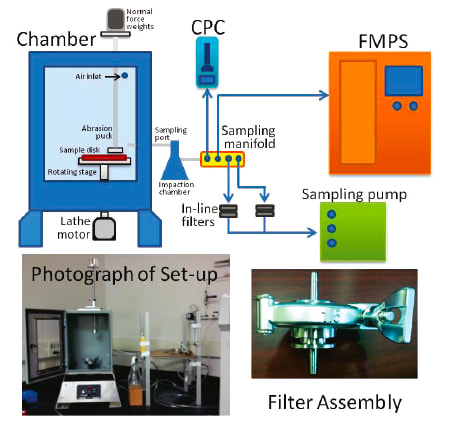
After particles are released, proper characterization is essential to determine the potential hazard of ENMs that may be included in the released material. The particle number density is characterized with a condensation particle counter (CPC), while a fast mobility particle sizer (FMPS) determines the particle size/mass distribution. Light microscopy (LM), scanning electron microscopy (SEM), and transmission electron microscope (TEM) are three techniques to further analyze the characterization of the wear particles. These procedures can also be coupled with energy dispersive x-ray spectroscopy (EDS) for chemical microanalysis.
One advantage of abrasion testing is it can provide data in a matter of minutes compared to the years that may be required by in-use testing. The results can be used to inform risk decisions based on the mass of material released, the number of nanoparticles, the size and composition of the particles, and the rate of their release. There are some limitations associated with abrasion testing, such as limited shear rates, potential clogging of the abrasion material due to pickup of test material, and potential contamination of testing due to interference by abrading material (e.g., an Al2O3 wheel). However, these limitations can be overcome significantly through test design and operational practices to ensure that the data represents realistic release scenarios.
The accompanying figure shows the general experimental setup. A 12 inch × 8 inch × 16 inch cabinet houses the abrasion testing system, which includes a commercial lathe with attached sample-holder, an aluminum disc with replaceable sandpaper attached to the face contacting the sample at the end of a rod with platform for adding mass (to increase normal force during abrasion), inlets for introduction of HEPA-filtered air into the cabinet, and outlets for particulate sampling/ collection. The inlet airflow is controlled to 20 lpm, matching or slightly exceeding the flow out to the instruments and collection filters. For this setup, the CPC has a flowrate of 0.7 lpm, the FMPS has a flowrate of 10 lpm, and the two in-line filters have flowrates of 4.5 lpm each, for a total sampling rate of 19.7 lpm. The airborne particles from the cabinet are passed through a large impaction chamber to allow settling of large particles, then into a 4-way distribution manifold that splits the flow to the instruments and filters.
It is recommended to run at least three tests on each material to help identify the presence of outlier abrasion tests and establish a more confident representation of the release of each material.
This work was done by Monica A. Ramsey, Jonathon Brame, Aimee R. Poda, Michael Cuddy, and Robert D. Moser for the Army Engineer Research and Development Center. ERDC-0001
This Brief includes a Technical Support Package (TSP).
Abrasion Testing of Products Containing Nanomaterials, SOP-R-2
(reference ERDC-0001) is currently available for download from the TSP library.
Don't have an account?
More From SAE Media Group
Aerospace & Defense Tech Briefs
Processing and Characterization of Polycrystalline YAG (Yttrium Aluminum Garnet) Core-Clad Fibers
Photonics & Imaging Technology
New Electron Microscopy Technique Offers First Look at Previously Hidden Processes
Aerospace & Defense Tech Briefs
Development of Hydrophobic Coatings for Water-Repellent Surfaces Using Hybrid Methodology
Aerospace & Defense Tech Briefs
Templated Synthesis of Aluminum Nanoparticles for Stable Energetic Materials
Aerospace & Defense Tech Briefs
Transparent Display Technology
Photonics & Imaging Technology
New Electron Microscopy Technique Offers First Look at Previously Hidden Processes
Aerospace INSIDER
A New Quantum Materials Research System
Tech Briefs
5 Ws of Invisible Glass
Aerospace & Defense Tech Briefs
Gold-Based Nanoparticle Liquids for Electronic Applications
Aerospace & Defense Tech Briefs
Cold Sprayed Coatings with Dual Nanoparticle Reinforcements for Wear and Corrosion Protection
Aerospace & Defense Tech Briefs
‘First of Its Kind’ Composite Material to Help Space Vessels Travel Longer Distances


Defense INSIDER
Scientists Explore Nanoparticles for Future Weapon Systems
Aerospace & Defense Tech Briefs
Reactive, Multifunctional, Micellar, Composite Nanoparticles for Destruction of Bio-Agents
Aerospace & Defense Tech Briefs
Cluster-Assembled Soft Magnets for Power Electronics Applications
Photonics & Imaging Technology
Military Optics Technology
Aerospace & Defense Tech Briefs
Hybrid Ultra-Low VOC and Non-HAP Rain Erosion Coatings
Aerospace & Defense Tech Briefs
Self-Lubrication of Hot YSZ-Ag-Mo Nanocomposite Coatings
Aerospace & Defense Tech Briefs
Modeling and Experimenting with 2D Materials for CMOS Type Devices and Digital Integrated Circuits
Aerospace & Defense Tech Briefs
New Diamond Super-Material Enhances Aircraft Survivability
Aerospace Manufacturing and Machining INSIDER
Can This Self-Healing Composite Make Airplane and Spacecraft Components Last for Centuries?
Automotive Engineering
Lyten Says 3D Graphene Could Disrupt Racing, Automotive and Space
Tech Briefs
Lighter Radiation Shielding for Electronics
Aerospace & Defense Tech Briefs
Outsourcing Plasma Treatments for Surface Modification

Aerospace & Defense Tech Briefs
Hydrolytic Stability of Polyurethane-Coated Fabrics Used for Collapsible Fuel Storage Containers
Overview
The document titled "Abrasion Testing of Products Containing Nanomaterials, SOP-R-2" (ERDC SR-16-2) outlines a standard operating procedure (SOP) for detecting and quantifying the release of nanoparticles from surface coatings during mechanical abrasion, simulating conditions such as sanding. The primary focus is on understanding the potential environmental and health impacts of nanoparticles released during the service life of nanotechnology products.
The SOP describes a method where a material containing nanoparticles is subjected to abrasion using a rotating sample platform in contact with a weighted sandpaper fixture. This process is conducted in a controlled, particle-free environment to ensure accurate measurement of released particles. The particles generated from the abrasion are collected and analyzed using various techniques, including a condensation particle counter (CPC) and a fast mobility particle sizer (FMPS). These instruments allow for real-time monitoring of particle release across a size range from 10 nm to over 1 μm, with the FMPS categorizing particles into 32 size bins from 5 to 550 nm.
In addition to real-time monitoring, particles are also collected on in-line filters for further characterization, which may include advanced imaging techniques such as Scanning Electron Microscopy (SEM) or Transmission Electron Microscopy (TEM). This comprehensive approach ensures that both the quantity and characteristics of the released nanoparticles are thoroughly assessed.
The document emphasizes the significance of abrasion as a critical factor in evaluating the safety and environmental impact of nanotechnology products. By providing a standardized method for testing, the SOP aims to facilitate consistent and reliable data collection, which is essential for regulatory compliance and risk assessment.
Overall, this SOP serves as a vital resource for researchers and industry professionals involved in the development and application of nanomaterials, ensuring that potential risks associated with nanoparticle release are adequately addressed. The findings and methodologies presented in this document contribute to the broader understanding of nanotechnology's implications, promoting safer practices in the use of nanomaterials across various applications.
Top Stories
NewsRF & Microwave Electronics
 Microvision Aquires Luminar, Plans Relationship Restoration, Multi-industry Push
INSIDERAerospace
 A Next Generation Helmet System for Navy Pilots
INSIDERDesign
 New Raytheon and Lockheed Martin Agreements Expand Missile Defense Production
INSIDERMaterials
 How Airbus is Using w-DED to 3D Print Larger Titanium Airplane Parts
NewsPower
 Ford Announces 48-Volt Architecture for Future Electric Truck
ArticlesAR/AI

Webcasts
Electronics & Computers
 Cooling a New Generation of Aerospace and Defense Embedded...
Automotive
 Battery Abuse Testing: Pushing to Failure
Power
 A FREE Two-Day Event Dedicated to Connected Mobility
Unmanned Systems
 Quiet, Please: NVH Improvement Opportunities in the Early Design Cycle
Automotive
 Advantages of Smart Power Distribution Unit Design for Automotive &...
Energy
 Sesame Solar's Nanogrid Tech Promises Major Gains in Drone Endurance