




Processing and Characterization of Polycrystalline YAG (Yttrium Aluminum Garnet) Core-Clad Fibers
New techniques could make polycrystalline YAG suitable for use in fiber lasers.
YAG-based fiber lasers could offer efficient operation at power levels beyond those achievable in current state-of-the-art silica-based fiber lasers if losses can be minimized. To address this, researchers have investigated creating both single-crystal and polycrystalline YAG fibers. Among the cases reported is the preparation of single-crystal YAG fibers using laser heated pedestal growth (LHPG), which resulted in fiber diameters of 400 μm and optical losses around 1–2 dB/m in the 1–3 μm wavelength range. Single-crystal YAG fibers with diameters of ~ 30 μm have even been reported.
Although single-crystal YAG fibers are now available, robust cladding pro - cesses have yet to be developed for them. While a number of cladding methods were investigated, they appear to be in their initial stages and lack the maturity required for the envisioned laser application. Indeed, glass can be used as a cladding on single-crystal fibers, but its thermal conductivity is about ten times lower than that of crystalline YAG. Therefore, it can only be used for characterization purposes as it negates the motivation to use YAG as a fiber media and is therefore not practical for actual applications.
Applying ceramic coatings to fully dense fiber is also problematic due to constrained sintering conditions which result in cracks forming in the cladding. On the other hand, polycrystalline YAG fibers can be prepared with conventional ceramic processing, which involves a variety of processing steps including the formation of so-called “green fiber”, the creation of binder-removed fiber, and finally fully dense fiber.
Optical propagation losses were measured by injecting a 1480-nm fiber-coupled laser into polycrystalline YAG fibers that were cladded with 3 μm of Schott SF57 glass. The loss of these fibers, measured to be ≥ 50 1/m, needs to be significantly lowered to facilitate practical applications. It was subsequently discovered that these fibers all contained second-phase inclusions which likely lead to excess scattering loss. It was determined the cladding thickness was too thin to optimally confine the light within the fibers, and the refractive index difference between the YAG core and the glass cladding was too large at the characterization wavelength used. As a result of these findings, work focused on removing the second-phase inclusions and on developing a process to apply an undoped YAG cladding to a doped poly-crystalline YAG fiber in order to optimize the refractive index difference between core and cladding.
Yb-doped YAG powders were ball-milled and classified to remove agglomerates and contamination from the milling media. Binder and plasticizer were mixed with the Yb-doped YAG powder and the mixture was extruded through a 50-μm custom-made nozzle at pressures 3000–5000 psi. The fibers were then dried at room temperature for ≥8 hours before any future process steps were taken.
An un-doped YAG slurry was subsequently prepared and the Yb-doped fibers were dip coated in this slurry multiple times to form the YAG cladding. After each dip coating, the coated fiber was dried at 120°C. Organics in the cladded green fiber were removed during slow ramping up to 600°C and the sintering was carried out under a variety of conditions.
To further investigate the composition of these fibers, they were mounted, polished, and coated with carbon as a conductive layer for scanning electron microscopy (SEM, Quanta ESEM, FEI). Then the back-scattered electron mode of the SEM was used to analyze fibers for the presence of second-phase inclusions. In addition, focused ion beam (FIB, Nova, FEI) was used to prepare foils for energy dispersive x-ray spectroscopy (EDS) analysis via TEM (CM 200, Philips) to perform chemical analysis on the second-phase inclusions and YAG matrix. Optical scattering losses of these fibers were also measured.
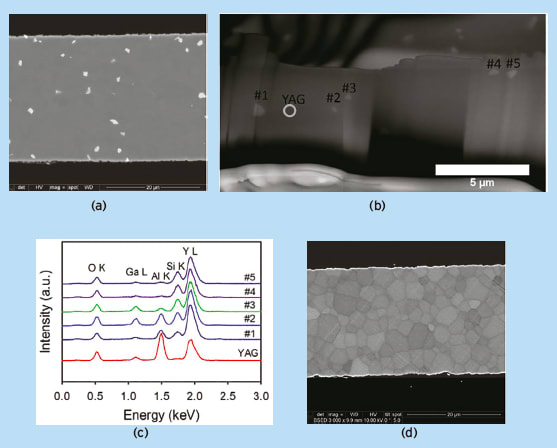
While earlier fibers guided light, the best loss coefficient was measured to be ~50 1/m. During the analysis of these fibers, however, it was found that they contained second-phase inclusions [as shown in Figure (a)]. This implies the loss of the fibers would improve if the second-phase inclusions could be removed. The EDS spectra shown in Figure (c) make it clear that the second-phase inclusions are Si rich and Al deficient. While it is still unclear what causes the formation of the second-phase inclusions, they are believed to increase the scattering losses of these fibers. After a number of experiments where the sintering conditions were changed, conditions were found that allowed the creation of polycrystalline YAG fibers without inclusions; the microstructure of such a fiber is shown in Figure (d).
This work was done by Nicholas Usechak, Hyun Jun Kim, Santeri Potticary, Matthew O'Malley and GE Aviation’s Geoff Fair for the Air Force Research Laboratory. AFRL-0246
This Brief includes a Technical Support Package (TSP).
PROCESSING AND CHARACTERIZATION OF POLYCRYSTALLINE YAG (YTTRIUM ALUMINUM GARNET) CORE-CLAD FIBERS -POSTPRINT
(reference AFRL-0246) is currently available for download from the TSP library.
Don't have an account?
More From SAE Media Group
Aerospace & Defense Tech Briefs
Abrasion Testing of Products Containing Nanomaterials
Photonics & Imaging Technology
Military Optics Technology
Tech Briefs
5 Ws of Invisible Glass
Aerospace & Defense Tech Briefs
New Diamond Super-Material Enhances Aircraft Survivability
Aerospace & Defense Tech Briefs
3D Meta-Optics for High-Energy Lasers
Aerospace & Defense Tech Briefs
Thermal Simulation and Testing of Expanded Metal Foils for Lightning Protection
Aerospace & Defense Tech Briefs
Transparent Ceramics for High-Energy Laser Systems
Aerospace & Defense Tech Briefs
Quantitative Diagnostics of Multilayered Composite Structures with Ultrasonic Guided Waves
Aerospace & Defense Tech Briefs
Unlocking the Power of Ceramic Matrix Composites
Aerospace & Defense Tech Briefs
Coating Technology Enables Effective Missile Countermeasures

Aerospace & Defense Tech Briefs
Outsourcing Plasma Treatments for Surface Modification
Aerospace Manufacturing and Machining INSIDER
Can This Self-Healing Composite Make Airplane and Spacecraft Components Last for Centuries?
Aerospace & Defense Tech Briefs
Thermal Conductivities of Some Polymers and Composites
Aerospace & Defense Tech Briefs
Transparent Display Technology
Aerospace & Defense Tech Briefs
MOVPE Growth of LWIR AlInAs/GaInAs/InP Quantum Cascade Lasers: Impact of Growth and Material Quality on Laser Performance
Aerospace & Defense Tech Briefs
Continuous Sputter Deposition Coating of Long Monofilaments
Aerospace & Defense Tech Briefs
Simulating Thermal Expansion in Composites with Expanded Metal Foil for Lightning Protection
Photonics & Imaging Technology
Specifying Coatings for Military and Aerospace Applications

Aerospace & Defense Tech Briefs
Hierarchical Diamond-Based Ceramic Composites
Aerospace & Defense Tech Briefs
Thermal Conductivity Measurement Setup for Low-Temperature Characterization of Laser Materials
Photonics & Imaging Technology
Can Harmful Gas Detection Improve With a New Way of Generating Powerful Lasers?

Battery & Electrification Technology
Emerging Plasma FIB-SEM Techniques Advancing Battery Innovation

Overview
The document titled "Processing and Characterization of Polycrystalline YAG (Yttrium Aluminum Garnet) Core-Clad Fibers - Postprint" discusses the advancements in the fabrication and characterization of polycrystalline YAG fibers, which are gaining attention as potential gain media for fiber lasers. The authors highlight the superior properties of polycrystalline YAG fibers compared to traditional silica-glass fibers, including a larger surface-to-volume ratio, higher stimulated Brillouin scattering threshold, and enhanced thermal conductivity.
The report outlines the techniques developed to reduce scattering loss in polycrystalline YAG core fibers while achieving optical gain. The authors detail their efforts in improving processing methods through feedback from mechanical testing and the innovative approach of encasing doped YAG core fibers with undoped YAG claddings. This dual-material structure aims to optimize light guidance and minimize losses.
Experimental results are presented, showing that the fabricated fibers successfully guide light at wavelengths separated by 500 nm. The scattering loss coefficient was measured to be below 70 1/m at 1480 nm, which, while higher than previous measurements (approximately 40 1/m), is attributed to the Yb doping in the core and excess scattering at the cladding-air interface. The presence of second-phase inclusions, which the authors have recently managed to suppress, also contributed to the increased loss.
The document includes detailed measurements of optical power detected using a cleaved SMF-28 fiber as a probe tip, demonstrating the effectiveness of the experimental setup. The authors note that the Yb doping significantly absorbs 980-nm pump light, leading to increased loss at that wavelength. Additionally, the combination of spontaneous emission and scattered amplified spontaneous emission in the 1030–1050 nm range indicates that part of the fiber is inverted, suggesting potential for laser applications.
In conclusion, the authors emphasize the importance of ongoing research to further enhance the optical properties of polycrystalline YAG fibers. They express optimism about future fibers with improved cladding thickness and reduced second-phase inclusions, which will be subjected to optical testing. The work is supported by the Air Force Office of Scientific Research, reflecting its relevance to aerospace applications and advanced optoelectronic systems.
Top Stories
NewsRF & Microwave Electronics
 Microvision Aquires Luminar, Plans Relationship Restoration, Multi-industry Push
INSIDERAerospace
 A Next Generation Helmet System for Navy Pilots
INSIDERDesign
 New Raytheon and Lockheed Martin Agreements Expand Missile Defense Production
INSIDERMaterials
 How Airbus is Using w-DED to 3D Print Larger Titanium Airplane Parts
NewsPower
 Ford Announces 48-Volt Architecture for Future Electric Truck
ArticlesAR/AI

Webcasts
Electronics & Computers
 Cooling a New Generation of Aerospace and Defense Embedded...
Automotive
 Battery Abuse Testing: Pushing to Failure
Power
 A FREE Two-Day Event Dedicated to Connected Mobility
Unmanned Systems
 Quiet, Please: NVH Improvement Opportunities in the Early Design Cycle
Automotive
 Advantages of Smart Power Distribution Unit Design for Automotive &...
Energy
 Sesame Solar's Nanogrid Tech Promises Major Gains in Drone Endurance