




Transparent Ceramics for High-Energy Laser Systems
These ceramics can be used as window and dome material for protecting sensors.
When a high-energy laser (HEL) beam transmits through a window material, a part of the laser energy is absorbed by the material and causes optical aberrations. This absorbed energy results in material heating in the local exposed region, changing its refractive index based on the material’s thermo-optic coefficient, thermal expansion coefficient, and stress optic coefficient. These changes result in beam distortion and loss of output power, measured as optical path distortion (OPD), which has a severe impact on system performance.
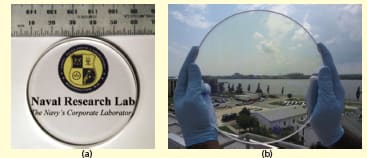
Transparent magnesium aluminate spinel (MgAl2O4) ceramic was developed as a rugged window and dome material for protecting sensors operating from the ultraviolet (UV) to the mid-IR. The transparent spinel ceramic was made from high-purity powder synthesized using aqueous chemical methods. The 5 × 9’s pure Al and Mg chloride were mixed together to form a homogeneous solution at 80 ºC. Ammonium hydroxide was added to the solution to form a precipitate that was subsequently filtered, washed with water and then acetone, and baked to dry. The powder was then calcined at 600 ºC to convert to magnesium aluminate spinel.
Ceramic spinel was made by hot-pressing ball-milled spinel powders at 1400-1650 ºC for 2-4 hours using a uniform coating of a small amount of LiF sintering aid that was eliminated by evaporation prior to full densification. The hot-pressed samples were transparent, with densities greater than 99% of theoretical. The samples were subsequently hot isostatically pressed (HIP) at 1600 ºC for 2 hours under an Ar gas pressure of 30,000 psi to produce fully dense and transparent ceramics. The samples ranged in size from 5 cm in diameter and 6 mm thick, to larger samples (15 cm diameter) from which smaller samples were cut, ground, and polished for many of the measurements. High-damage-threshold anti-reflective (AR) coatings (SiO2/ZrO2) were applied to the surface of polished 5-cmdiameter samples using dc-magnetron sputtering.
Spinel powder synthesized by the aqueous process produced approximately 100-200 nm crystallites with excellent phase purity as highlighted by X-ray diffraction analysis and chemical analysis. Compared to commercial powder, the impurity content is several orders of magnitude lower. The surface area of the synthesized powder was 25 m2/g compared with a range of 10-30 m2/g for commercial powder.
Rain and sand erosion tests performed on spinel ceramic were successful. The spinel samples were able to withstand impact from rain droplets at speeds up to 600 mph and sand particles at speeds up to 460 mph without damage, without surface pitting, and with no change in transmission, unlike glass, which exhibits considerable damage.
Spinel is a rugged ceramic material that transmits from the UV to 5 μm and could be used as an exit aperture for HEL systems. However, spinel made from commercial powder exhibits high absorption losses due to extrinsic impurities. Ceramic samples made from spinel powders demonstrated a record low absorption loss of 6 ppm/cm at 1.06 μm.
This work was done by Jas Sanghera, Shyam Bayya, Guillermo Villalobos, Woohong Kim, Jesse Frantz, Brandon Shaw, Colin Baker, and Ishwar Aggarwal of the Naval Research Laboratory; Bryan Sadowski, R. Miklos, and Fred Kung of GTEC Inc.; Michael Hunt of University Research Foundation; David Reicher and Stan Peplinski of the Air Force Research Laboratory; Al Ogloza and Peter Langston of NAWC; Chuck Lamar of the Army Space & Missile Defense Command; Peter Varmette of SAIC; Mark Dubinskiy of the Army Research Laboratory; and Lewis DeSandre of ONR Global. NRL-0048
This Brief includes a Technical Support Package (TSP).
Transparent ceramics for high-energy laser systems
(reference NRL-0048) is currently available for download from the TSP library.
Don't have an account?
More From SAE Media Group
Aerospace & Defense Tech Briefs
Processing and Characterization of Polycrystalline YAG (Yttrium Aluminum Garnet) Core-Clad Fibers
Photonics & Imaging Technology
How to Innovate and Overcome the Challenges of Blue Laser Beam Shaping
Aerospace & Defense Tech Briefs
3D Meta-Optics for High-Energy Lasers
Medical Design Briefs
Optical Design Considerations for Additive Manufacturing

Tech Briefs
New Family of Glass for Lens Applications
Photonics & Imaging Technology
Can Harmful Gas Detection Improve With a New Way of Generating Powerful Lasers?
Tech Briefs
5 Ws of Invisible Glass

Photonics & Imaging Technology
Optical Coatings Technology
Tech Briefs
A Near-Perfect Blackbody Calibration Target
Photonics & Imaging Technology
A First-Of-Its-Kind Integrated Optical Isolator
Photonics & Imaging Technology
Ultrafast Laser Micromachining
Photonics Tech Briefs
Customizing Visual 3D Optical Coatings
Photonics & Imaging Technology
A New Optical Metamaterial Makes True One-Way Glass Possible

Photonics & Imaging Technology
OPO Lasers Put Optical Components to the Test
Photonics & Imaging Technology
Blue Laser Power Beaming for Planetary Exploration

Aerospace & Defense Tech Briefs
Rare-Earth-Doped Soft Glass Optical Fibers for Coherent Wavelength Sources Above 2 Microns
Tech Briefs
Polyimides From a-BPDA and Aromatic Diamines
Photonics & Imaging Technology
New “Metalens” Shifts Focus Without Tilting or Moving
Photonics & Imaging Technology
Specifying Coatings for Military and Aerospace Applications

Photonics & Imaging Technology
New Blue Light Technique Could Enable Advances in Understanding Nanoscale Technologies
Photonics & Imaging Technology
Rice ‘Metalens’ Could Disrupt Vacuum UV Market
Photonics & Imaging Technology
A Sharper Look at the Interior of Semiconductors
Overview
The document discusses the development and application of transparent ceramics, specifically magnesium aluminate spinel (MgAl₂O₄) and Yb³⁺:Y₂O₃, for high-energy laser (HEL) systems. It highlights the unique material requirements for both the lasing medium and the exit aperture window in these systems, emphasizing the need for materials that can withstand harsh environmental conditions while maintaining optical clarity.
Magnesium aluminate spinel ceramic is presented as a prime candidate for use as an exit window aperture due to its excellent thermo-optical properties, which include a record low absorption loss of 6 ppm/cm. This low absorption is crucial as it minimizes the heating and optical aberrations that can occur when a high-energy beam transmits through a window material. The document explains that absorbed energy can lead to changes in the refractive index, resulting in beam distortion and loss of output power, which negatively impacts system performance. Therefore, the ideal window material should possess low absorption loss, environmental ruggedness, and strength, allowing for thinner designs that further reduce weight and absorption loss.
The research also discusses the limitations of traditional materials like fused silica and oxyfluoride glasses, which may not survive in extreme conditions. The authors argue that transparent ceramics like spinel can fulfill the requirements for HEL systems operating in the short-wave infrared (SWIR) wavelength region (1–2 µm), providing a more robust solution.
Additionally, the document reports on the lasing efficiency achieved with Yb³⁺:Y₂O₃ ceramic, which was demonstrated to be about 45% when produced through hot pressing high-purity submicron co-precipitated powder. This finding suggests that ceramics with higher thermal conductivity than traditional materials like YAG (Yttrium Aluminum Garnet) can enhance the performance of solid-state lasers.
In summary, the document outlines the promising advancements in transparent ceramics for HEL systems, focusing on their potential to improve performance in demanding environments. The research indicates a significant step forward in the development of materials that can effectively support high-energy laser applications, paving the way for future innovations in laser technology.
Top Stories
NewsAutomotive
 Microvision Aquires Luminar, Plans Relationship Restoration, Multi-industry Push
INSIDERDesign
 A Next Generation Helmet System for Navy Pilots
INSIDERWeapons Systems
 New Raytheon and Lockheed Martin Agreements Expand Missile Defense Production
NewsPower
 Ford Announces 48-Volt Architecture for Future Electric Truck
INSIDERAerospace
 Active Strake System Cuts Cruise Drag, Boosts Flight Efficiency
ArticlesTransportation

Webcasts
Aerospace
 Cooling a New Generation of Aerospace and Defense Embedded...
Test & Measurement
 Battery Abuse Testing: Pushing to Failure
Internet of Things
 A FREE Two-Day Event Dedicated to Connected Mobility
Transportation
 Quiet, Please: NVH Improvement Opportunities in the Early Design Cycle
Electronics & Computers
 Advantages of Smart Power Distribution Unit Design for Automotive &...
Aerospace
 Sesame Solar's Nanogrid Tech Promises Major Gains in Drone Endurance