




Transparent Display Technology
Edgewood Chemical Biological Center
Aberdeen, MD
410-436-7118
www.ecbc.army.mil
The U.S. Army Edgewood Chemical Biological Center (ECBC) has partnered with the Massachusetts Institute of Technology’s Institute for Soldier Nanotechnologies (MIT-ISN) and the Harvard University Department of Physics to develop a transparent display technology. Through ECBC’s In-House Laboratory Independent Research program, the teams have explored how particles scatter and absorb light efficiently.
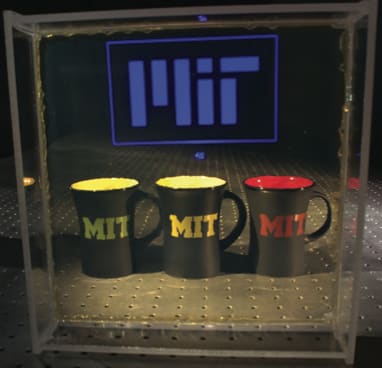
As the team researched the use of nanoparticles in obscurants, which block a warfighter’s visibility over several bands of light, Marin Soljacic, a physics professor at MIT and leader of the team, had the idea of putting the technology to use in a different setting.
“The work on nanoparticles in the obscurants project is closely related to the development of this transparent display technology,” said Brendan DeLacy, an ECBC researcher in the Toxicology and Obscurants Division. “In our obscurants project, MIT provides computational models that predict the optimum size and shape of nanoparticles that are required to absorb and scatter light. ECBC is responsible for creating the particles that are predicted by those models.”
Typically, when an image is projected onto a transparent material such as glass, it simply goes through the glass and the image cannot be viewed. By coating the glass with a polymer containing silver nanoparticles with the appropriate size, however, an image can be reflected back and viewed as it if were on a screen. Additionally, the transparency of the glass is still retained. Advantages of this technology also include a wide viewing angle and the ability to scale the materials onto large display areas.
Each of the silver nanoparticles used in the technology is designed to scatter or reflect one color while rejecting the rest. Currently, a silver particle is used for imaging blue light. In order to simultaneously scatter red, green, and blue light, DeLacy said, researchers have one of two options: They can use three different nanoparticles, or they can create a clever particle with the correct properties that can display all three of the colors.
“The best part about this technology is how inexpensive it is. It costs much less than the other transparent display technologies, and it can be coated onto virtually any material that is transparent,” DeLacy said.
For Free Info Click Here
More From SAE Media Group
Aerospace & Defense Tech Briefs
Abrasion Testing of Products Containing Nanomaterials
Aerospace & Defense Tech Briefs
Reactive, Multifunctional, Micellar, Composite Nanoparticles for Destruction of Bio-Agents
Aerospace & Defense Tech Briefs
Processing and Characterization of Polycrystalline YAG (Yttrium Aluminum Garnet) Core-Clad Fibers
Aerospace & Defense Tech Briefs
Development of Hydrophobic Coatings for Water-Repellent Surfaces Using Hybrid Methodology
Aerospace & Defense Tech Briefs
Luminescence Materials as Nanoparticle Thermal Sensors

Aerospace & Defense Tech Briefs
MOVPE Growth of LWIR AlInAs/GaInAs/InP Quantum Cascade Lasers: Impact of Growth and Material Quality on Laser Performance
Tech Briefs
5 Ws of Invisible Glass
Aerospace INSIDER
Smart Skin Simplifies Spotting Strain in Aircraft
Aerospace & Defense Tech Briefs
New Diamond Super-Material Enhances Aircraft Survivability
Aerospace & Defense Tech Briefs
Advanced Multifunctional Materials for High Speed Combatant Hulls
Aerospace & Defense Tech Briefs
Molecular Engineering for Mechanically Resilient and Stretchable Electronic Polymers and Composites
Aerospace & Defense Tech Briefs
Silicon Microsphere Fabrication
Aerospace & Defense Tech Briefs
Industry Invited to Participate in AeroTech Aerospace and Defense Technical Program
Photonics & Imaging Technology
Military Optics Technology
Medical Design Briefs
Scientists Create Continuously Emitting Microlasers With Nanoparticle-Coated Beads
Aerospace Manufacturing and Machining INSIDER
Can This Self-Healing Composite Make Airplane and Spacecraft Components Last for Centuries?
Aerospace & Defense Tech Briefs
3D Meta-Optics for High-Energy Lasers
Aerospace & Defense Tech Briefs
Integration of Adaptive Optics Into High-Energy Laser Modeling And Simulation
Aerospace & Defense Tech Briefs
Hydrolytic Stability of Polyurethane-Coated Fabrics Used for Collapsible Fuel Storage Containers
Aerospace INSIDER
A New Quantum Materials Research System
Aerospace & Defense Tech Briefs
Development of High Quality 4H-SiC Thick Epitaxy for Reliable High Power Electronics Using Halogenated Precursors

Aerospace & Defense Tech Briefs
Outsourcing Plasma Treatments for Surface Modification

Aerospace INSIDER
Transparent Display System Could Provide Heads-Up Data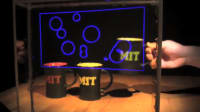
Tech Briefs
Extrans Permeation Measurement System
Aerospace & Defense Tech Briefs
Ultrafast Optics: Vector Cavity Lasers — Physics and Technology
Top Stories
INSIDERDefense
 New Raytheon and Lockheed Martin Agreements Expand Missile Defense Production
NewsAutomotive
 Ford Announces 48-Volt Architecture for Future Electric Truck
INSIDERManufacturing & Prototyping
 Active Strake System Cuts Cruise Drag, Boosts Flight Efficiency
ArticlesTransportation
 Accelerating Down the Road to Autonomy
INSIDERMaterials
 How Airbus is Using w-DED to 3D Print Larger Titanium Airplane Parts
Road ReadyTransportation

Webcasts
Electronics & Computers
 Cooling a New Generation of Aerospace and Defense Embedded...
Power
 Battery Abuse Testing: Pushing to Failure
Connectivity
 A FREE Two-Day Event Dedicated to Connected Mobility
Automotive
 Quiet, Please: NVH Improvement Opportunities in the Early Design Cycle
Transportation
 Advantages of Smart Power Distribution Unit Design for Automotive &...
Aerospace
 Sesame Solar's Nanogrid Tech Promises Major Gains in Drone Endurance